What Makes an AI System 'Agentic,' and Why It Matters for Your Research
Most computational tools researchers currently rely on are transactional, single-shot systems. You ask a question, the interface returns a static response, and the conversation ends. To perform a complete, multi-step analysis, you must manually capture that response and carry it over to the next disconnected interface (such as running a database search, downloading a PDF, or aligning a sequence), creating a fragmented, slow workflow.
With Purna agentic AI, we are introducing a unified solution to this friction. By launching an autonomous, context-aware biological research workspace, Purna transforms computational workflows from passive search to active, multi-step execution.
Defining ‘Agentic’ in Scientific Terms
At its core, an AI research agent is distinguished by its ability to plan, reason, and execute complex workflows autonomously.
Rather than executing a single, isolated query, an agentic system deconstructs a high-level scientific goal into sequential sub-tasks. It selects and utilizes specialized computational tools (such as live literature databases, structure-prediction models, and statistical execution code blocks) in parallel, evaluates intermediate outputs, and continuously refines its trajectory until the goal is fully resolved.
The Autonomous Research Workflow in Action
To understand how this functions mechanically, let us walk through a real-world scientific query executed on the Purna platform:
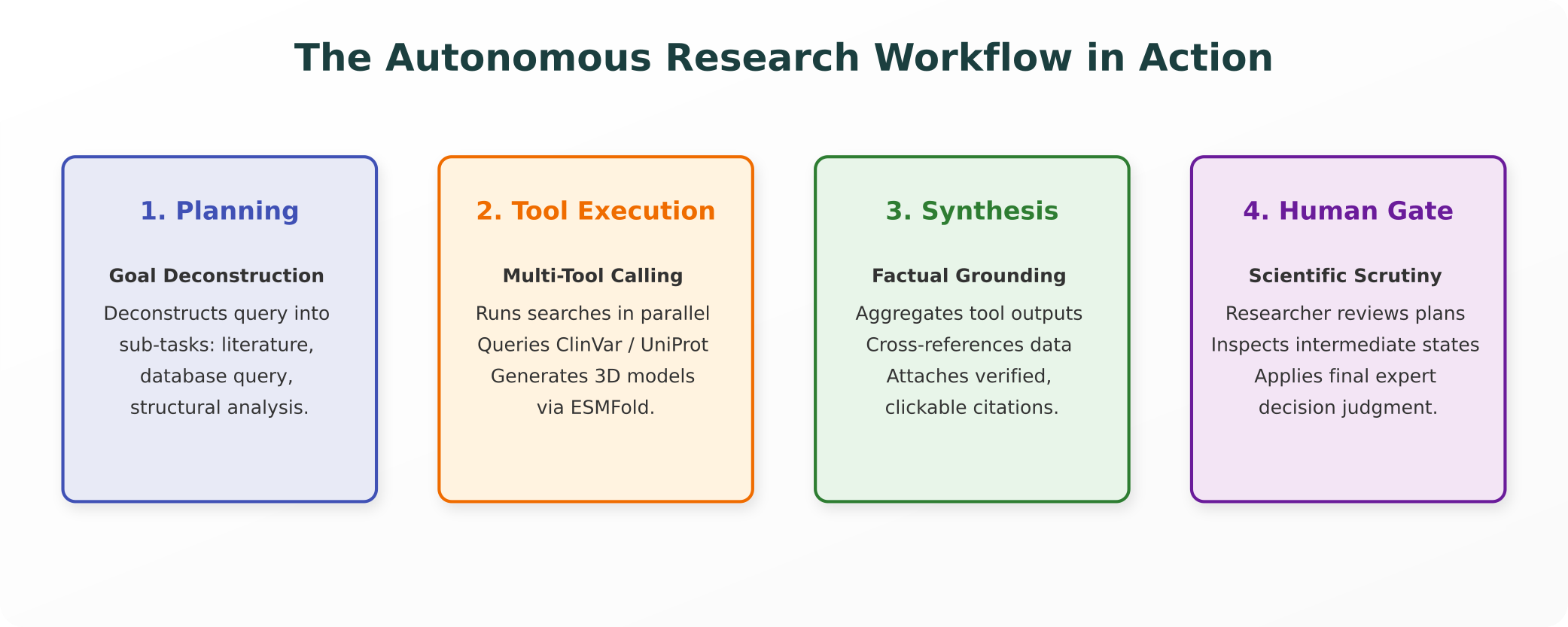
When a researcher submits a complex prompt (such as: “Identify rare somatic variants in the EGFR active site associated with drug resistance, map their structural coordinates, and summarize the literature evidence”), Purna executes an autonomous research workflow:
- Planning and Decomposition: The agent breaks the request into three parallel tasks: retrieving variant records from ClinVar, fetching the EGFR reference protein structure from the Protein Data Bank (PDB), and running a semantic search across PubMed oncology papers.
- Concurrent Tool Calling: Purna’s execution engine calls the relevant APIs simultaneously. It extracts raw variant tables, downloads the PDB structure coordinates, and summarizes literature cohorts.
- Structured Synthesis and Curation: The agent compiles these disparate outputs into a single, cohesive report. It co-localizes the variant positions directly onto the EGFR structural active pocket, highlights structural stability changes ($\Delta\Delta G$), and attaches verified, clickable citations with direct source links to the primary literature.
Instead of navigating five separate interfaces and manually copying data, the scientist receives a complete, traceably curated biological analysis in a single workspace.
Honest Scope and Boundaries
While agentic AI for research dramatically accelerates pre-clinical workflows, it operates within strict boundaries:
- Human-in-the-Loop Control: Purna does not replace human scientific judgment. The agent is designed to prioritize and present evidence-backed hypotheses, but final decisions (such as deciding whether to purchase a candidate small molecule or advance a target to wet-lab screening) remain exclusively with the researcher.
- Factual Verification Required: Like any computational prediction, agentic outputs represent statistical probabilities. All prioritized targets, binding energies, and variant classifications must be clinically verified and experimentally validated before clinical translation.
By keeping the scientist firmly in control while automating the mechanical data-gathering loops, Purna AI helps research teams move from raw sequence data to validated biological insights with unprecedented speed and complete scientific integrity.
Explore Purna's Molecular Intelligence Platform
AI-powered workspace for biology teams to accelerate drug discovery from target identification to lead optimization.
Try Purna AI →