Biomni vs Edison Scientific vs Elicit vs Purna AI: Comparing AI Research Platforms for Biology (2026)

AI is changing how scientists work
Biological research rarely follows a straight line. A single question can require reviewing hundreds of papers, connecting molecular mechanisms, analyzing datasets, and deciding which hypotheses deserve further investigation.
Disclosure: This article is published by Purna AI, one of the four platforms compared here. We describe each product using its own public documentation and announcements, and we link to those sources throughout so you can check them.
AI research platforms are emerging to help scientists navigate this complexity. They approach the problem differently, though. Some focus on coordinating AI agents across a large catalogue of tools, some on running long autonomous research projects, some on synthesizing published evidence, and others on connecting biological reasoning with computational execution and written output.
This article compares four platforms that researchers often evaluate together: Biomni Lab from Phylo, Edison Scientific (and its AI scientist, Kosmos), Elicit, and Purna AI. We cover what each platform is designed to do, how their documented capabilities compare, and which kinds of work each one fits best. If you are new to the idea of AI systems that plan and execute multi-step work, our explainer on what makes an AI system agentic is a useful starting point.
The short answer: choose Elicit for systematic reviews and evidence synthesis, Edison Scientific to hand off a research question to a long autonomous run, Phylo Biomni Lab for a broad catalogue of bioinformatics tools and pipelines, and Purna AI to go from literature and hypotheses to protein models, analysis and a written manuscript in one workspace. Many teams use more than one.
At a glance: four approaches
| Phylo Biomni Lab | Edison Scientific | Elicit | Purna AI | |
|---|---|---|---|---|
| Positioning | Integrated Biology Environment | Autonomous AI scientist plus specialist agents | AI for literature search, review and evidence synthesis | Applied AI research lab building biomedical agents |
| Core idea | AI agents coordinating a broad catalogue of biology tools, databases and software | Hand off a research question for a multi-hour autonomous run, or use focused agents | Find, screen, extract and synthesize evidence from papers | Connect deep research, specialized models, computation and scientific writing in one workspace |
| Best known for | Breadth of tools and pipelines | Kosmos runs of up to 12 hours | Systematic reviews and sentence-level citations | Research-to-manuscript workflow with protein design models |
Phylo's Biomni Lab: an Integrated Biology Environment
Phylo developed Biomni Lab, which it describes as an Integrated Biology Environment (IBE). Biomni Lab builds on Biomni, a general-purpose biomedical AI agent that began as an open-source project at Stanford in 2024. Phylo announced Biomni Lab as a research preview on 3 February 2026. The announcement came alongside a seed round co-led by a16z and Menlo Ventures' Anthology Fund with Anthropic (Phylo announcement). The open-source Biomni project remains available under the Apache 2.0 license on GitHub. The original Biomni preprint described an environment of 150 specialized tools, 105 software packages and 59 databases (bioRxiv, 2025).
Biomni Lab combines AI agents with a broad set of biological research tools and computational resources. Phylo's FAQ cites 120+ software packages, 70+ databases and 190+ specialized tools (Phylo FAQ). Its documented capabilities include:
- Literature and database research with linked sources, drawing on resources such as PubMed, UniProt, PDB, Ensembl, ClinVar, GEO, Open Targets and the GWAS Catalog (Biomni docs).
- Statistical analysis and visualization, with publication-style figures.
- Genomics and multi-omics workflows, including single-cell analysis and nf-core/Nextflow pipelines (pipelines docs).
- Protein structure prediction and molecular design. Some models are deployed natively, such as Biohub's ESMC and ESMFold2 models (Phylo blog). Others run through partner integrations: Boltz models connect with the user's own Boltz API key (Phylo blog). Tools such as RFdiffusion are listed as HPC tools where enabled (models and compute docs).
- Custom Python, R and shell analysis in an isolated cloud workspace, with options for CPU, high-memory and GPU machines.
- Skills, MCP connectors and cloud imports from Google Drive, Dropbox and S3, plus team workspaces with role-based access (connectors docs, skills docs).
The emphasis is on bringing research tools and AI agents together in a collaborative environment, so scientists can coordinate different activities within a broader biomedical research workflow. Teams that already rely on a wide range of bioinformatics tools and pipelines are likely to find this breadth the main draw.
Edison Scientific: an autonomous AI scientist
Edison Scientific is the commercial spinout of FutureHouse, a nonprofit AI research organization. FutureHouse announced Edison in November 2025 (FutureHouse), and Edison announced a $70M seed round the following month (Edison Scientific).
Its flagship product, Kosmos, is an AI scientist designed to take on research projects end to end. Scientists can hand off a full research question for autonomous execution and receive a report with analyzed datasets and figures after a run of up to around twelve hours. They can also work interactively with specialized agents for specific tasks such as literature synthesis, data analysis, molecular design, or precedent search. According to Edison's documentation, a single Kosmos run reads roughly 1,500 papers and writes around 42,000 lines of analysis code. Each conclusion in the report is traceable to the code or source behind it (Edison docs; Kosmos preprint, arXiv 2025).
Edison's platform agents include:
- Literature, for cited answers and deep reviews, drawing on more than 175 million papers, clinical trials and patents.
- Analysis, for analyzing biological datasets such as RNA-seq and flow cytometry data, with statistics and figures.
- Precedent, for checking whether an idea or experiment has been tried before and identifying gaps.
- Molecules, a chemistry-focused agent for ADMET prediction, retrosynthesis planning, molecular property calculation and ChEMBL search.
Edison's stated emphasis is on integrating AI across the full R&D stack, from basic discovery through to clinical development. It aims to cover the whole research pipeline rather than accelerating only its upstream or downstream portions. It also offers an API client and built-in connectors to tools such as Slack, Microsoft Teams, Notion, Google Drive and GitHub (Edison docs).
Elicit: literature-centered research
Elicit focuses on helping researchers find, organize and synthesize scientific literature. Elicit was spun out of the nonprofit Ought in 2023 and operates as a public benefit corporation (Elicit).
Its tools support semantic paper search across more than 138 million academic papers from Semantic Scholar, PubMed and OpenAlex (Elicit support). They also cover structured data extraction, research reports and systematic literature reviews with screening and extraction workflows. Claims in Elicit's outputs are supported with sentence-level citations. More recently, Elicit has added a Research Agent that can work across literature, trials, patents and uploaded data (Elicit). It has also added reusable Skills and shared projects for teams (Elicit), and an API and MCP server so other AI tools can call Elicit's search (Elicit).
For researchers who need to understand what existing studies show, compare findings, or organize evidence across publications, Elicit provides a literature-centered approach to AI-assisted research. If systematic reviews are a large part of your work, our article on where automation helps in systematic reviews covers the trade-offs in more depth.
Purna AI: from scientific question to research output
Purna AI is an applied AI research lab from India building biomedical agents for biology. It has built an AI-powered research platform that brings together biological knowledge, specialized models, scientific databases and computational tools. The idea behind it is what we call molecular intelligence: AI as the connective layer across biological data, models and evidence.
The platform brings together specialized AI agents and computational tools for pipeline execution, alongside capabilities for deep research, scientific writing, image generation and document creation. Researchers can use it to investigate complex scientific questions, carry out computational tasks, and turn their findings into structured written and visual outputs. Its focus spans both the scientific work itself and the communication of that work.
Deep Research for literature analysis, gaps and hypotheses
Purna's Deep Research runs a multi-agent literature pipeline. It starts with a research plan you approve, then runs search and screening agents and evidence synthesis, and shows a dedicated Gaps view that surfaces open questions in the literature. Results hand off directly to the paper-writing workflow. For hypothesis work, Consilium convenes a panel of two to eight AI expert personas to debate and stress-test an idea under a moderator. Personas include a molecular biologist, geneticist, structural biologist, drug discovery scientist or bioinformatician (Consilium docs). We have written separately about identifying research gaps with AI without inventing unsupported claims.
Specialized models for protein and molecular design
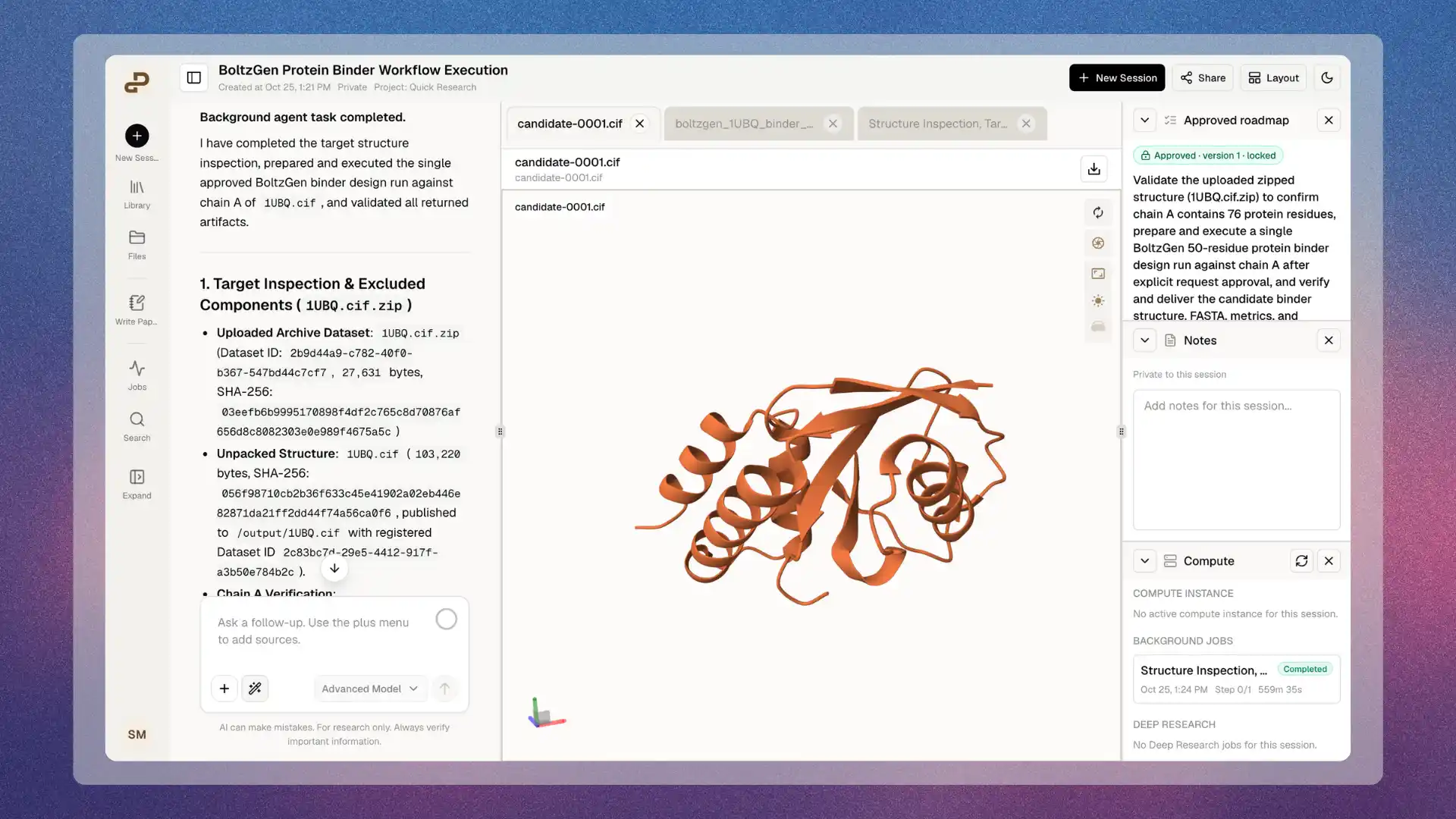
Purna's agents can call specialized biology models as managed GPU jobs, without any setup by the researcher. The documented models include Boltz-2, BoltzGen, RFdiffusion, ProteinMPNN, DiffDock, ESM-2 and AbLang-2 (Jobs docs), along with DISCO for de novo enzyme design (enzyme design docs). That makes it possible to go from a question about a target to predicted structures, designed binders and docking results within the same conversation. Our comparison of RFdiffusion and BoltzGen for de novo binder design and our field guide to AI models in biology go deeper into these models.
Computational agents and background jobs
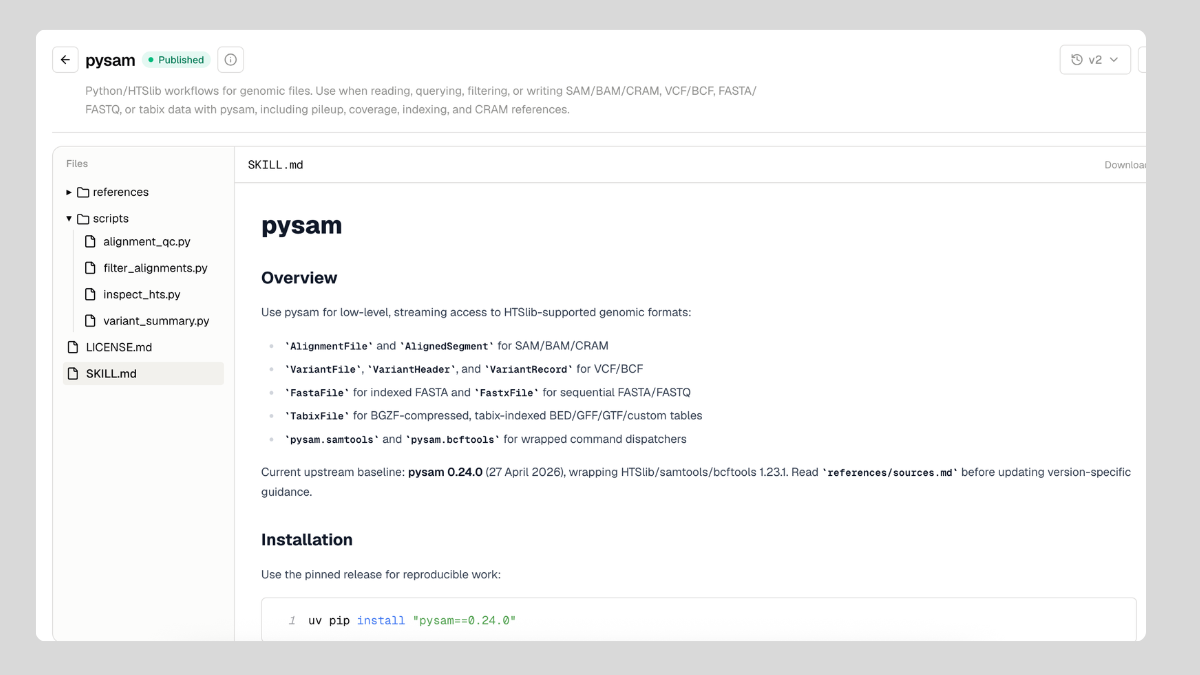
For analysis, Purna runs Python and R in a private session, with libraries such as pandas, SciPy, scikit-learn, Biopython, pysam and scanpy, and command-line tools including samtools and bcftools. Longer work runs as background Jobs in an isolated sandbox for up to 24 hours. There, an orchestrating agent can write pipelines, install packages and refine its own code (code execution docs). Results open in built-in scientific viewers for 3D structures, spatial omics, whole-slide images and sequence alignments.
Databases, MCP integrations and Skills
Purna connects to more than 50 biology databases, including ClinVar, gnomAD, OMIM, dbSNP, UniProt, PubMed, Open Targets, PDB, the AlphaFold Database, PubChem and ChEMBL (Purna docs). Researchers can choose which knowledge sources an answer draws from.
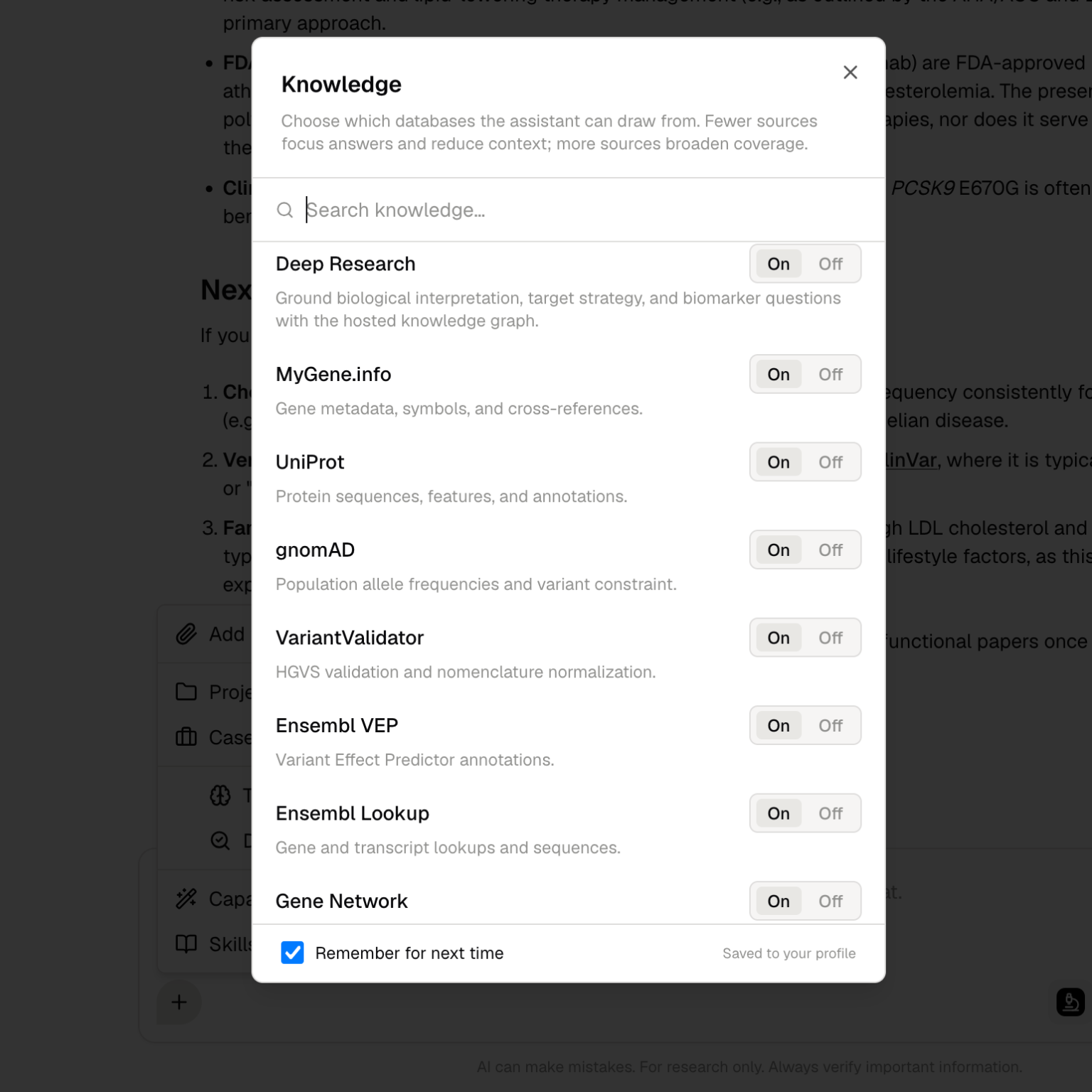
Through Library, teams can connect custom MCP services, build and share reusable Skills, and manage their article corpus in one place. Enterprise team deployments (Team Max) can also connect private Amazon S3 or Google Cloud Storage buckets (Purna pricing).
Scientific image generation and document intelligence
Two capabilities focus on communicating results. A dedicated scientific image generation agent creates diagrams, schematics, pathway figures and illustrations from a prompt, which you can then refine (scientific figures docs). The paper writer is a document intelligence engine for manuscripts. It has templates for research articles, systematic reviews and clinical trial reports, ten citation styles, AI-assisted drafting, and export to Word, Markdown, LaTeX and PDF (paper writer docs). See our posts on image generation in Purna and paper writing in Purna for walkthroughs.
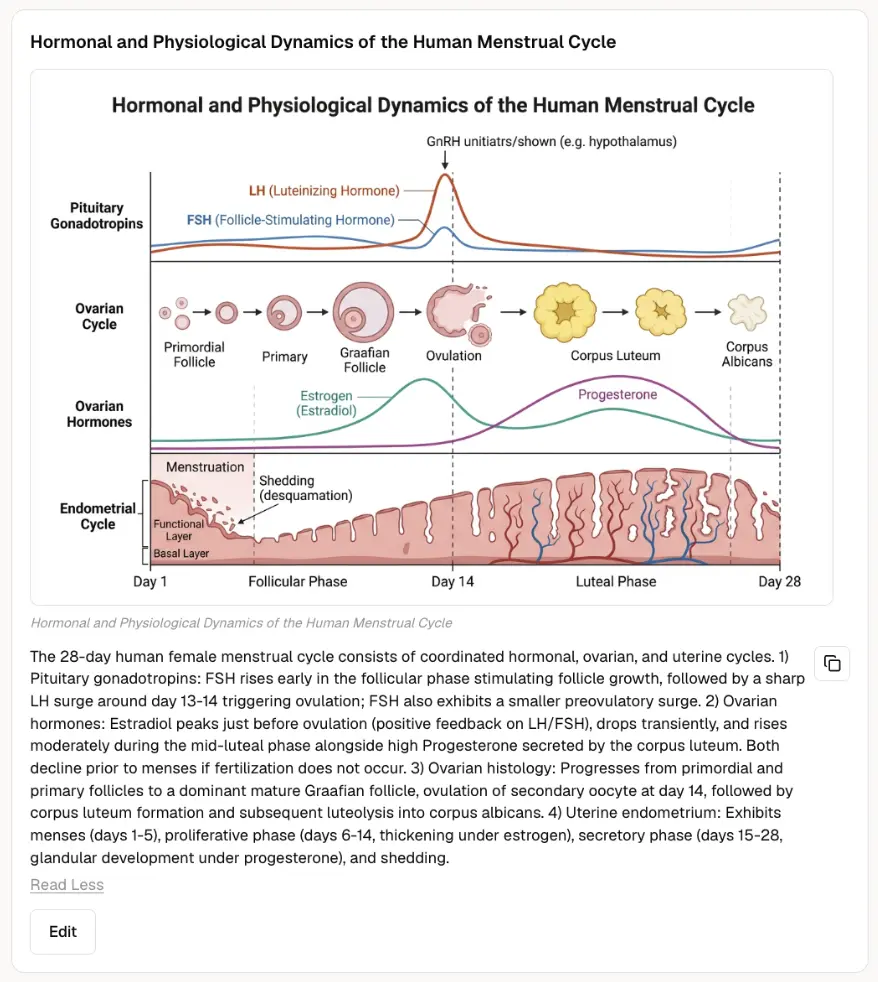
The focus is on making complex biological research more accessible and connected. Scientists can move between scientific context, computational workflows and research outputs without having to manage every component separately.
Biomni vs Edison Scientific vs Elicit vs Purna AI: capability comparison
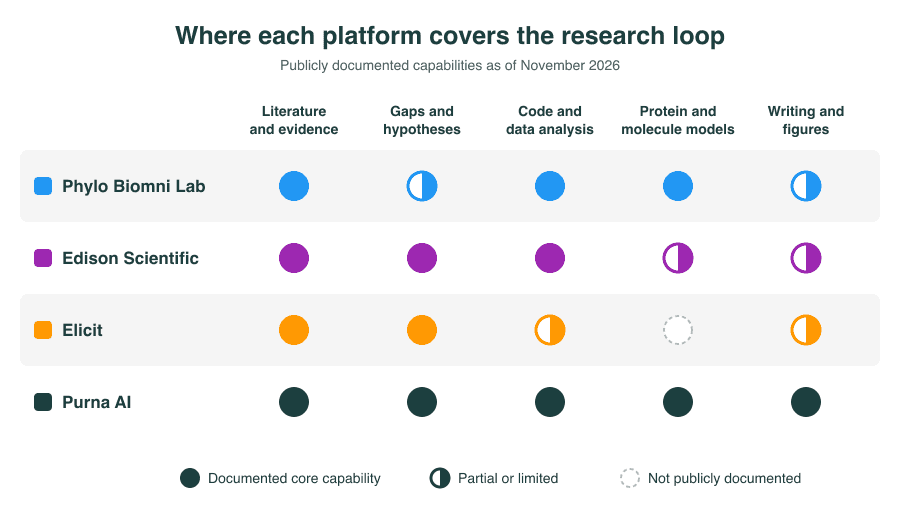
The table below summarizes publicly documented capabilities. "Yes" means the capability is described in the platform's own documentation or announcements. "Partial" means it is available in a limited form or only on some plans. "Not documented" means we could not find it in public materials. It does not necessarily mean the capability is missing.
| Capability | Phylo Biomni Lab | Edison Scientific | Elicit | Purna AI |
|---|---|---|---|---|
| Computational agents (write and run code) | Yes | Yes | Partial | Yes |
| Long-running autonomous research | Yes | Yes (Kosmos, up to about 12 hours) | Partial | Yes (background Jobs, up to 24 hours) |
| Literature search with citations | Yes | Yes | Yes | Yes |
| Deep research, gap analysis | Partial | Yes | Yes | Yes |
| Systematic review workflow | Not documented | Not documented | Yes | Partial |
| Multi-agent expert debate | Not documented | Not documented | Not documented | Yes (Consilium) |
| Biological database integrations | Yes (70+) | Partial | Partial | Yes (50+) |
| Genomics and multi-omics workflows | Yes | Yes | Partial | Yes |
| Protein structure and design models | Yes | Not documented | Not documented | Yes |
| Dedicated chemistry agent | Partial | Yes (Molecules) | Not documented | Partial |
| Scientific image generation | Partial | Not documented | Partial | Yes |
| Manuscript writing engine | Not documented | Not documented | Not documented | Yes |
| Built-in scientific viewers | Partial | Not documented | Not documented | Yes |
| MCP support | Yes | Not documented | Yes | Yes |
| Cloud storage connections | Yes | Partial | Not documented | Yes |
| Reusable Skills | Yes | Not documented | Yes | Yes |
| Team collaboration | Yes | Partial | Yes | Yes |
A few notes on how to read the table:
- Protein models. Purna documents Boltz-2, BoltzGen, RFdiffusion, ProteinMPNN, DiffDock, ESM-2 and AbLang-2 as managed models that its agents call directly. Biomni Lab offers some models natively (such as ESMC and ESMFold2), others through partner integrations that use your own API key (Boltz), and others on its compute where enabled (RFdiffusion). Neither Edison nor Elicit documents protein structure or design models.
- Chemistry. Edison's Molecules agent is the most developed chemistry offering of the four. Purna offers molecular docking with DiffDock and chemical database lookups. Biomni Lab offers molecule editing, Boltz-based ligand design and an ADME skill. Neither has a dedicated chemistry agent.
- Writing. All four platforms produce reports. Purna is the only one that documents a dedicated manuscript editor with citation styles and LaTeX export. Elicit's help center notes that its agent is not designed to write your content for you.
- Systematic reviews. Elicit has the most complete systematic review workflow, including PRISMA 2020 support. Purna's Deep Research screens papers and has systematic review templates in its paper writer, but its documentation notes that it does not guarantee PRISMA compliance.
- MCP. Biomni Lab and Purna let you connect external MCP servers. Elicit's MCP server works the other way, letting AI assistants such as Claude or ChatGPT call Elicit's search.
Pricing and access
All four platforms publish some form of free or entry-level access. The figures below are as listed on each vendor's site in November 2026 and are subject to change.
| Platform | Free access | Paid plans |
|---|---|---|
| Phylo Biomni Lab | Free tier | Pro from $100/month ($50/month with an academic email), Team per seat, Enterprise custom (pricing) |
| Edison Scientific | Credit-based access | At launch, a Kosmos run was priced at $200 in credits (Edison); current plans via Edison |
| Elicit | Basic (free) | Pro $49/user/month, Scale $229/user/month, Enterprise custom (pricing) |
| Purna AI | Free plan | Plus $49/month, Pro $99/month, Discoverer $149/month, Enterprise custom (pricing) |
Academic researchers can also apply for Purna research credits.
Which platform fits your work?
These platforms overlap, but each is built around a different center of gravity. Many teams will use more than one.
| If your main need is to... | Consider |
|---|---|
| Screen and extract evidence from thousands of papers for a review | Elicit |
| Hand off a full research question for a long autonomous run | Edison Scientific (Kosmos) |
| Run a broad catalogue of bioinformatics tools and pipelines in a shared environment | Phylo Biomni Lab |
| Go from literature and hypotheses to protein models, analysis, figures and a written manuscript in one workspace | Purna AI |
Whichever platform you choose, the same evaluation questions apply. Can you trace every claim to a source? Can you inspect the code behind every analysis? And does the platform keep you in control of the scientific judgment? Our guide on what scientists should expect from a biology AI assistant with citations covers these questions in more detail. Our broader comparison of bioinformatics platforms covers pipeline-focused tools such as Galaxy and Terra.
Frequently asked questions
What is Biomni?
Biomni is a general-purpose biomedical AI agent that began as an open-source project at Stanford. Phylo, a company founded by members of the Biomni team, builds Biomni Lab, a commercial Integrated Biology Environment based on it. The open-source version remains available on GitHub under the Apache 2.0 license.
What is the difference between Biomni and Biomni Lab?
Biomni is the open-source agent framework that researchers can self-host. Biomni Lab is Phylo's hosted product, which adds a collaborative workspace, managed compute, model integrations, Skills, connectors and team features.
What is Edison Scientific?
Edison Scientific is the commercial spinout of the nonprofit FutureHouse. It offers Kosmos, an AI scientist that runs autonomous research projects, along with specialized agents for literature, data analysis, precedent search and chemistry.
What is Kosmos?
Kosmos is Edison Scientific's AI scientist. Given a research question and optional datasets, it runs for up to around twelve hours, reading literature and writing analysis code. It returns a report with figures where each conclusion links back to its source or code.
Is Elicit good for biology research?
Elicit is well suited to literature-heavy work in biology, such as systematic reviews, evidence tables and research reports with sentence-level citations. It does not document protein modeling or bioinformatics pipeline features, so teams that need those typically pair it with a computational platform.
How is Purna AI different from Biomni Lab and Edison Scientific?
All three run AI agents for biology. Purna's emphasis is on connecting the full path from question to output. That path covers deep research with gap analysis, specialized protein design models such as Boltz-2, RFdiffusion and ProteinMPNN, and computational jobs. It ends with scientific image generation and a manuscript writer for communicating the results.
Explore Purna AI
If your work spans literature, computation and writing, you can try Purna's research platform at purna.ai. Start with a question you are already working on and see how far the workspace can take it, from evidence to models to a draft.
Purna AI brings together deep research, specialized biology models such as Boltz-2, RFdiffusion and ProteinMPNN, computational jobs, 50+ biology databases, scientific image generation and a manuscript writer in one workspace for biology teams.
Disclaimer: All trademarks, product names and company names mentioned in this article belong to their respective registered holders. Their use here is for identification and comparison only and does not imply any affiliation with or endorsement by those companies. This comparison is based on publicly available information on each company's website, documentation and announcements, reviewed on 16 November 2026. Products in this category change quickly, so check each vendor's site for current details. If you represent one of these companies and believe something is inaccurate, please contact us and we will review it.
Explore Purna's Molecular Intelligence Platform
AI-powered workspace for biology teams to accelerate drug discovery from target identification to lead optimization.
Try Purna AI →