
Interpret genomics, transcriptomics, proteomics, and single-cell data together
Purna AI helps researchers inspect omics results, run long-running computational pipelines, cross-reference biological databases, and translate outputs into hypotheses that can be reviewed.

Analyze multi-omics datasets from upload to interpretation
Ingest heterogeneous omics data without breaking context
Work across RNA-seq, scRNA-seq, proteomics, variant calls, pathway tables, metadata, and generated artifacts in one research thread.
Run differential analysis, enrichment, and integration pipelines
Ask for a biological result, not a sequence of scripts. MIP writes and executes analysis steps while keeping logs, generated files, and interpretation together.
Connect molecular signals to pathways and testable hypotheses
Move from ranked genes and enriched pathways to disease mechanisms, candidate biomarkers, validation experiments, and review-ready summaries.
Automate your Computational Biology Workflows
Launch Jobs That Run Themselves
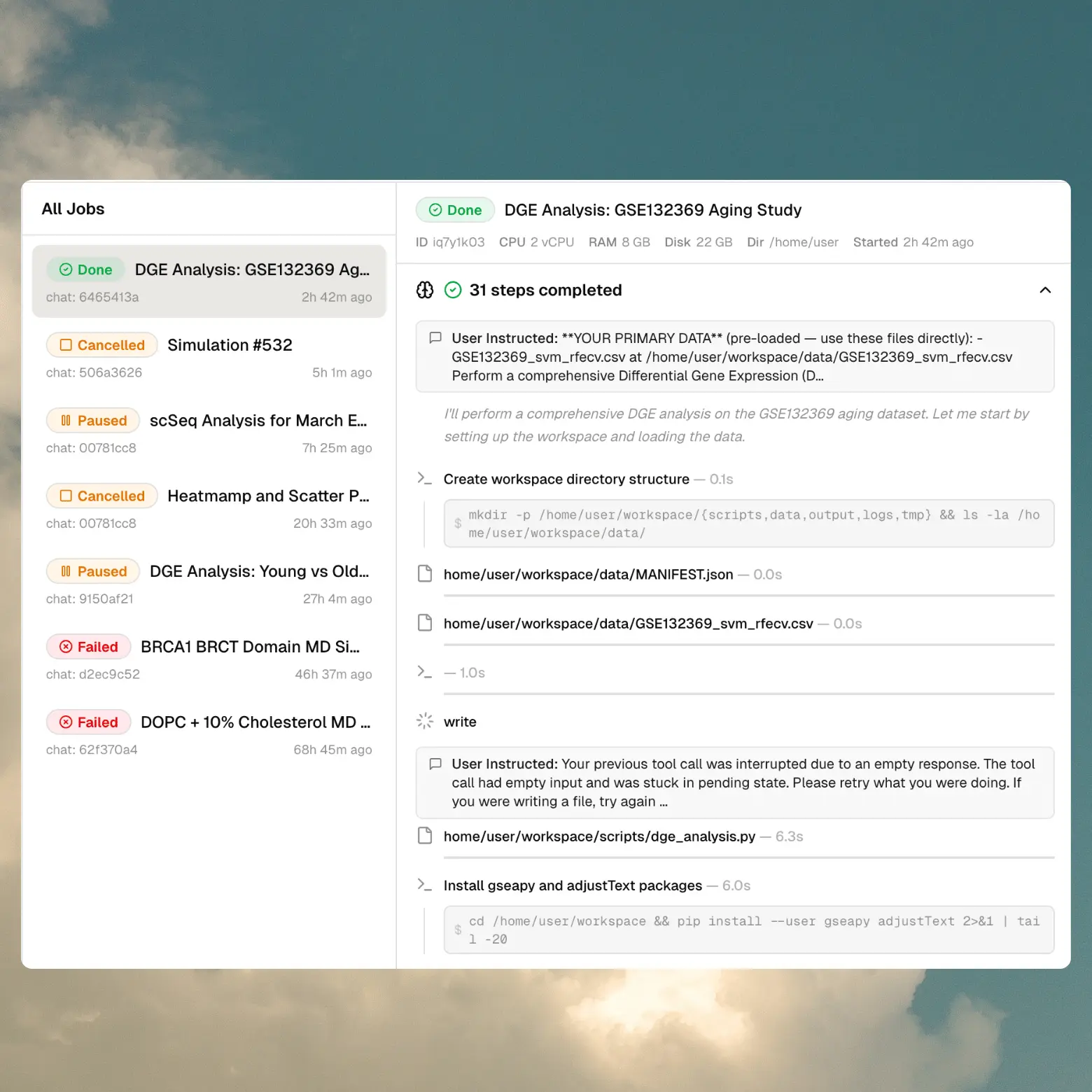
Upload your Data and Ask the Question
MIP can write, debug, iterate, and execute every step of a bioinformatics pipeline. Come back to finished results, not error logs. Any dataset, Any Query.
- Orchestrates 100s of pipeline steps autonomously
- Handles multi-GB datasets without breaking a sweat
- Agents write, test, and fix code in real time
- Full execution logs and reproducible outputs
Start with a sentence. Finish with an answer.
No scripting, no config files, no Slack-pinging the bioinformatics team.
“Run differential expression on this RNA-seq dataset and flag the top 20 genes.”
“Annotate these variants and highlight anything linked to pediatric cardiomyopathy.”
“Build me a single-cell atlas from these 10x samples and cluster by cell type.”
“Compare these proteomics hits against the RNA-seq signature and identify pathway-level agreement.”
“Find all ChIP-seq peaks overlapping known enhancer regions in these samples.”
“Combine these omics outputs into a ranked list of mechanisms and validation experiments.”