
A Field Guide to the Different Types of AI Models Used in Biology
The phrase “artificial intelligence in medicine” has become a ubiquitous catch-all in modern scientific literature and industry reporting. For researchers, computational biologists, and R&D leaders, this broad categorization is often more confusing than helpful. In practice, AI models in biology are not a single, homogeneous technology capable of answering any scientific question.
A common, frustrating bottleneck occurs when a research team assumes that a model designed for one specific task (such as predicting a 3D fold conformation) can automatically perform another completely unrelated task (such as synthesizing literature or predicting genomic variant effects). Treating these distinct mathematical architectures as a single “black box” leads to misaligned expectations, inappropriate tool selection, and wasted computational resources.
This field guide provides a practical, structured orientation to the diverse landscape of computational biology models. It classifies the primary categories of AI systems used in modern research, explains their underlying mechanisms, and outlines which biological questions each is mathematically designed to answer.
The Landscape of AI Models in Biology
Biological AI consists of distinct, highly specialized model families, each designed to solve a unique layer of the molecular and translation pipeline:
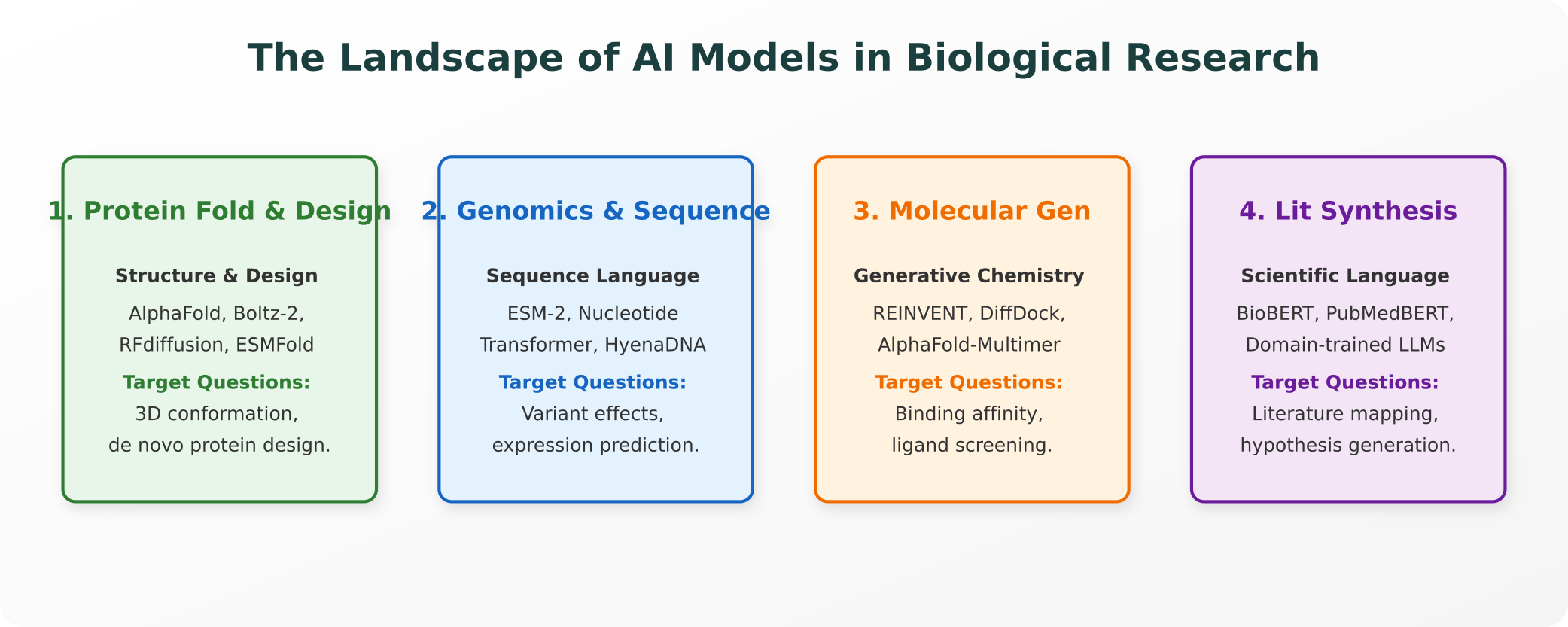
1. Protein Structure and Design Models
Protein folding and design models are engineered specifically to process three-dimensional structural coordinates and biophysical spatial relationships.
- What They Do: These models predict the physical 3D conformation of an amino acid sequence, simulate macromolecular complexes, or generate entirely novel, de novo protein structures that do not exist in nature.
- Key Examples: AlphaFold2, AlphaFold3, Boltz-2, ESMFold (for structure prediction), and RFdiffusion (for de novo design).
- The Biological Questions They Answer:
- “What is the 3D structure of this newly identified target receptor?”
- “How does this candidate antibody physically bind to its target antigen?”
- “Can we design a novel protein scaffold to bind a specific, flat receptor pocket?”
These systems excel at geometric and spatial reasoning, but they do not possess semantic or literature context. They calculate physical stability and binding pockets, not cellular pathways or clinical phenotypes.
2. Genomic and Sequence Models
Genomic and sequence models are fundamentally sequence-centric, often structured as biological language models that treat amino acid strings or nucleotide bases as “text.”
- What They Do: Trained on massive, unlabelled databases of genomic sequence records (such as UniRef or whole-genome assemblies), these models learn the evolutionary “grammar” and statistical rules governing DNA, RNA, or protein sequences.
- Key Examples: ESM-2 (for protein sequences), and the Nucleotide Transformer, HyenaDNA, or DNABERT (for genomic and nucleotide sequences).
- The Biological Questions They Answer:
- “What is the predicted functional consequence of this somatic missense mutation?”
- “Which regions of this synthetic mRNA sequence can be optimized to improve ribosomal translation efficiency?”
- “Does this nucleotide variant disrupt a known transcription factor binding site?”
By capturing evolutionary conservation patterns directly from sequences without requiring slow database alignments, these models excel at rapid, scale-level mutation scanning and sequence optimization.
3. Molecular Generation and Small-Molecule Models
Generative chemistry models are distinct from protein-centric systems, designed instead to process, optimize, and generate small-molecule chemical structures.
- What They Do: These drug discovery AI models are trained on chemical structures, bioactivity assays, and pharmacokinetics datasets (such as PubChem or ChEMBL). They generate novel, drug-like small molecules, optimize lead compounds for specific properties, or predict ligand-receptor docking interactions.
- Key Examples: REINVENT (for generative chemistry), DiffDock (for molecular docking), and various quantitative structure-activity relationship (QSAR) models.
- The Biological Questions They Answer:
- “What novel small-molecule structure can we generate to inhibit this specific active pocket?”
- “How can we modify this lead compound to improve its solubility and metabolic stability while retaining binding potency?”
- “What is the estimated binding affinity of this chemical library against our target enzyme?”
These models are the primary engines of computer-aided drug design, transitioning discovery from high-throughput physical screening to rational, in silico molecular optimization.
4. Single-Cell and Imaging Models
Single-cell and imaging models specialize in high-dimensional cellular profiles, bridging the gap between molecular coordinates and tissue-level phenotypes.
- What They Do: These models are trained on massive multi-omics profiles (such as single-cell RNA-seq datasets) or high-content microscopy images, learning to classify cell types, segment spatial features, or predict cellular perturbation responses.
- Key Examples: CellVirgo, scVI (single-cell Variational Inference), and various deep-learning image segmentation models (like Cellpose).
- The Biological Questions They Answer:
- “How does this tumor cell sub-population respond transcriptomically to a specific drug perturbation?”
- “Can we automatically identify and segment different immune cell types in this spatial transcriptomic microscopy slide?”
- “What is the underlying cell-state trajectory of this differentiation pathway?”
By processing cellular patterns, these systems help researchers understand complex, heterogeneous tissue environments and identify cellular biomarkers.
5. Literature Synthesis and Biomedical Language Models
Biomedical language models represent the cognitive, information-curation layer of the research lifecycle, distinct from molecular prediction models.
- What They Do: Trained on millions of full-text scientific publications, preprints, patents, and clinical trial records, these models excel at semantic text mining, relation extraction, and literature synthesis.
- Key Examples: BioBERT, PubMedBERT, and specialized domain-trained large language models (LLMs).
- The Biological Questions They Answer:
- “Summarize the current clinical evidence linking gene X with disease Y, including any reported contradictions.”
- “Are there any documented drug-drug interactions or adverse events associated with this specific molecular class?”
- “Based on published literature, which indirect biological pathways connect this variant to mitochondrial dysfunction?”
These models function as an AI co-scientist, helping research teams map complex disease biology landscapes, identify clinical research gaps, and build evidence-backed hypotheses.
The Integration Challenge: Why Interoperability Matters
In a real-world R&D workflow, these models do not operate in isolation. A complete target validation or drug discovery campaign requires uniting these disparate systems into a unified pipeline:
- Hypothesis Generation: A biomedical language model synthesizes literature and clinical trial databases to prioritize a disease-driving target gene.
- Variant Analysis: A genomic language model scans patient sequencing data to identify and prioritize specific mutations in that gene.
- Structure Prediction: A protein structure prediction model generates the 3D structure of the mutated protein, visualizing the altered active site.
- Lead Generation: A molecular generation models platform designs novel small-molecule inhibitors optimized to bind that specific mutated pocket.
- Cellular Validation: Single-cell analysis models evaluate the transcriptomic perturbation response of the drug in patient-derived assays.
This multi-step pipeline highlights why software interoperability is a critical challenge. If the outputs of your sequence model cannot be translated, normalized, and programmatically routed to your structure model or visualization interface, your researchers waste valuable time manually formatting files and copying data between disconnected environments. Achieving true computational momentum in biology requires building platforms that handle these format translations and model-to-model interfaces transparently, keeping the biological context completely intact at every step of the research process.
Explore Purna's Molecular Intelligence Platform
AI-powered workspace for biology teams to accelerate drug discovery from target identification to lead optimization.
Try Purna AI →
