
Codon Usage Bias vs. Codon Optimality: Resolving a Common Conflation in Gene Expression

In the field of synthetic biology and gene expression, researchers routinely rely on a set of core terminologies to guide sequence design. Among these, two concepts are frequently treated as entirely interchangeable: codon usage bias and codon optimality. When utilizing standard online codon optimization tools, practitioners are typically presented with a ranking of codons sorted by their observed frequency in highly expressed host genes, and the software quietly treats “frequently used” as synonymous with “efficiently translated.”
For many standard expression campaigns, treating these two properties as equivalent is a reasonable, practical shorthand. In most organisms, natural selection has aligned these forces: highly expressed genes are under intense selective pressure to utilize codons that can be translated rapidly and accurately. However, this correlation is far from absolute.
Confusing a static, genome-wide statistical frequency with a dynamic, biochemically driven translation rate leads to sequence designs that look “optimized” on a database table but fail to express efficiently in the host cell. This article defines the underlying biological distinctions between codon usage bias and codon optimality, analyzes where they align and where they decouple, and examines the real-world consequences of conflating them in construct design.
Resolving the Codon Conflation
Understanding the difference between a static observation of genomic frequency and the dynamic mechanics of ribosomal translation is the first step toward rational sequence design:
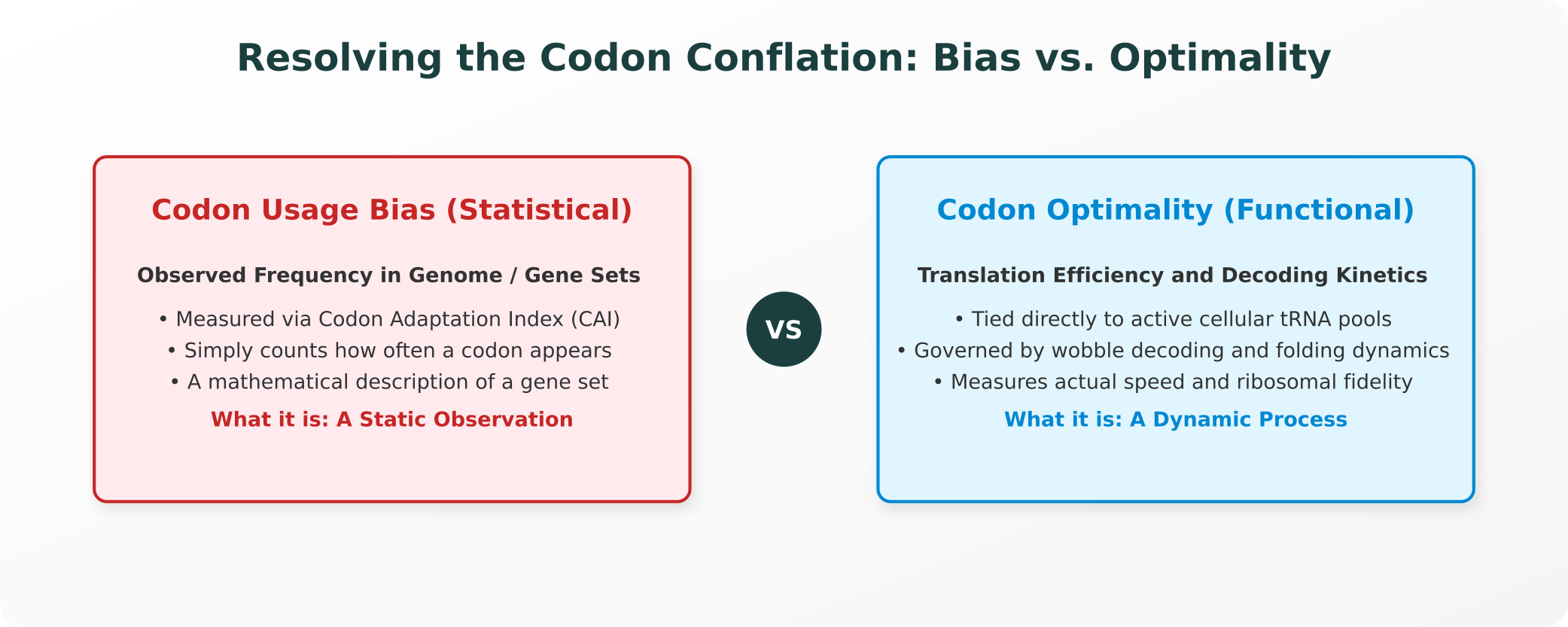
1. Codon Usage Bias: The Static Genomic Description
Codon usage bias is a strictly statistical, observational property of a genome, a single gene, or a defined set of genes. It describes the non-random, unequal frequency of synonymous codons in genetic sequences.
- What It Measures: It simply counts occurrences. For example, in Escherichia coli, the amino acid lysine is encoded by two synonymous codons: AAA and AAG. Across the entire E. coli genome, AAA is observed far more frequently than AAG, exhibiting a distinct usage bias.
- How It Is Calculated: Researchers quantify this bias using metrics like the Codon Adaptation Index (CAI). CAI measures the synonymous codon usage bias of a target gene relative to a reference set of highly expressed genes.
- What It Does Not Imply: On its own, a codon usage table does not make a functional claim. It describes what a genome looks like, not how fast a specific ribosome travels along an mRNA molecule. A codon can be highly frequent in a genome overall simply due to historical mutational bias or GC-content selection, without necessarily being the most efficient option for active, high-velocity translation.
2. Codon Optimality: The Dynamic Translation Kinetic
In contrast to usage bias, codon optimality is a functional, kinetic property of a codon during active translation. It describes whether a specific codon is translated rapidly and with high fidelity by the ribosome.
- What Dictates Optimality: Rather than genomic counts, optimality is governed by the biophysics of the translation machinery:
- The Host tRNA Pool: The cellular abundance of specific transfer RNA (tRNA) molecules that carry corresponding anticodons. A codon matched to an abundant tRNA species is translated much faster than one matched to a scarce tRNA.
- Wobble Base Pairing Kinetics: Not all tRNA-codon interactions are energetically equivalent. Codons that require standard Watson-Crick base pairing at the third position are often decoded with different kinetics than those utilizing wobble base pairing (where G can pair with U, or modified bases like inosine are involved).
- Ribosomal Elongation Speed: Measures the actual rate of amino acid incorporation (the number of residues added per second), which can be quantified directly using techniques like ribosome profiling.
- How It Is Quantified: Researchers assess this functional property using metrics like the tRNA Adaptation Index (tAI), which scores codons based on gene copy numbers of tRNA and the biophysical efficiency of wobble-pairing interactions, rather than simple genomic frequency.
3. Where They Align, and Where They Diverge
In many model organisms, codon usage bias and codon optimality are highly correlated. This alignment is driven by evolutionary forces: highly expressed housekeeping genes require rapid translation, selecting for codons that match the host’s most abundant tRNAs.
However, these two forces can diverge, creating significant bottlenecks in synthetic constructs:
- The Low-Abundance tRNA Bottleneck: A codon can exhibit moderate frequency in a genome overall, yet the specific tRNA required to decode it is expressed at low levels in a particular cell type or under stress conditions. In this scenario, the codon appears moderately unbiased in genomic tables but behaves as highly non-optimal during translation, triggering ribosomal stalling.
- Context-Dependent Dynamics: Standard codon usage tables are entirely context-blind. They analyze single codons in isolation, completely missing context-dependent variables like codon pairs (how adjacent codons affect translation speed) or local mRNA secondary structures. A codon that appears “optimal” on a frequency table can underperform if placing it next to another specific codon physically slows down the ribosome or creates a tight, untranslatable hairpin loop.
4. Real-World Consequences for Gene Expression
Mistaking genomic frequency for functional translation kinetics has real, measurable consequences for construct design and protein yields:
- Over-Optimization Aggregation: Standard vendor algorithms often “maximize” a sequence by replacing all codons with the single most frequent synonymous codon. This brute-force approach ignores the biological utility of non-optimal codons.
- Stripping Out Translation Pauses: Natural proteins do not fold instantaneously. They require carefully timed translational pauses (often mediated by rare, non-optimal codons) to allow the emerging domain to fold correctly before the ribosome translates the next segment. Stripping out these non-optimal codons accelerates translation kinetics to the point where the nascent peptide cannot fold co-translationally, leading to misfolded, inactive proteins or insoluble aggregation.
- Host-System Mismatches: Because tRNA pools vary significantly between cell types and tissues (such as between undifferentiated stem cells and specialized muscle cells), a sequence that is chemically optimal in one tissue can face severe tRNA bottlenecks in another, even if their genomic codon usage tables appear identical.
Closing: A Metric of Description vs. a Metric of Function
For researchers designing synthetic constructs, resolving this common conflation is essential:
- Codon usage bias is a description of a genome’s static state.
- Codon optimality is a claim about a ribosome’s dynamic translation velocity.
Treating the first as absolute proof of the second is a fundamental error. To design constructs that express reliably and fold correctly, synthetic biologists must evaluate sequences through both lenses: balancing the need for high translation speed against the necessary biophysical pauses that dictate protein folding fidelity.
References and Primary Sources
For researchers seeking to review the structural biology and ribosomal kinetics datasets discussed, the following publications serve as authoritative references:
- tRNA Abundance and Translation Rates: dos Reis, M. et al. (2004). “Solving the riddle of codon usage: tRNA-mediated codon selection.” Nucleic Acids Research, 32(17), 5036-5044. doi:10.1093/nar/gkh834
- Ribosome Profiling of Elongation Kinetics: Ingolia, N. T. et al. (2009). “Genome-wide analysis in vivo of translation with nucleotide resolution using ribosome profiling.” Science, 324(5924), 218-223. doi:10.1126/science.1168978
- The Role of Non-Optimal Codons in Protein Folding: Pechmann, S., & Frydman, J. (2013). “Evolutionary conservation of codon optimality reveals its role in protein folding.” Nature Structural & Molecular Biology, 20(2), 237-243. doi:10.1038/nsmb.2466
- Wobble Base Pairing Kinetics: Cranford-Smith, T. et al. (2020). “The biophysical basis of wobble decoding.” Journal of Molecular Biology, 432(20), 5030-5042. doi:10.1016/j.jmb.2020.08.012
Explore Purna's Molecular Intelligence Platform
AI-powered workspace for biology teams to accelerate drug discovery from target identification to lead optimization.
Try Purna AI →
