
CRISPR Off-Target Prediction: How Cas-OFFinder, CRISPOR, and Similar Tools Actually Differ

In the practice of genome engineering, selecting an off-target prediction tool is often dictated by laboratory habit or platform accessibility. When designing a new sgRNA construct, researchers frequently paste their target sequence into whichever web-based portal their lab has traditionally used, trust the output checklist, and proceed directly to synthesis.
This operational inertia is a significant risk. In reality, different CRISPR off-target prediction platforms utilize fundamentally different mathematical and computational models to generate their candidate lists. For the same input guide RNA, different tools can output significantly divergent candidate pools, prioritizing different sites for experimental validation. Defaulting to a single tool without understanding its underlying algorithms introduces major blind spots, leading researchers to miss true off-target cleavage sites or waste time validating low-probability candidates.
This article serves as a technically precise reference guide to guide RNA design tools. We examine the core methodological split between alignment-based search and predictive scoring models, analyze the mechanics of Cas-OFFinder and CRISPOR specifically, and outline how to choose the appropriate computational pipeline for your specific genome editing applications.
The Core Methodological Split
Genomic tools segment candidate sites based on their computational approach, transitioning from raw genomic alignments to prioritized, empirically trained models:
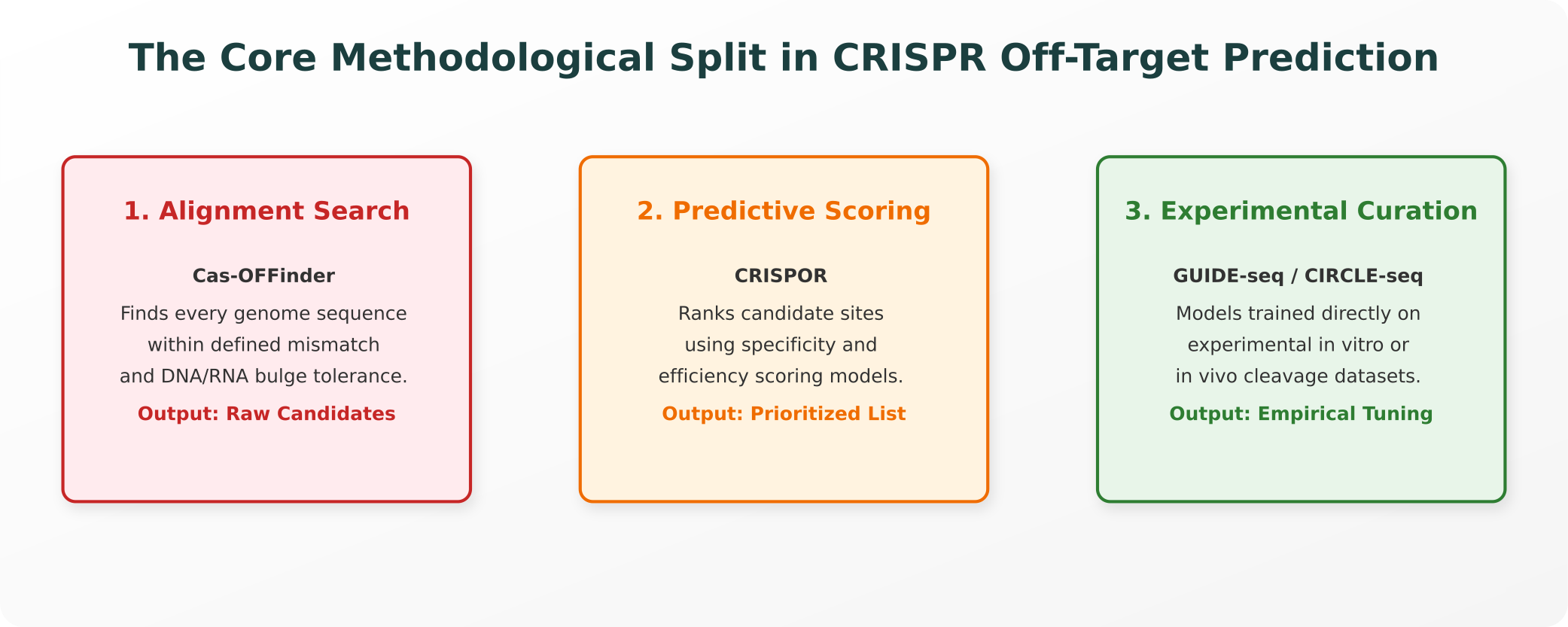
1. Alignment-Based Search: Cas-OFFinder
Cas-OFFinder represents the standard for exhaustive, alignment-based genomic search.
- The Computational Approach: Rather than predicting biological cleavage probability, Cas-OFFinder is designed to find every single sequence in a target genome that matches your sgRNA within a user-defined threshold of mismatches, DNA bulges, and RNA bulges.
- The Mechanics: It utilizes highly parallel GPU acceleration to perform a comprehensive, exact alignment search across multi-gigabyte reference genomes. By allowing for bulges (insertions or deletions in either the DNA or RNA backbone relative to the guide), it captures atypical off-target alignments that standard mismatch-only algorithms miss.
- What It Does Not Do: Cas-OFFinder does not rank, score, or filter the resulting candidates based on their biological likelihood of being cleaved. If a guide RNA aligns to ten thousand genomic sites with four mismatches, Cas-OFFinder will output a raw list of all ten thousand coordinates.
- When to Use It: Cas-OFFinder is the essential tool when your objective is complete genome-wide enumeration (such as designing custom amplification panels for off-target sequencing) and you do not want an algorithm to pre-filter or hide any potential alignment matches.
2. Predictive Scoring Models: CRISPOR
CRISPOR builds on genomic alignment but introduces a cognitive layer: utilizing mathematical models to rank and filter candidates based on predicted biological cleavage likelihood.
- The Computational Approach: Rather than outputting a raw list of alignments, CRISPOR evaluates every candidate site using empirical algorithms trained on published experimental datasets.
- The Scoring Models: CRISPOR calculates two primary categories of metrics:
- Specificity Scores: Such as the Hsu-Zhang and CFD (Cutting Frequency Determination) scores. These algorithms assign a penalty to each mismatch based on its position along the spacer sequence (with mismatches near the PAM site receiving higher penalties due to their greater impact on Cas9 binding kinetics).
- Efficiency Scores: Such as the Doench-Root score, which predicts the on-target cleavage efficiency of the sgRNA based on local nucleotide context and sequence features.
- The Output value: By applying these scores, CRISPOR transforms a raw list of thousands of alignments into a highly prioritized shortlist of high-probability off-target sites, allowing researchers to focus their validation efforts on the most likely biological risks.
3. Empirically-Trained Scoring: GUIDE-seq and Beyond
Beyond heuristic scores, a third class of predictive tools utilizes machine learning models trained directly on experimental, genome-wide off-target detection assays.
- Experimental Baselines: Standard prediction models are often trained on in vitro cleavage data. However, in vivo cleavage kinetics are highly influenced by chromatin accessibility, epigenetic modifications, and local cellular environments.
- Empirical Models: Advanced prediction platforms incorporate datasets generated from direct, cell-based assays such as GUIDE-seq (Genome-wide Unbiased Identification of DSBs Enabled by Sequencing) and CIRCLE-seq.
- The Advantage: These models learn the complex, non-linear relationships between sequence features and actual cellular cleavage. They can capture unexpected off-target patterns (such as distant sites that are cleaved despite having many mismatches because of local chromatin accessibility) that standard alignment-based algorithms or isolate heuristic models routinely miss.
4. Practical Implications: Tool Blind Spots and Validation Risks
Relying on a single prediction tool as if it represents absolute ground truth introduces significant experimental risks:
- The Scoring Blind Spot: If you use CRISPOR to prioritize your validation candidates, you are relying on the assumptions of its underlying models (such as the Hsu-Zhang or CFD datasets). If your target cell type exhibits different chromatin accessibility or Cas9 expression levels than the cells used to generate those training sets, the predictive model can miss active off-target sites.
- The Alignment Blind Spot: If you rely solely on mismatch-only search tools and do not configure Cas-OFFinder to allow for DNA/RNA bulges, you will miss off-target sites that undergo conformational shifts, potentially overlooking highly active mutagenic sites.
- The Pipeline Standard: For clinical-grade applications or therapeutic gene editing, the standard practice is to use an exhaustive alignment tool (like Cas-OFFinder) to map every theoretical risk, pair it with cell-based empirical data (such as GUIDE-seq assays), and utilize prioritized scoring models (like CRISPOR) to construct a highly focused, traceably curated validation panel.
Closing: Hypothesis Generators, Not Replacements
Understanding the mathematical and algorithmic architecture of your CRISPR analysis tools is what allows you to use them effectively:
- Cas-OFFinder is an exhaustive, sequence-based search engine.
- CRISPOR is a predictive, model-based filtering engine.
- Empirical tools are experimental classifiers of cellular kinetics.
None of these computational predictions represent a complete guarantee of genomic safety. They function as highly valuable hypothesis generators, and realizing their value requires researchers to understand their structural assumptions, identify their blind spots, and back every prioritized candidate with rigorous, experimental wet-lab validation.
References and Authoritative Specifications
For genome engineers seeking to review the primary literature and algorithmic specifications discussed, the following publications serve as authoritative references:
- The Cas-OFFinder Publication: Bae, S., Park, J., & Kim, J. S. (2014). “Cas-OFFinder: a fast and versatile algorithm for searching single-guide RNA off-target sites.” Bioinformatics, 30(10), 1473-1475. doi:10.1093/bioinformatics/btu048
- The CRISPOR Publication: Haeussler, M. et al. (2016). “Evaluation of off-target and on-target scoring algorithms and most consistent guide design for CRISPR technology.” Genome Biology, 17(1), 148. doi:10.1186/s13059-016-1012-2
- The GUIDE-seq Method: Tsai, S. Q. et al. (2015). “GUIDE-seq enables genome-wide profiling of off-target cleavage by CRISPR-Cas nucleases.” Nature Biotechnology, 33(2), 187-197. doi:10.1038/nbt.3117
- The CFD Scoring Model: Doench, J. G. et al. (2016). “Optimized sgRNA design to maximize activity and minimize off-target effects of CRISPR-Cas9.” Nature Biotechnology, 34(2), 184-191. doi:10.1038/nbt.3437
Explore Purna's Molecular Intelligence Platform
AI-powered workspace for biology teams to accelerate drug discovery from target identification to lead optimization.
Try Purna AI →
