Deep Research AI Tools for Scientists: What They Do Differently From Search
For decades, the search bar has been the primary gateway to human knowledge. Whether scanning PubMed, checking Google Scholar, or searching patent databases, the underlying mechanism of scientific search has remained largely unchanged: you enter a query, and the engine returns a list of indexed links. From there, the burden of reading, synthesizing, and validating the material sits entirely with the researcher.
However, a new class of computational systems is emerging. Known as deep research AI tools, these platforms represent a fundamental shift in how scientists interact with literature and biological data. Rather than simply retrieving documents, an AI deep research tool functions as an active research partner, conducting systematic explorations across separate sources.
But what actually distinguishes deep research for scientists from traditional search? In this article, we outline three concrete distinctions and evaluate their practical consequences for R&D workflows.
Search vs. Deep Research: A Side-by-Side Comparison
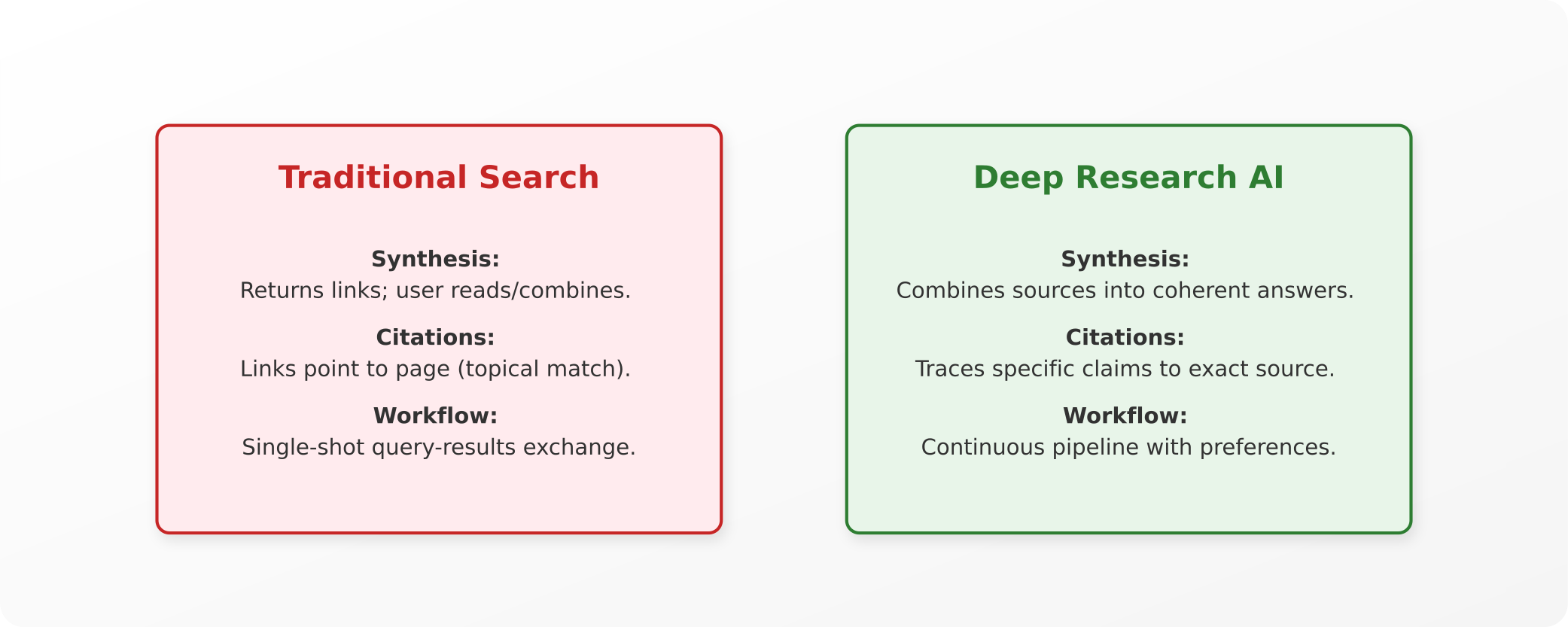
The differences between traditional search engines and advanced deep research systems span the entire research lifecycle:
1. Synthesis: Fragmented Links vs. Coherent Answers
The first major difference lies in how information is presented to the researcher.
- Traditional Search: When you query a search engine, it returns lists of individual publications, preprints, or database entries. You must manually open each tab, read through dense methodologies, extract relevant figures, and manually combine the findings to answer your question.
- Deep Research AI: A deep research tool reads, evaluates, and integrates information across separate, independent publications before you see it. It looks for common threads, connects adjacent findings (such as mapping how a genetic variant described in paper A impacts a protein mediator described in paper B), and synthesizes those details into a single, comprehensive answer.
- Practical Consequence: In a traditional workflow, a researcher spends hours compiling and formatting information before they can even begin to analyze it. With deep research synthesis, the administrative task of data-compiling is handled instantly, allowing scientists to focus their mental energy on higher-level biological reasoning and critical study design.
2. Citations: Topical Matching vs. Precise Claim Grounding
In scientific research, claims are only as strong as the evidence supporting them. How a platform handles citations defines its utility as a research assistant with citations.
- Traditional Search: Traditional search engines match keywords to find pages that are topically relevant. If you click a search link, you must manually skim the document to verify if it actually supports your specific claim, which frequently leads to miscitation errors.
- Deep Research AI: A robust deep research system uses precise claim grounding. Every factual assertion generated by the tool is tied directly to a specific, clickable citation pointing to the exact section of the primary source (such as a database entry or a peer-reviewed PDF).
- Practical Consequence: When evaluating a novel therapeutic target, researchers must verify every single claim to prevent costly downstream laboratory failures. Traditional search requires tedious manual audit loops. Deep research provides instant, clickable traceability, allowing scientists to verify the experimental context and clinical significance of any claim in seconds.
3. Workflow Support: Single-Shot Queries vs. Context-Aware Pipelines
The final distinction is the transition from transactional tools to continuous, context-aware workflows.
- Traditional Search: Search is a transactional, single-shot exchange. You ask a question, you get a set of results, and the session ends. If you want to refine your search, you must enter a new query, and the engine starts again with no memory of your previous context, goals, or formatting preferences.
- Deep Research AI: Deep research platforms support continuous, multi-step workflows. Researchers can define precise parameters upfront (such as study-design preferences, target organisms, publication dates, and specific disease models). The AI then conducts iterative rounds of search, verification, and formatting, producing a structured, editable output (such as a target prioritization matrix or clinical summary report) rather than a list of raw documents.
- Practical Consequence: Instead of constantly switching between search bars, citation managers, and spreadsheets, scientists can execute complex, multi-stage pipelines in a single, unified workspace. The platform preserves the biological and clinical context, delivering production-ready materials with complete transparency.
Conclusion: Purna AI as Your Molecular Intelligence Workspace
The consensus among modern R&D teams is clear: traditional search engines lack the domain reasoning required to keep pace with the exponential growth of biological data.
Purna AI’s Molecular Intelligence Platform (MIP) is built to solve this exact bottleneck. Designed specifically as a biology IDE and workspace for professional scientific teams, Purna goes far beyond simple document retrieval:
- Rigid Evidence Grounding: Purna does not write ungrounded assertions. Every target, variant, pathway, and clinical outcome analyzed by the platform is tied directly to 30+ live clinical and biological databases and indexed literature with clickable, verified citations.
- Integrated Structural Validation: For any prioritized target, Purna integrates structural biology validation natively. Researchers can instantly pull the 3D protein structure from the Protein Data Bank (PDB), visualize the relevant binding pockets, and calculate stability changes (ΔΔG), grounding literature-extracted claims in hard physical biochemistry.
- Continuous, Workflow-Aware Research: Purna acts as a force multiplier for scientific teams. By automating the mechanical tasks of multi-omics data gathering, database querying, and initial relation mapping, Purna frees researchers to focus on critical study designs and high-confidence drug discovery decisions.
By transforming raw search results into structured, evidence-backed molecular intelligence, Purna AI replaces fragmented copy-paste workflows and empowers research teams to advance their science with complete confidence.
Explore Purna's Molecular Intelligence Platform
AI-powered workspace for biology teams to accelerate drug discovery from target identification to lead optimization.
Try Purna AI →