
How Long Does Target Validation Actually Take, and Where the Time Really Goes
Before advancing any molecule into active lead optimization or chemical synthesis, researchers must prove that modulating their candidate protein produces a robust therapeutic effect. This process of drug target validation is highly complex, expensive, and slow, taking an average of roughly 1.5 years within the broader drug discovery pipeline. While specific timelines vary depending on disease complexity, even highly integrated, small-scope discovery campaigns require a narrow 2 to 6 month window simply to compile baseline evidence.
With the launch of Purna AI, we are introducing a unified, computational workspace designed to compress this pre-clinical timeline. By integrating cross-database queries, automated literature synthesis, and structural validation, Purna streamlines early-stage target curation while keeping scientific rigor completely intact.
Where the Time Really Goes
To understand why the target validation timeline is historically so long, we must break down the specific manual tasks that consume researcher hours:
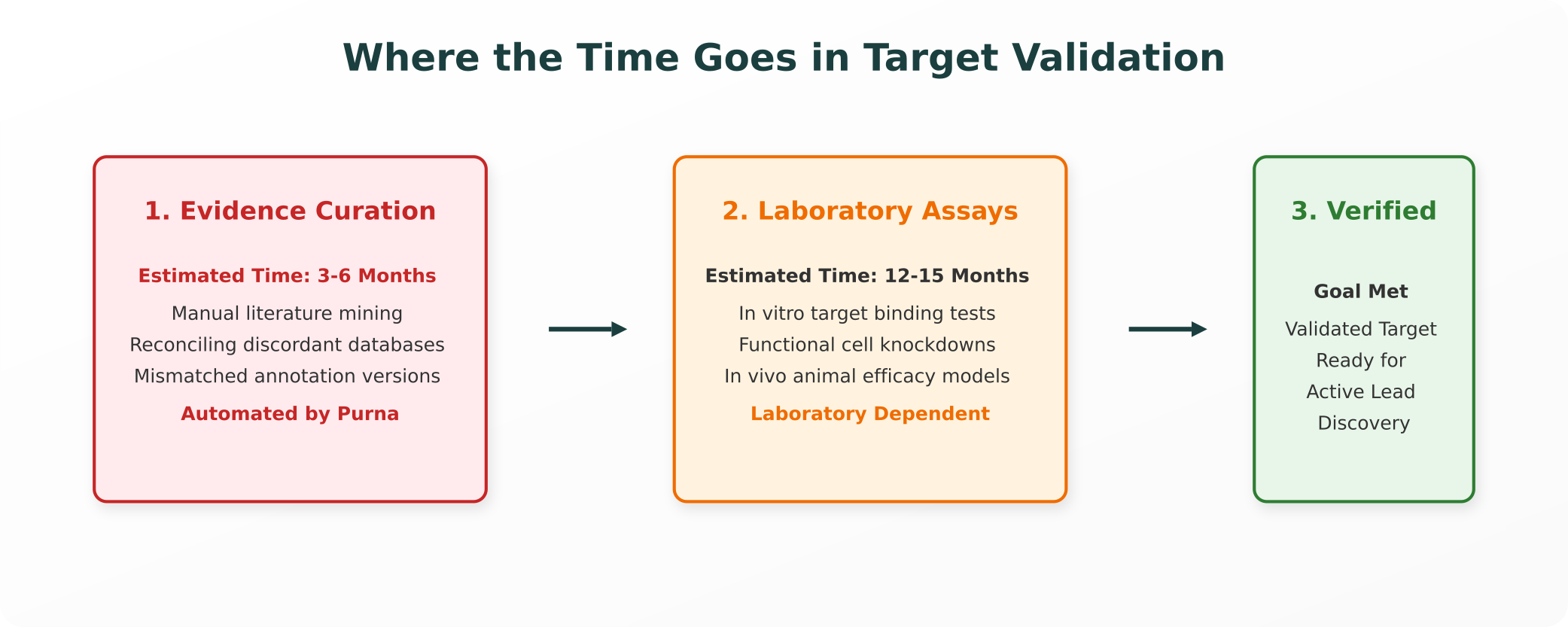
- Extensive Literature Mining (3 to 6 Months): Reviewing and extracting disease-target association evidence across thousands of publications is often the single most time-consuming manual step in a project.
- The Reproducibility Bottleneck: Before committing millions of dollars to a wet-lab campaign, research teams must repeat and confirm the original academic experiments that identified the target, protecting against manual reporting errors or false positives.
- The Database Reconciliation Problem: Because biological databases (such as ClinVar, gnomAD, and UniProt) are curated independently using different nomenclatures and release cycles, their annotations are frequently inconsistent. A researcher often has to spend weeks manually reconciling conflicting reports, rather than relying on a single, trusted source.
- Gaps in Structural and Functional Knowledge: A complete target evaluation requires assessing druggability. When a protein lacks high-resolution experimental structures, researchers must manually transfer sequence files across disconnected external servers to generate structural predictions.
How Purna Compresses the Target Validation Workflow
Purna addresses these pre-clinical bottlenecks directly at the architecture layer, unifying your target validation workflow into a single, automated workspace:
- Simultaneous Database Cross-Referencing: Instead of visiting multiple websites, Purna queries across 30+ live clinical and biological databases simultaneously. It automatically highlights where public resources agree and where they conflict, allowing you to identify discordant annotations instantly.
- Traceable Literature Synthesis: Purna automatically synthesizes disease-target relationships across indexed literature, delivering structured, concise summaries. Every factual claim is anchored directly to live evidence with clickable, verified citations, eliminating manual search loops.
- Integrated Structural and Druggability Curation: Purna incorporates ESMFold natively. Researchers can instantly generate 3D protein structures, visualize active-site geometries using Molstar, and calculate stability changes ($\Delta\Delta G$) from a single, unified query.
Honest Scope and Boundaries
While Purna dramatically compresses the time required to gather, normalize, and validate pre-clinical evidence, it does not bypass the laws of physical biology.
The platform accelerates the evidence-gathering and database curation phases of research, but the actual experimental validation (such as in vitro binding assays, functional genetic knockdowns, and in vivo animal model studies) must still occur inside the wet-lab. By automating the mechanical tasks of data collection while keeping the final decision judgment with your scientific experts, Purna AI helps your team make high-confidence “go/no-go” drug discovery decisions with speed and complete scientific integrity.
Explore Purna's Molecular Intelligence Platform
AI-powered workspace for biology teams to accelerate drug discovery from target identification to lead optimization.
Try Purna AI →
