
The Literature Review Bottleneck No One Budgets Time For
When R&D teams plan a new drug discovery or target validation campaign, they construct detailed, structured budgets. They allocate months of labor and millions of dollars for wet-lab assays, computational genomic pipelines, lead optimization, and regulatory writing. However, they almost universally treat literature review as a preliminary, negligible task: a quick step that happens “before the real work starts” and resolves after a few Google Scholar searches.
This is a major planning mistake. In practice, literature curation is not a one-time setup step; it is a continuous, highly fragmented time sink that recurs throughout every single phase of a project’s lifecycle. Treating it as a negligible cost leads to chronic project delays, misallocated lab resources, and redundant experimental assays when researchers miss critical, already-published findings.
This article establishes literature review as a genuine, underestimated time cost in R&D workflows and outlines how integrating modern, automated tools can accelerate discovery.
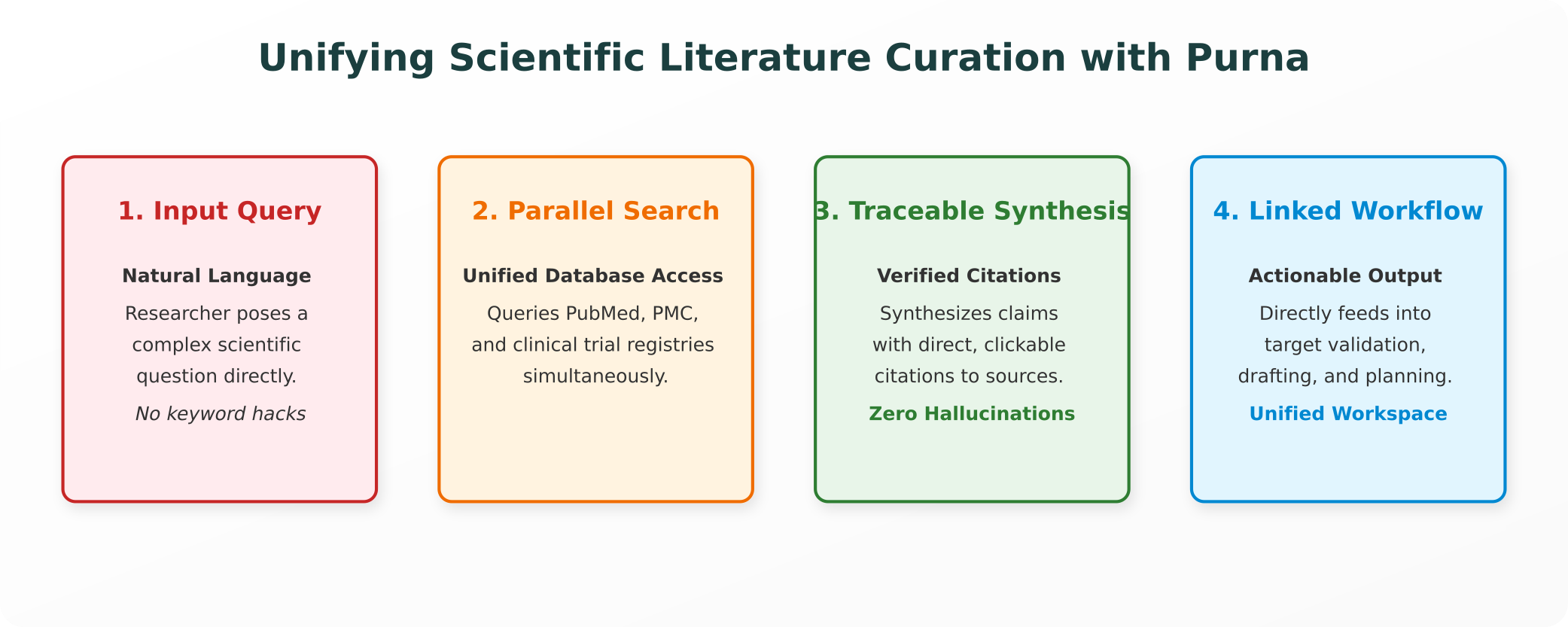
Unifying Literature Curation with Purna
By transitioning from manual searches to an automated, traceable pipeline, researchers can streamline the entire synthesis lifecycle:
Why the Bottleneck is Real and Underestimated
The core reason literature review is consistently underbudgeted is that its scale has completely outgrown manual human curation capabilities.
- Exponential Publication Volume: According to official National Library of Medicine (NLM) milestones, PubMed passed 35 million citations in December 2022 and currently comprises more than 40 million citations. This addition of over five million citations in just a few years means that for any target pathway, hundreds of new, highly specific papers are published monthly.
- The Scale of the Search: Researchers consistently describe literature search and synthesis as one of the most time-consuming, least analytical parts of their work, with large-scale studies on scholarly reading patterns indicating that life scientists spend hundreds of hours each year discovering, reading, and organizing publications.
- The Failure of Keyword Search: Traditional database search engines rely on exact keyword matching. In biology, where a single gene or disease can have dozens of historical aliases, standard keyword queries frequently return thousands of irrelevant results or miss critical papers because of minor naming differences, forcing researchers to spend hours manually refining search terms.
What the Bottleneck Actually Costs
To understand where these hours are lost, we must break down the specific manual tasks involved in a standard literature review workflow:
- Searching Across Siloed Databases: A thorough evaluation requires querying PubMed, Europe PMC, bioRxiv, and clinical trial registries independently, requiring constant interface-switching.
- Filtering and Relevance Screening: Researchers must manually read through hundreds of abstract previews to discard irrelevant papers, a highly repetitive, non-analytical task.
- Extracting and Cross-Referencing Findings: Once relevant papers are identified, researchers must copy-paste data points, tissue types, and experimental outcomes into isolated spreadsheets, creating static records that quickly become stale.
- Building Citations for Written Outputs: When it is time to write a patent, regulatory filing, or paper, compiling and formatting references in specific journal styles represents another major formatting bottleneck.
The Mid-Project Cost: It Never Stops
A common misconception is that literature review ends once the project proposal is approved. In reality, the need for a thorough scientific literature search is a recurring cost:
- A wet-lab assay returns an unexpected result, requiring the team to immediately search for alternative biological pathways or transcription factor compensations.
- A new competitor molecule enters clinical trials, forcing researchers to quickly extract and analyze its published safety and efficacy profiles.
- A target knockdown fails to show the expected phenotypic effect, requiring a deep dive into tissue-specific expression datasets to identify possible redundant mechanisms.
Because these needs arise dynamically, manual literature review acts as a constant drag on active R&D execution.
Streamlining Curation with Purna
Purna addresses these administrative bottlenecks directly at the architecture layer, transitioning biomedical literature synthesis from a manual chore into an automated, integrated workflow:
1. Automated Multi-Database Curation
Instead of forcing researchers to visit and query multiple siloed databases, Purna integrates direct programmatic connections to PubMed, PMC, clinical trial registries, and structural databases. When a user poses a complex research question, Purna queries these repositories simultaneously, eliminating manual interface-switching.
2. Traceable Semantic Synthesis
Rather than simply returning a list of links, Purna synthesizes findings into a structured, highly focused summary of the target biology. Crucially, every single claim, pathway association, or experimental result generated by the platform is anchored directly to its source. The output contains clear, clickable citations and direct links back to the primary literature, allowing researchers to verify the factual provenance of any statement in seconds.
3. Connected Workflow Integration
Unlike static search engines that exist outside your workspace, Purna’s outputs plug directly into your ongoing project work. The synthesized findings, target classifications, and literature evidence feeds can be directly routed into target validation planning, 3D structural visualizers, or drafting editors, keeping your research context completely intact.
Closing: Accelerating Scientific Judgment
The goal of automated research database curation is not to replace human scientific reasoning or eliminate the need for critical, peer-led review. Rather, it is to automate the mechanical, non-analytical tasks of searching, filtering, and copy-pasting that consume a substantial portion of your R&D team’s time.
By compressing the search-and-synthesis loop, Purna ensures that your researchers spend less time managing files and formatting spreadsheets, and more time applying their expert judgment to the actual science, helping you move from target hypothesis to validated discovery with speed and absolute scientific confidence.
Explore Purna's Molecular Intelligence Platform
AI-powered workspace for biology teams to accelerate drug discovery from target identification to lead optimization.
Try Purna AI →
