Why Bioinformatics Tools Are Often Harder to Combine Than to Use Individually
Every computational biologist has experienced the same frustration. You discover a newly published algorithm that promises to solve a key step in your analysis. You install it, run it against the author’s provided test dataset, and it compiles perfectly. You have a second, established tool that handles the subsequent downstream step of your pipeline, which also works flawlessly in isolation.
Yet, the moment you attempt the process of combining bioinformatics tools into a unified, automated pipeline, the system breaks. A script crashes due to an unhandled null value, coordinates shift by a single base pair, or a parser silently corrupts your genomic metadata.
This friction is the central challenge of modern bioinformatics tool integration. Why is it that tools that are highly effective on their own are so notoriously difficult to link together?
This article explores the deep, documented software engineering barriers that drive these bioinformatics pipeline challenges, examines empirical evidence of the interoperability gap, and outlines what a well-designed integrated platform actually needs to solve this properly.
The Interoperability Gap
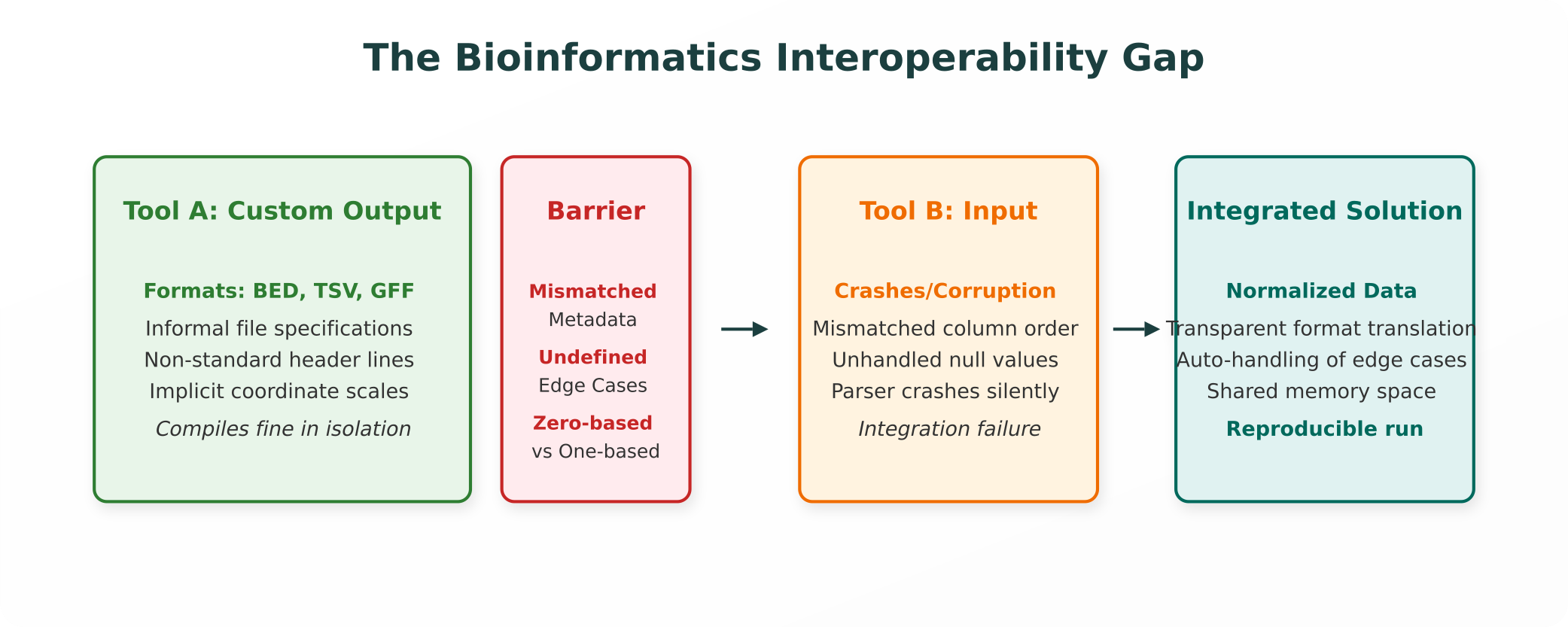
The friction of combining bioinformatics tools spans from informal file specifications to mismatched runtime environments:
1. The Deceptive Test Case: A Realistic Scenario
The integration bottleneck typically begins with a common, documented software engineering pattern. A researcher is building a variant-filtering pipeline. They retrieve alignment coordinates from an established aligner, filter them using a newly published peak-caller, and attempt to annotate the filtered peaks using a third, standard annotation package.
On paper, the workflow is simple. Each tool is peer-reviewed, heavily cited, and works flawlessly on the original developers’ Github repository test files. However, the moment the researcher runs their own real-world patient data through the pipeline, the peak-caller crashes or, worse, outputs misaligned annotations.
The root of this failure is not a bug in the algorithms themselves. Instead, it is driven by subtle, unrecorded differences in how the tools parse and represent data structures under the hood. While the developer’s test case was clean and tightly constrained, real-world biological files contain messy edge cases, non-standard chromosomes, and highly variable metadata that reveal deep incompatibilities between independent software packages.
2. The Root Cause: Inconsistent File Format Standardization
At the core of the integration crisis is a lack of rigorous, enforceable file format standards. In computational biology, data formats are rarely specified with the mathematical precision seen in general software engineering.
- The Exceptions (Well-Specified Formats): There are notable, highly successful exceptions. Formats like SAM (Sequence Alignment/Map), BAM, CRAM, and VCF (Variant Call Format) are formally maintained and specified by the Global Alliance for Genomics and Health (GA4GH). These formats have strict, documented specifications, ensuring high interoperability in bioinformatics across major global tools.
- The Norm (Informal Specifications): Unfortunately, many other common formats are informally specified. Formats like BED, GFF, and generic tab-separated (TSV) outputs are frequently treated as “standards,” but lack a centralized, governing body. The original creator of a tool often writes a custom parser that handles their specific data needs, leaving downstream developers to guess how to handle edge cases, null values, or coordinate systems. This inconsistency is the primary driver of integration failures.
For example, coordinate systems are a frequent source of silent errors. Some tools output coordinates using a zero-based, half-open system (where the coordinate index starts at 0 and the end index is non-inclusive, standard for BED files), while others use a one-based, fully closed system (where indexing starts at 1 and both ends are inclusive, standard for GFF and SAM files). When combining these tools, a pipeline that fails to explicitly translate between these two coordinate definitions will silently introduce one-base-pair shifts across millions of genomic coordinates, invalidating the downstream biology.
3. Measurable Evidence: The BED Format Interoperability Study
This integration friction is not just an anecdotal annoyance. It is a measurable, systemic issue.
In a landmark software engineering study, researchers conducted a systematic verification analysis of the BED (Browser Extensible Data) format, which is widely used to represent genomic features. They tested how a variety of peer-reviewed, standard bioinformatics packages parsed a set of BED files containing standard genomic coordinates alongside edge cases (such as zero-length features, negative coordinates, or trailing whitespaces).
The findings were striking. Out of 80 software packages examined:
- 75 of the 80 tools (93.75%) achieved less than 70% correctness on the test suite, showing a widespread vulnerability to parsing and validation failures when encountering format boundaries and edge cases (Niu et al., 2022).
- Tools frequently diverged in how they handled edge cases within the format, revealing that even a widely-used, seemingly standard file format does not guarantee two independent tools will parse it identically.
This study provided empirical proof of the interoperability gap: even when using one of the most common file formats in the field, biologists cannot assume that two independent tools will parse the same file in the same way.
4. Compounding Factors: Versioning, Environments, and Academic Gaps
Beyond file formats, several other factors compound the difficulty of building robust bioinformatics pipelines:
- Inconsistent Software Versioning: Minor version changes in underlying libraries can completely break a pipeline. A tool that worked yesterday may fail today because a dependent package updated its default float-precision handling or changed a command-line flag.
- Mismatched Environment and Dependency Requirements: Tool A may require Python 3.8 and specific versions of NumPy, while Tool B requires Python 3.11 and an incompatible set of scientific libraries. Forcing these tools onto a single server often leads to “dependency hell,” requiring complex containerization (such as Docker or Singularity) or virtual environments (Conda) simply to run a three-step analysis.
- The Academic Software Gap: Many single-purpose bioinformatics tools are developed by individual graduate students or postdocs as part of a specific research publication. Once the paper is published and the student graduates, the software is rarely maintained. Unlike commercial software, academic tools rarely have dedicated engineering support, leading to stale documentation, unaddressed bugs, and compatibility decay over time.
5. Why AI-Assisted Workflows Face the Same Barrier
A common modern belief is that artificial intelligence will solve these pipeline bottlenecks. Proponents suggest that AI agents can simply write custom python glue scripts, manage Docker containers, and orchestrate these tools automatically.
This is an overclaim. While AI agents can accelerate code generation, they run into the exact same structural limitations as human developers. An AI agent cannot programmatically resolve a silent one-base-pair coordinate shift if the underlying tool specifications do not document which coordinate system they use.
Similarly, if an academic tool crashes on a null value due to undocumented edge-case handling, the AI must engage in the same time-consuming, iterative debugging loops as a human engineer. AI does not eliminate the interoperability gap; it merely automates the process of hitting it. To truly solve the integration crisis, we must address the problem at the structural platform level.
6. The Solution: What a Well-Designed Integrated Platform Actually Needs
Simply compiling separate tools into a single, shared directory is not integration. A truly robust computational biology platform must solve the interoperability challenge at the architecture layer:
- Transparent Format Translation and Normalization: The platform must act as an active, semantic data-routing layer. When data flows between Tool A and Tool B, the platform must automatically detect coordinate scales, handle synonyms in metadata headers, and normalize null values, preventing parser crashes before they occur.
- Shared, Immutable Memory Space: Instead of constantly writing and reading huge flat-files to disk (which introduces parsing errors and massive I/O bottlenecks), integrated platforms should utilize a shared, in-memory data representation. This keeps the biological context completely intact across different analysis steps.
- Hermetically Sealed Environments: Each tool should run in its own, isolated runtime environment with fully pinned dependencies, completely eliminating “dependency hell” while preserving full reproducibility.
Purna AI: The Unified Biology IDE
Purna AI’s Molecular Intelligence Platform (MIP) is engineered from the ground up to solve these integration bottlenecks. Rather than serving as a generic folder of disconnected scripts, Purna serves as a unified, semantic workspace for R&D teams:
- Automated Data Normalization: Purna’s data pipeline automatically handles coordinate translations (zero-based vs. one-based), variant naming conventions, and metadata normalization between tools, completely eliminating silent parsing errors.
- 30+ Natively Integrated Databases: By housing biological databases (ClinVar, UniProt, OMIM, gnomAD) and computational tools in a single, unified memory space, Purna allows researchers to cross-reference literature, sequence, and structural data without manual copy-pasting or file-conversion steps.
- Hermetic, Reproducible Runs: Purna automatically captures full, immutable provenance for every run. Every parameter, data hash, and tool version is recorded in a secure audit ledger, ensuring that your pipelines are 100% reproducible today, tomorrow, and years down the road.
By addressing the interoperability gap at the software architecture layer, Purna AI transforms fragmented, fragile pipelines into precise, evidence-backed molecular intelligence, allowing research teams to focus on science instead of debugging code.
Explore Purna's Molecular Intelligence Platform
AI-powered workspace for biology teams to accelerate drug discovery from target identification to lead optimization.
Try Purna AI →