Drug Repurposing With AI: Old Molecules, New Targets
The cost and time required to bring a novel chemical entity to market are well-documented barriers in modern drug discovery. On average, developing a new therapeutic takes over a decade and costs upwards of two billion dollars, with historical clinical success rates hovering below ten percent. To bypass this massive bottleneck, researchers have long sought to identify new therapeutic indications for existing compounds: a strategy known as repurposing existing drugs.
Recently, the integration of deep learning and predictive analytics has sparked intense interest in drug repurposing AI workflows. By processing high-dimensional biological data, computational models can quickly generate hypotheses connecting old molecules to new target proteins and diseases.
However, amidst the excitement surrounding AI drug repositioning, it is essential to separate speculative computational signals from established biological reality. This article provides a measured, evidence-grounded analysis of how AI is actually used in repurposing, evaluates the boundaries of computational predictions, and outlines the non-negotiable wet-lab and clinical steps required to turn a virtual hit into a validated therapeutic.
1. The Core Appeal of Drug Repurposing
The primary attraction of drug repurposing is simple: risk mitigation and timeline reduction.
- Established Clinical Data: Repurposed drugs (particularly those that are already FDA or EMA approved) possess extensive, pre-existing human safety, pharmacokinetic, and toxicology profiles. Because these compounds have already been tested in phase 1 clinical trials, researchers can often bypass early safety bottlenecks, accelerating the timeline to phase 2 efficacy trials.
- Optimized Manufacturing: For approved compounds, robust, scalable chemical synthesis and formulation protocols are already established. This eliminates years of CMC (Chemistry, Manufacturing, and Controls) development.
- Historical Precedents: The field is underpinned by several landmark, albeit accidental, successes. For example, sildenafil was originally developed as an anti-angina medication before being repurposed for erectile dysfunction, while thalidomide was repurposed from a discontinued sedative to a highly effective treatment for multiple myeloma.
The Reality Check: While these historical successes prove that repurposing is possible, they are highly anomalous. The vast majority of drugs do not possess the multi-functional pharmacology required to be safely and effectively redirected to completely unrelated disease indications. AI is used to systematically explore this narrow possibility, not to guarantee automatic success.
2. How AI is Applied: The Computational Toolkit
Rather than relying on accidental clinical observations, modern research teams use computational drug repurposing platforms to systematically screen compounds across several distinct modalities:
(a) Network-Based and Knowledge Graph Methods
Biomedical data is highly interconnected. AI platforms can construct massive knowledge graphs where drugs, targets, biological pathways, phenotypes, and diseases serve as nodes, and known scientific literature relationships serve as edges.
- The Mechanism: Graph neural networks (GNNs) analyze these networks to find hidden, indirect connections. For instance, if drug A inhibits protein B, and protein B is closely connected in a disease pathway to protein C, the algorithm flags drug A as a candidate for diseases driven by protein C.
(b) Molecular Similarity and Structure-Based Docking
If a novel disease-driving target protein is discovered, researchers can use AI-driven structural modeling to screen library databases of approved compounds.
- The Mechanism: Algorithms calculate the 3D binding affinity of existing molecules against the new target’s active pocket. Tools simulate molecular dynamics to predict whether an approved drug (or its metabolites) can physically bind and modulate the target with high selectivity.
(c) Literature Mining and Evidence Synthesis
Tens of thousands of biomedical papers are published weekly, creating a massive coverage gap. No single human can read every study to connect adjacent findings.
- The Mechanism: Natural language processing (NLP) models scan full-text PDFs to extract subtle, indirect biological associations (such as a paper in immunology describing a pathway that overlaps with a rare oncology mutation), surfacing overlooked mechanisms of action for existing compounds.
3. Credible vs. Speculative: The Curation Funnel
In any AI-driven drug discovery campaign, the computational output is only the first filter. There is a fundamental difference between a virtual statistical correlation and a credible, validate-ready therapeutic hypothesis.
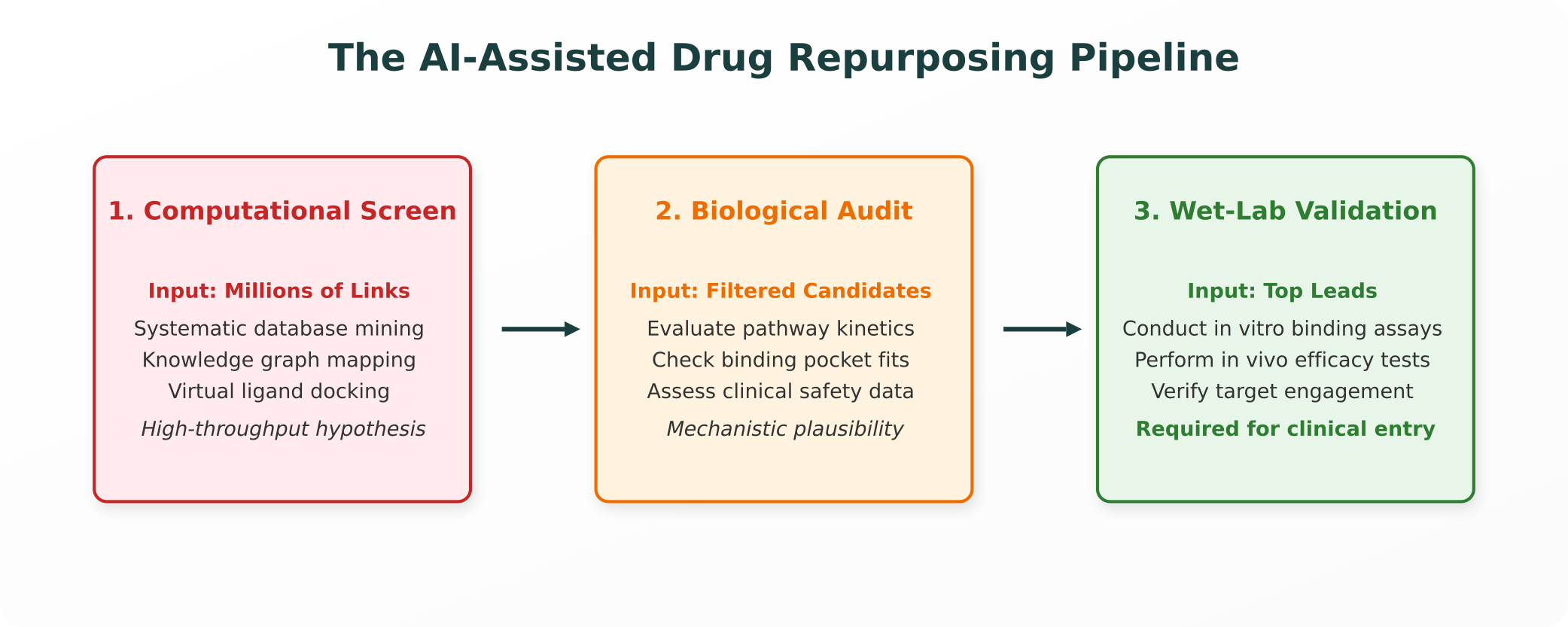
To separate high-probability candidates from speculative noise, researchers must filter computational hits through a rigorous curation funnel:
The Validation Gap
A computationally predicted drug-target association is not a biological fact. It is merely a statistical probability generated by a pattern-matching algorithm. A candidate only becomes credible when:
- Biological Plausibility is Established: The proposed mechanism must be biochemically logical. If the AI suggests an approved anti-viral drug can treat a specific cancer, researchers must trace a clear, verifiable pathway explaining how inhibiting the viral protein (or its host target) modifies the tumor microenvironment.
- In Vitro Validation is Confirmed: The compound must undergo direct biochemical assays in the wet-lab. Researchers must physically test whether the drug binds the target with sufficient potency (low-nanomolar affinity) in cell lines and patient-derived assays.
- In Vivo Efficacy is Demonstrated: Cell-based assays do not capture the systemic complexity of an organism. Before clinical entry, the repurposed drug must demonstrate in vivo efficacy in disease-relevant animal models, confirming that the drug can reach the target tissue in therapeutic concentrations without inducing off-target toxicities.
4. Real, Current Limitations of AI Repurposing
Despite advanced predictive capabilities, computational drug repositioning faces severe structural constraints:
- Incomplete and Biased Reference Databases: AI models are only as good as the data they train on. Public biological databases are heavily biased toward highly funded disease areas (such as oncology and cardiovascular disease), leaving rare or tropical diseases underrepresented. Furthermore, much of the world's primary literature remains locked behind academic paywalls, creating a massive coverage gap for text-mining algorithms.
- Spurious Correlations: Large-scale computational screens are prone to identifying spurious statistical correlations that have no physical or biological relevance. An AI model may link a drug to a disease simply because they were frequently mentioned in the same patent document, despite having no causal biological connection.
- The Unchanged Clinical Evidence Bar: Computational modeling can shorten the time required to generate a hypothesis, but it does not skip the evidence requirement. To achieve regulatory approval, a repurposed drug must still undergo rigorous, prospective, randomized clinical trials to prove efficacy in the new patient population. Repurposing accelerates preclinical discovery, but it does not bypass the clinical validation phase.
5. The Regulatory Reality
A common misconception is that because a repurposed drug has already been approved, it can quickly be prescribed for a new indication with minimal regulatory oversight.
In reality, regulatory bodies (such as the FDA or EMA) enforce strict boundaries:
- The New Indication Requirement: Existing safety and toxicology data are highly context-dependent. A dose that is safe for treating a mild, chronic condition may be toxic when administered at the higher concentrations required to penetrate the blood-brain barrier for a central nervous system disorder.
- Prospective Clinical Trials: Safety data from the original indication does not substitute for prospective efficacy evidence in the new context. Researchers must still file an Investigational New Drug (IND) application and run controlled trials (typically phase 2 and phase 3) to prove clinical benefit before receiving market authorization.
Purna AI: Grounding Hypotheses in Hard Biochemistry
Most generic AI search and indexing tools operate as unconstrained search engines, presenting researchers with flat lists of associations without biological context.
Purna AI’s Molecular Intelligence Platform (MIP) is built to solve this exact bottleneck. Designed specifically as an IDE and biology workspace for professional R&D teams, Purna integrates text-extracted relations with live reference databases and physical biochemistry:
- Rigid Evidence Grounding: Purna does not generate speculative, ungrounded claims. Every drug-target relationship or clinical phenotype analyzed by the platform is tied directly to 30+ live biological databases and indexed literature with clickable, verified citations.
- Integrated 3D Structural Validation: To validate virtual docking hits, Purna integrates structural molecular biology natively. Researchers can instantly pull the 3D structures of receptors from the Protein Data Bank (PDB), visualize the binding pockets using Molstar, and run biophysical simulations to computationally verify target-ligand binding energies.
- Continuous, Multi-Step Curation: Purna acts as a force multiplier for scientific teams. By automating the mechanical tasks of multi-omics data gathering, database querying, and initial relation mapping, Purna allows researchers to focus on critical study designs and high-confidence drug discovery decisions.
By transforming raw computational signals into structured, evidence-backed molecular intelligence, Purna AI replaces speculative search and empowers research teams to advance their drug repurposing campaigns with complete scientific integrity.
Explore Purna's Molecular Intelligence Platform
AI-powered workspace for biology teams to accelerate drug discovery from target identification to lead optimization.
Try Purna AI →