How to Identify Research Gaps With AI Without Inventing Unsupported Claims
Identifying a genuine novelty is the first and most critical step of any scientific endeavor. Whether writing a grant proposal, launching a new drug discovery program, or designing a clinical study, researchers must prove that their proposed work addresses a real, unaddressed void in human knowledge. Traditionally, conducting a literature gap analysis required months of manual reading, citation tracing, and painstaking comparison across separate publications.
With the advent of advanced language models, scientists are increasingly employing an AI tools to identify research gaps workflow. While these computational systems can dramatically accelerate information mapping, they also present a severe risk: the fabrication of false or unsupported “gaps” due to a lack of genuine scientific understanding.
This guide establishes a responsible, evidence-grounded framework for conducting research gap analysis AI tasks, explaining how to utilize AI to surface hidden opportunities while keeping claims strictly validated and transparent.
1. What a Genuine Research Gap Actually Looks Like
Before deploying any algorithm to find voids, researchers must understand that not all “missing data” constitutes a valuable or genuine research gap. In biomedical and drug discovery research, genuine gaps generally fall into five distinct structural categories:
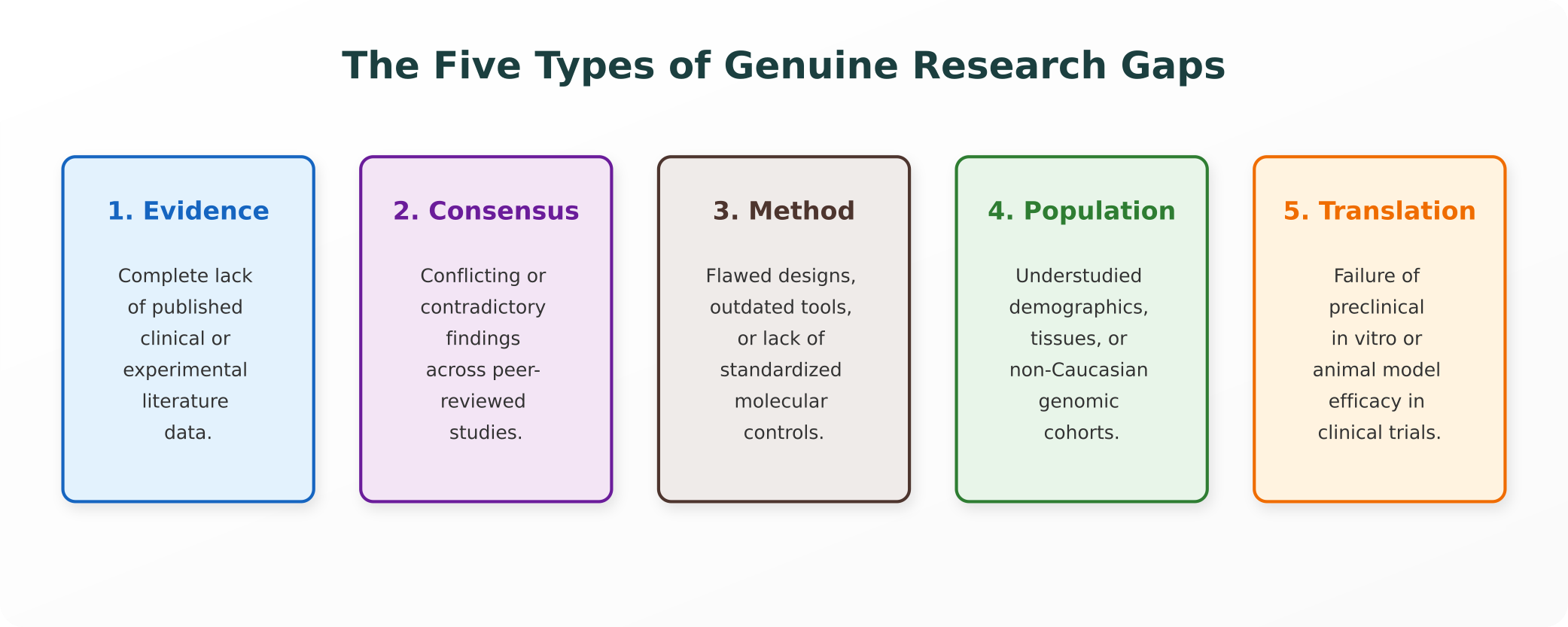
- Evidence Gaps: A complete or near-complete lack of published empirical data on a specific molecular target, biochemical pathway, or clinical phenotype.
- Consensus (Knowledge) Gaps: Conflicting, contradictory, or inconsistent findings across peer-reviewed studies (for example, where one paper claims a variant is pathogenic and another claims it is benign).
- Methodological Gaps: Situations where the existing body of evidence was generated using flawed experimental designs, outdated technologies, or lacked standardized molecular controls.
- Population Gaps: Understudied demographic cohorts, specific tissues, or patient groups (such as non-Caucasian genomic cohorts) that are excluded or underrepresented in the current literature.
- Translation Gaps: Occurrences where a molecular mechanism demonstrated robust efficacy in vitro or in animal models but consistently fails to translate to clinical efficacy in human trials.
2. Where AI Genuinely Helps: Systematic Mapping at Scale
When properly constrained, AI excels at processing high-dimensional text to highlight structural patterns and anomalies across vast collections of literature.
- Systematic Literature Mapping: AI can scan tens of thousands of abstracts in seconds, mapping co-occurrence networks between genes, variants, tissues, and diseases. This allows researchers to quickly visualize which target-disease networks are densely studied and which remain virtually unmapped.
- Surfacing Real Contradictions: By analyzing semantic relationships and sentiment across papers, AI can flag conflicting assertions (such as opposing findings on protein-protein interactions), systematically highlighting consensus gaps that require further experimental resolution.
- Objectively Flagging Low Evidence Density: AI can calculate publication and citation density across specific pathways, helping research teams locate “under-researched” biological nodes that have been overlooked by major funding cycles.
3. Where It Goes Wrong: The Pitfalls of Automated Search
Relying on generic AI systems to declare a “novel gap” without strict validation loops introduces severe risks of scientific misrepresentation.
- Confusing “Not Found in This Search” with “Does Not Exist”: Standard AI models often fail to capture synonyms, alternative gene nomenclatures, or publications indexed outside their training data. If an AI asserts that “no paper has linked gene X with disease Y,” it is highly possible the connection was published under an alternative gene name or in a non-indexed journal.
- Confidently Fabricating Voids: Large language models are optimized for linguistic coherence, not factual truth. If prompted to find a gap, a generic model will often confidently invent a non-existent scientific limitation, complete with plausible-looking (but entirely hallucinated) citations.
- Overstating Novelty: AI tools often lack the temporal and clinical context of drug development. A model might flag a “novel target” simply because it has low recent publication density, failing to realize that the target was heavily studied and discontinued due to safety or tolerability issues fifteen years prior.
4. What Responsible AI-Assisted Gap Analysis Requires
To ensure that a computationally identified gap is truly grant- or proposal-ready, research teams must enforce a rigorous, multi-step verification protocol.
- Absolute Traceability of Searches: Every claimed gap must be accompanied by a transparent log of what was actually searched. This includes the exact queries, boolean operators, database versions, and inclusion thresholds used by the AI, allowing other researchers to reproduce the analysis.
- Explicit Uncertainty and Confidence Language: Factual claims regarding a lack of evidence must be framed with conservative, probability-based language. Instead of stating “this pathway has never been studied,” responsible reports write, “no direct associations between pathway X and phenotype Y were identified within our retrieved dataset of N peer-reviewed publications.”
- Mandatory Primary Source Audits: Before treating an AI-surfaced gap as validated, researchers must manually audit the primary literature. This involves verifying that apparent contradictions are not simply differences in experimental cell lines, or that “low publication density” is not due to a well-known, unpublished clinical safety barrier.
Where Purna AI Fits: Evidence-Grounded Molecular Intelligence
Most generic AI search tools are built on unconstrained web data, making them highly susceptible to hallucinating gaps or overstating novelty.
Purna AI’s Molecular Intelligence Platform (MIP) is designed to eliminate this exact failure mode. Built specifically as a biology IDE and workspace for professional research teams, Purna enforces strict factual grounding for all target and literature analyses:
- Programmatic Multi-Database Integration: Purna does not rely on static web data. When performing a literature gap analysis, Purna queries across 30+ live clinical and biological databases (such as ClinVar, UniProt, and OMIM) in real-time. This ensures that synonym mapping and nomenclature resolution are completely handled, preventing false “not found” classifications.
- Clickable Provenance and Audit Trails: Purna does not generate ungrounded claims. Every target-disease association, clinical phenotype, or genetic variant evaluated by the platform is tied directly to live primary evidence with clickable, verified citations.
- Combining Literature with Physical Reality: For any surfaced target, Purna integrates structural biology validation natively. Researchers can instantly pull the 3D protein structure from the PDB, visualize the relevant binding pockets, and run biophysical simulations to verify if a “literature gap” is physically and biochemically tractable.
By combining advanced text mining with rigid biological grounding, Purna AI transforms speculative search into precise, evidence-backed molecular intelligence, helping research teams discover and advance genuine, validated targets with complete confidence.
Explore Purna's Molecular Intelligence Platform
AI-powered workspace for biology teams to accelerate drug discovery from target identification to lead optimization.
Try Purna AI →