Systematic Review AI: Where Automation Helps and Where Researchers Must Stay in Control
Systematic reviews and scoping reviews are the gold standard of evidence-based medicine and biological target validation. They provide a transparent, rigorous, and reproducible synthesis of all available evidence on a specific scientific question. However, the sheer volume of emerging publications makes conducting these reviews manually a massive, exhausting task. A typical review can take up to a year or more to complete, during which time new data can emerge and render parts of the review obsolete.
To address this bottleneck, researchers are increasingly adopting systematic review AI technologies. From title screening to data extraction and evidence synthesis, an AI systematic review tool can drastically shorten development timelines. However, complete automation remains a major risk to scientific rigor.
This guide provides a measured look at where an automated systematic review workflow helps, and where human researchers must maintain strict, non-negotiable control across the three primary stages of the review process.
The Three Core Stages of a Systematic Review
A high-fidelity systematic or scoping review consists of three sequential stages. Each stage has unique computational opportunities and distinct human boundaries:
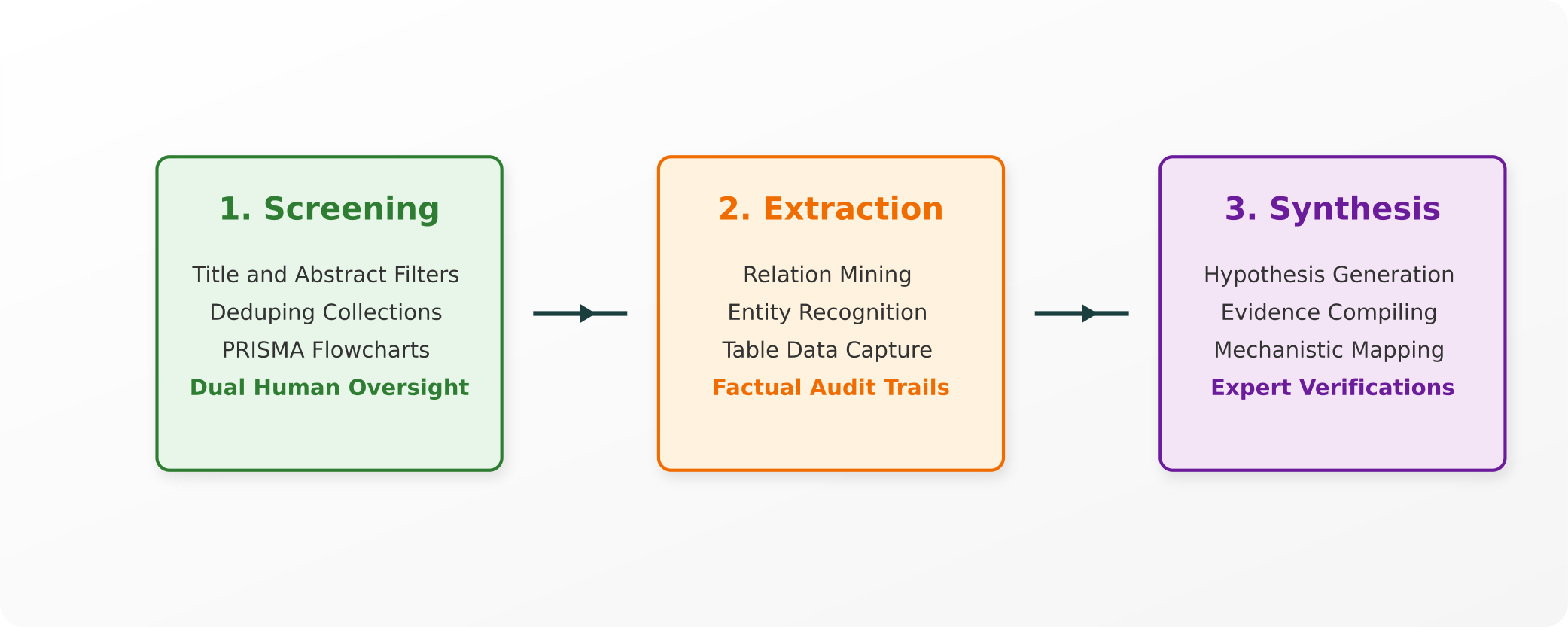
Stage 1: Screening (Study Selection)
The screening stage is the first major hurdle of any systematic or scoping review. Researchers must filter thousands of search results (often retrieved from databases like PubMed, Embase, and Scopus) down to a precise, final set of eligible studies based on pre-defined inclusion and exclusion criteria.
Where Automation Helps:
- Automated De-duplication: Merging search results from different databases inevitably results in duplicate records. AI-powered algorithms can instantly identify and merge these duplicates with near-perfect accuracy, accounting for differences in formatting or minor typos.
- Abstract and Title Screening Assistance: Active learning algorithms can be trained on a small subset of manually screened abstracts to predict the eligibility of the remaining pool. By sorting abstracts by relevance, the AI ensures that researchers review high-probability papers first, dramatically reducing overall screening time.
- PRISMA Flowchart Generation: Some systems can track document flows automatically, recording exactly how many studies were screened, excluded (with reasons), and included, simplifying final reporting.
Where Researchers Must Stay in Control:
- Dual-Review Consensus: Even the most advanced active learning model can make false-negative exclusions. Standard guidelines (such as Cochrane or Joanna Briggs Institute) dictate that study screening must be performed independently by at least two human reviewers. AI can serve as a supportive third screener or prioritize documents, but it cannot replace the consensus-seeking dialogue between human experts.
- Refining Inclusion/Exclusion Criteria: AI lacks clinical or biological intuition. If the initial criteria are ambiguous, the AI will faithfully apply the ambiguity across the entire dataset. Human researchers must continuously monitor early screening results and refine the criteria to ensure biological relevance.
Stage 2: Extraction (Data Retrieval)
Once the eligible studies are finalized, researchers must extract specific data points, such as study designs, sample sizes, patient demographics, therapeutic doses, biomolecular targets, and clinical outcomes, into structured matrices.
Where Automation Helps:
- Named Entity Recognition (NER): Natural language processing (NLP) models can scan full-text PDFs to automatically flag genes, proteins, diseases, cell lines, and small molecule inhibitors.
- Automated Table Extraction: Extracting data from embedded tables is notoriously slow. Specialized document-parsing AI can convert complex, multi-column PDF tables into clean, structured CSV files in seconds.
- Drafting Relationship Matrices: AI can assist in constructing initial draft tables mapping specific mutations to drug-response rates, providing a structured starting point for human curators.
Where Researchers Must Stay in Control:
- Strict Fact-Checking and Traceability: Language models are prone to subtle transcription errors. They can misinterpret “no significant change” as “significant change” or mismatch sample sizes across different study cohorts. Researchers must audit every single extracted value against the primary source, maintaining a direct audit trail (provenance) back to the exact section of the PDF.
- Evaluating Bias and Study Quality: AI cannot assess the risk of bias within a study. Evaluating whether a paper has methodology flaws, selective reporting bias, or conflicts of interest requires deep, critical human judgment and familiarity with scientific standards.
Stage 3: Synthesis (Evidence Aggregation)
The final stage is synthesizing the extracted data to answer the core scientific question. This involves compiling findings, calculating pooled effect sizes, and building a cohesive biological or clinical hypothesis.
Where Automation Helps:
- Mapping Mechanistic Pathways: For a scoping review AI workflow, tools can co-localize findings from separate publications, highlighting indirect pathways (for example, how a variant in one paper affects a protein mediator described in another).
- Meta-Analysis Calculation Support: Computational code assistants can write custom R or Python scripts to run meta-analyses, construct forest plots, and calculate heterogeneity indices.
- Drafting Clarity and Summaries: AI models can suggest clear phrasing, summarize conflicting findings, and improve the narrative flow of the final synthesis document.
Where Researchers Must Stay in Control:
- Causality vs. Correlation Judgment: AI models are pattern finders. They can map biological correlations, but they cannot evaluate whether the physical biochemistry supports a causal relationship. Human experts must weigh the mechanistic evidence and decide if a connection is biologically valid.
- Validating Clinical Relevance: A statistical synthesis is only useful if it translates to clinical reality. Determining whether a pooled effect size is clinically meaningful (rather than just statistically significant) requires the clinical expertise and experience of human researchers.
- Policy and Disclosure Compliance: Authors must remain fully compliant with reporting guidelines (such as PRISMA) and AI-disclosure policies from bodies like the ICMJE and COPE. These guidelines mandate that any use of AI in the screening, extraction, or synthesis phases must be transparently documented in the methodology section, and that AI cannot be listed as a co-author.
How Purna AI Bridges the Systematic Review Gap
Traditional software options are often split: they are either simple citation managers that lack biological reasoning, or they are generic language models that lack scientific evidence and are prone to hallucinations.
Purna AI’s Molecular Intelligence Platform (MIP) is built to bridge this exact gap. Designed as a dedicated biology workspace and IDE for research teams, Purna combines advanced automation with strict human control points:
- Factual Grounding and Provenance: Purna does not write ungrounded text. Every target, gene-disease relationship, and clinical outcome synthesized by the platform is tied directly to live primary databases and indexed literature with verified, clickable citations. This ensures complete traceability for human audit loops.
- Integrated Structural Validation: When a systematic review highlights a specific mutated protein, Purna automatically retrieves its 3D structure from the Protein Data Bank (PDB), visualizes the mutation site, and calculates stability changes (ΔΔG). This grounds literature-extracted relations in hard, physical biochemistry.
- Empowering Human Reasoning: Purna acts as a force multiplier for scientific teams. By automating the mechanical tasks of multi-omics data gathering, database querying, and initial relation mapping, Purna frees researchers to focus on what they do best: applying critical biological reasoning, evaluating study quality, and making high-confidence drug discovery decisions.
By maintaining absolute transparency and factual grounding, Purna AI helps research teams conduct rigorous, reproducible literature reviews with greater speed and scientific integrity.
Explore Purna's Molecular Intelligence Platform
AI-powered workspace for biology teams to accelerate drug discovery from target identification to lead optimization.
Try Purna AI →