R vs Python for Bioinformatics: Where Each Ecosystem Actually Wins
A common, silent bottleneck in computational biology is language dogmatism. Most bioinformaticians and research scientists choose between R and Python based entirely on what they happened to be taught first in their graduate labs, rather than actively evaluating which ecosystem is biochemically or computationally optimized for the task at hand. Defending a single-language workflow as an absolute standard costs real time, forcing researchers to write complex custom workarounds for problems that have elegant, native solutions in the alternative language’s libraries.
To build robust, high-performance pipelines, researchers must move past treating programming languages as personal identities. R and Python are both exceptional tools, but their primary advantages do not lie in basic syntax: they reside in their highly specialized, independently matured package ecosystems.
This article serves as a definitive, technically precise reference guide to R vs Python bioinformatics workflows. We analyze where each language genuinely holds the edge, examine the role of Bioconductor and PyPI repositories, and outline a practical, task-based decision framework for choosing the correct ecosystem for your specific analyses.
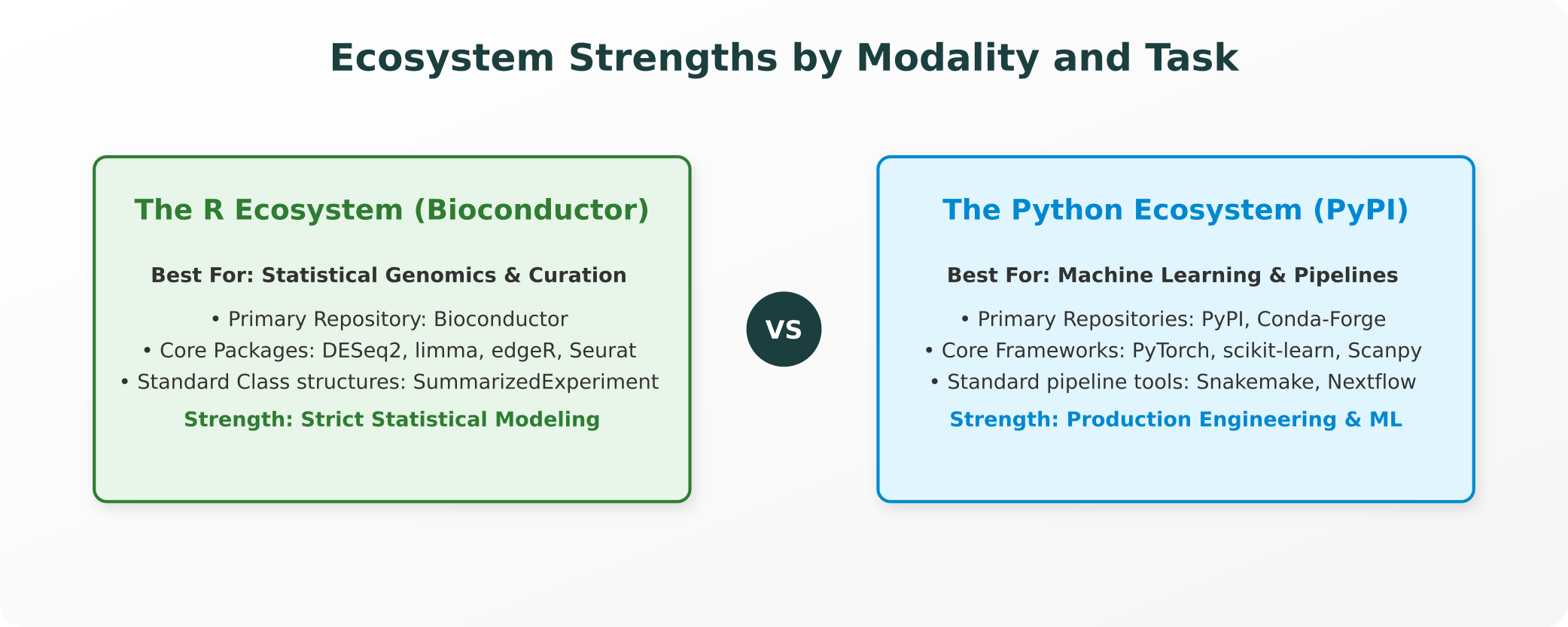
Ecosystem Strengths by Modality and Task
Different programming architectures are optimized for different computational scales, transitioning from strict statistical genomic modeling to large-scale machine learning and production pipeline engineering:
1. Where R Genuinely Wins: Statistical Rigor and Bioconductor
R was designed from its origin as a language for statistical computing and graphics. In computational biology, R’s dominance is anchored in a single, unparalleled repository: Bioconductor.
- The Maturity of Bioconductor Packages: Bioconductor is a curated, open-source repository designed specifically for high-throughput genomic data analysis. Key packages like DESeq2 (for differential expression), limma (linear modeling for microarrays and RNA-seq), and edgeR (empirical analysis of digital gene expression) represent decades of peer-reviewed, mathematically validated statistical development.
- Consistent Data Structures: One of Bioconductor’s greatest advantages is its use of standardized, highly consistent data classes. The SummarizedExperiment and
SingleCellExperimentclasses define a strict, uniform way to store expression matrices, sample metadata, and genomic feature coordinates. Because almost all Bioconductor packages are built to accept and output these standardized classes, researchers can chain different tools together seamlessly without needing to write custom file-format parsers. - Statistical Expressiveness: For classical statistical modeling (such as fitting generalized linear models, adjusting for complex experimental designs with nested batch variables, or performing ANOVA), R’s native formula syntax and statistical libraries are exceptionally expressive, robust, and mathematically mature.
2. Where Python Genuinely Wins: General Programming and Machine Learning
Python was built as a general-purpose, object-oriented programming language. In bioinformatics, Python’s dominance is driven by its exceptional software engineering features and its absolute hegemony in artificial intelligence.
- Machine Learning and Deep Learning integration: The modern field of structural biology, variant calling, and cellular modeling is heavily driven by deep neural networks. Frameworks like PyTorch, TensorFlow, and scikit-learn are native to Python. Deep variant callers (such as Google’s DeepVariant) or single-cell foundation models (such as scGPT) are written exclusively in Python, making it the essential language for any machine learning in biology workflow.
- Production Bioinformatics Pipeline Development: For large-scale data engineering (such as processing terabyte-scale FASTQ files, parsing massive XML databases, or building production-grade web APIs), Python’s general-purpose programming features are vastly superior to R. Python is faster, has better memory management, handles multi-threading more efficiently, and integrates seamlessly with cloud infrastructures and orchestration engines like Nextflow or Snakemake.
- File Parsing and Automation: Python’s standard library excels at text-processing, system file-management, and scripting, making it the ideal choice for secondary-analysis automation, database curations, and pipeline glue-code.
3. Where the Lines Blur: Single-Cell and Interoperability
The “versus” framing begins to break down in several modern computational areas where both languages maintain highly mature, competitive ecosystems:
Scanpy vs Seurat in Single-Cell Transcriptomics
Single-cell analysis represents an active, highly competitive overlap between both languages:
- Seurat (R): A comprehensive, highly established R package for single-cell analysis. It features exceptionally robust plotting, mature multimodal integration (such as CITE-seq or spatial transcriptomics), and a massive clinical user base.
- Scanpy (Python): A python-based framework built on the
anndataclass structure. Because it leverages Python’s efficient memory handling and integration with sparse matrices, Scanpy typically scales to much larger datasets (millions of cells) and runs clustering algorithms faster than Seurat on equivalent hardware.
Bridges Over the Divide: Interoperability
Modern bioinformaticians rarely limit themselves to a single language. They utilize advanced bridge packages to run both languages in a single computational notebook:
reticulate(R): An R library that allows you to import and call Python modules, classes, and functions directly inside an R script, facilitating seamless data-sharing between the two runtimes.anndata2ri(Python): A specialized converter that allows researchers to programmatically translate Python’s single-cellanndataobjects into R’sSingleCellExperimentstructures, allowing you to run Scanpy preprocessing and Seurat clustering on the identical cell cohort without manual export steps.
A Task-Based Decision Framework
To optimize computational efficiency, research teams should choose their environment based on the specific task, rather than personal familiarity:
- Choose the R/Bioconductor Ecosystem For:
- Bulk RNA-seq differential expression profiling (using
DESeq2oredgeR). - Classical microarray analysis (using
limma). - Complex clinical statistical modeling (such as survival analysis or nested batch adjustments).
- Publication-grade genomic visualizations (using
ggplot2orComplexHeatmap).
- Bulk RNA-seq differential expression profiling (using
- Choose the Python Ecosystem For:
- Processing massive raw data files or parsing large databases programmatically.
- Designing or executing deep-learning models, variant callers, and neural networks (using
PyTorch). - Large-scale single-cell workflows containing over a million cells (using
Scanpy). - Building automated pipelines, APIs, and software integrations.
References and Authoritative Specifications
For computational biologists seeking to review the primary documentations and landmark publications discussed, the following resources serve as authoritative references:
- Bioconductor Project and Classes: Huber, W. et al. (2015). “Orchestrating high-throughput genomic analysis with Bioconductor.” Nature Methods, 12(2), 115-121. doi:10.1038/nmeth.3252
- The DESeq2 Method: Love, M. I., Huber, W., & Anders, S. (2014). “Moderated estimation of fold change and dispersion for RNA-seq data with DESeq2.” Genome Biology, 15(12), 550. doi:10.1186/s13059-014-0550-8
- The Seurat Single-Cell Package: Stuart, T. et al. (2019). “Comprehensive integration of single-cell data.” Cell, 177(7), 1888-1902. doi:10.1016/j.cell.2019.05.031
- The Scanpy Single-Cell Framework: Wolf, F. A., Angerer, P., & Theis, F. J. (2018). “SCANPY: large-scale single-cell gene expression data analysis.” Genome Biology, 19(1), 15. doi:10.1186/s13059-017-1382-0
Explore Purna's Molecular Intelligence Platform
AI-powered workspace for biology teams to accelerate drug discovery from target identification to lead optimization.
Try Purna AI →