
What 'Undruggable' Actually Means, and Why the List Keeps Shrinking
The landscape of modern pharmacology was founded on a simple lock-and-key principle. To modulate a disease-driving protein, medicinal chemists designed small-molecule drugs (the keys) to bind snugly into well-defined, hydrophobic active pockets on the protein's surface (the locks). By physically occupying this active site, the drug competitively blocks natural substrates or ligands from binding, halting the protein's downstream signaling activity.
However, as genomic sequencing and structural biology have mapped the molecular drivers of human disease, researchers have confronted a frustrating reality: the vast majority of disease-relevant proteins do not possess these convenient active pockets. Historically, these proteins were classified into a single, daunting category: the "undruggable" proteome [1].
But what does it actually mean for a protein to be "undruggable," and why is this classification undergoing a profound transformation? This article provides a precise definition of druggability, examines the biochemical breakthrough that unlocked KRAS (the flagship undruggable target), analyzes the mechanisms behind targeted protein degradation using PROTACs and molecular glue degraders, and evaluates the real, ongoing challenges that remain on this scientific frontier.
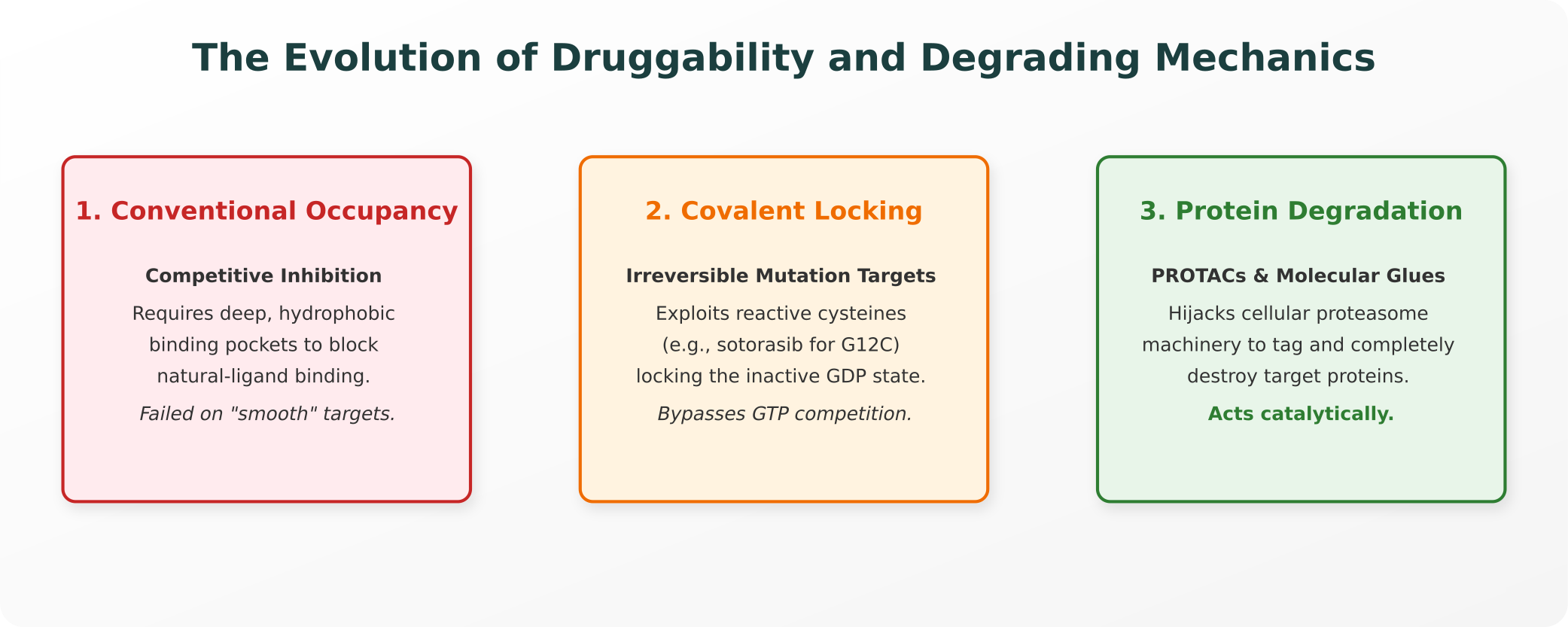
The Evolution of Druggability
The transition from competitive inhibition to catalytic degradation has fundamentally expanded the boundary of what counts as druggable:
1. Defining the "Undruggable" Proteome Precisely
In structural biology, a target protein is not classified as "undruggable" due to lack of interest or funding, but because of specific, well-defined biophysical characteristics:
- Smooth and Flat Surfaces: Many disease-driving proteins (particularly transcription factors and scaffolding proteins) lack the deep, hydrophobic pockets required to bind small-molecule drugs with high affinity and selectivity. Their surfaces are smooth, flat, and chemically inhospitable to conventional chemical designs [1].
- Extremely High Natural-Ligand Affinity: Some targets bind their natural substrates with exceptionally tight affinity (low-nanomolar or picomolar dissociation constants). To competitively block these substrates, a small-molecule drug would need to be administered at toxic concentrations, making competitive inhibition clinically impractical [1].
- Intrinsically Disordered Domains: Many transcriptional regulators and oncogenic signaling mediators contain large regions that do not fold into a stable 3D conformation in isolation. Because these regions are highly dynamic and flexible, they present no fixed structural coordinates for rational drug design [1].
Historically, these three biophysical traits have excluded massive, high-value families of therapeutic targets, including key oncogenes, transcription factor networks, and structural scaffolding proteins.
2. Breaking the KRAS Barrier: A Covalent Case Study
For over thirty years, the KRAS oncogene served as the classic archetype of the "undruggable" target. Mutated in approximately twenty percent of human cancers (including the vast majority of pancreatic, colorectal, and lung adenocarcinomas), KRAS was considered completely untargetable for three precise reasons [2]:
- It possesses an exceptionally smooth, spherical surface with no detectable hydrophobic active pockets.
- It binds its natural signaling substrate, GTP (guanosine triphosphate), with near-picomolar affinity.
- Because the intracellular concentration of GTP is extremely high, designing a molecule to competitively displace GTP was mathematically and biochemically impossible.
The Covalent Breakthrough
The breakthrough occurred when researchers identified an allosteric, sub-surface pocket (the switch-II pocket) that briefly opens when KRAS is in its inactive, GDP-bound state [2].
- The Mechanism: Rather than attempting to competitively displace GTP, scientists designed small molecules (such as sotorasib and adagrasib) that exploit a reactive cysteine residue specific to the KRAS G12C mutation. By forming an irreversible covalent bond with this cysteine, the drug locks KRAS in its inactive, GDP-bound state, preventing it from binding GTP and halting oncogenic downstream signaling [3, 4].
- The Clinical Reality: This structural insight led to landmark FDA approvals for KRAS G12C-positive non-small cell lung cancer [3, 4]. However, to maintain scientific integrity, researchers must acknowledge that these first-generation covalent inhibitors represent a modest victory rather than a complete solution. Clinical trials demonstrated modest progression-free survival benefits, and tumor resistance emerged rapidly through upregulation of wild-type RAS or secondary mutations in the switch-II pocket.
3. PROTACs: Hijacking Cellular Machinery
While covalent inhibitors successfully exploited mutation-specific cysteines, they still required some form of bindable pocket. To target flat, pocket-less proteins, drug design required a complete conceptual shift: moving from active-site occupancy to physical destruction.
This is the core principle of proteolysis-targeting chimeras (PROTACs), which represent a mechanistically distinct approach to therapeutics [5]:
- The Bifunctional Architecture: A PROTAC is a single, bifunctional molecule consisting of three components: a ligand that binds the target protein, a second ligand that binds an E3 ubiquitin ligase, and a chemical linker connecting the two.
- The Mechanism: By simultaneously binding both proteins, the PROTAC brings the target protein into close physical proximity with the E3 ligase. This proximity allows the ligase to transfer ubiquitin molecules onto the target protein [5]. Once tagged with a ubiquitin chain, the target protein is recognized and completely degraded by the cell's own quality-control machinery: the ubiquitin-proteasome system.
- The Catalytic Advantage: Unlike conventional inhibitors, which must remain bound to a target to block its function (requiring a 1:1 stoichiometric ratio), PROTACs act catalytically. Once a target protein is tagged and degraded, the PROTAC molecule dissociates intact, moving on to tag another target molecule. This allows a single PROTAC molecule to destroy thousands of target proteins, drastically lowering the required therapeutic dose.
- Clinical Milestones: The first PROTAC entered clinical trials in 2019. By late 2024, multiple oncology programs (such as ARV-471, targeting estrogen receptors in breast cancer) completed Phase III trials, establishing targeted protein degradation as a clinically validated modality [6].
4. Molecular Glues: Simpler, Smaller Degraders
While PROTACs are highly effective, their large, bifunctional structure often results in high molecular weights (typically above 800 Daltons), which can lead to poor cell permeability, variable oral bioavailability, and complex chemical synthesis.
Molecular glue degraders represent a simpler, monovalent alternative:
- The Mechanism: Unlike PROTACs, molecular glues are small, monovalent molecules that do not require dual-binding domains or linkers. Instead, the glue binds directly to either the E3 ligase or the target protein, modifying its physical surface topology. This structural modification induces a direct, highly specific protein-protein interaction (PPI) between the ligase and a target protein (often termed a "neosubstrate"), leading to ubiquitination and subsequent degradation.
- The Clinical Proof-of-Concept: While the discovery of many early molecular glues was accidental, their therapeutic power is already clinically validated. Lenalidomide and pomalidomide, which are standard-of-care treatments for multiple myeloma, work exactly as molecular glues. They bind to the E3 ligase cereblon, structurally altering its surface to selectively recruit and degrade key lymphoid transcription factors (IKZF1 and IKZF3), which were previously considered completely undruggable targets [7].
5. Shrinking the List: KRAS Mutant Degraders
The list of "undruggable" targets is shrinking rapidly as researchers combine covalent chemistry with targeted protein degradation:
- Reversible-Covalent PROTACs: In results published through 2024 and 2025, researchers have developed advanced, reversible-covalent PROTACs designed to target the KRAS G12C mutation. By pairing covalent chemistry with proteasomal degradation, these degraders achieve complete, durable clearance of the mutant protein, overcoming the resistance pathways that limit first-generation inhibitors [8].
- Targeting Non-G12C Mutants: While G12C has a reactive cysteine, other highly prevalent KRAS mutations (such as G12D or G12V) do not. In recent publications, researchers have successfully developed PROTAC-based degraders targeting KRAS G12D by utilizing highly selective, non-covalent ligands, demonstrating that targeted protein degradation can expand the druggability of formerly untargetable oncogenes regardless of cysteines [9].
6. Honest, Ongoing Challenges
Despite unprecedented momentum, the field of targeted protein degradation faces severe structural and biochemical limitations:
- Serendipity vs. Rational Design: While PROTAC design has become highly structured, the discovery of molecular glues remains largely serendipitous. Screening libraries to identify molecules that fortuitously induce a direct protein-protein interaction is an incredibly slow process, and rational design rules for molecular glues are still actively being established.
- Selectivity and Safety Risks: Because degraders hijack systemic cellular machinery, any off-target degradation can lead to severe, irreversible toxicity. For example, recruiting the wrong neosubstrate or degrading a target in healthy tissues can drive catastrophic clinical side effects, making selectivity the absolute priority of ADC and degrader design.
- Clinical Translation Barriers: Translating early degrader success from breast and prostate cancers into broader clinical validation remains a major hurdle. Complex tissue-specific exposure, cellular resistance (such as mutations in the E3 ligase machinery), and manufacturing complexity under strict GMP guidelines remain significant, unresolved challenges.
By continuing to investigate these biophysical and clinical boundaries with absolute scientific rigor, researchers are transforming "undruggable" targets from speculative scientific concepts into highly reliable, life-saving precision medicines.
References
- Hopkins, A. L., & Groom, C. R. (2002). The druggable genome. Nature Reviews Drug Discovery, 1(9), 727–730. https://doi.org/10.1038/nrd892
- Ostrem, J. M., et al. (2013). K-Ras(G12C) inhibitors allosterically control GTP affinity and effector interactions. Nature, 503(7477), 548–551. https://doi.org/10.1038/nature12796
- Skoulidis, F., et al. (2021). Sotorasib for Lung Cancers with KRAS p.G12C Mutation. New England Journal of Medicine, 384(25), 2371–2381. https://doi.org/10.1056/NEJMoa2103695
- Jänne, P. A., et al. (2022). Adagrasib in Non–Small-Cell Lung Cancer Harboring a KRASG12C Mutation. New England Journal of Medicine, 387(2), 120–131. https://doi.org/10.1056/NEJMoa2204619
- Sakamoto, K. M., et al. (2001). Protacs: Chimeric molecules that target proteins to the Skp1-Cullin-F-box (SCF) E3 ubiquitin ligase for degradation. Proceedings of the National Academy of Sciences, 98(15), 8554–8559. https://doi.org/10.1073/pnas.141230798
- Hamilton, E. P., et al. (2025). Vepdegestrant, a PROTAC Estrogen Receptor Degrader, in Advanced Breast Cancer. New England Journal of Medicine. https://doi.org/10.1056/NEJMoa2505725
- Krönke, J., et al. (2014). Lenalidomide Causes Selective Degradation of IKZF1 and IKZF3 by Recruiting Cereblon to the CRL4CRBN Ubiquitin Ligase. Science, 343(6168), 301–305. https://doi.org/10.1126/science.1244851
- Bond, M. J., et al. (2020). LC-2, the First-in-Class Endogenous KRAS G12C PROTAC Degrader. ACS Central Science, 6(8), 1367–1375. https://doi.org/10.1021/acscentsci.0c00411
- Hallin, J., et al. (2022). The KRASG12D Inhibitor MRTX1133 Is Highly Potent and Selective and Shows Robust Tumor Activity in KRASG12D-Mutant Cancer Models. Cancer Discovery, 12(10), 2382–2398. https://doi.org/10.1158/2159-8290.CD-22-0411
Explore Purna's Molecular Intelligence Platform
AI-powered workspace for biology teams to accelerate drug discovery from target identification to lead optimization.
Try Purna AI →