Antibody-Drug Conjugates: The Quiet Revolution Reshaping Oncology
The history of cancer treatment is defined by a continuous struggle between therapeutic efficacy and systemic toxicity. For decades, traditional chemotherapy has served as a primary weapon against malignant cells. However, because systemic chemotherapeutic agents lack cellular specificity, they destroy rapidly dividing healthy tissues alongside cancerous ones, resulting in severe, dose-limiting side effects that frequently compromise patient outcomes.
In recent years, the maturation of advanced targeted therapeutics has enabled a highly precise biological class of drugs: antibody-drug conjugates. By combining the exquisite, target-seeking specificity of monoclonal antibodies with the high cytotoxic potency of small-molecule payloads, this class aims to deliver toxic agents directly to cancer cells while sparing healthy surrounding tissues, addressing the primary limitation of traditional oncology regimens.
Today, this is one of oncology’s fastest-growing drug classes. Global market estimates for ADC oncology therapies sit in the $13 billion to $19 billion range [1], with 15 FDA-approved conjugates commercially available as of early 2026 [2].
This article establishes a rigorous, scientific overview of how ADCs work, examines the biochemistry of their three core components, analyzes the clinical significance of the bystander effect, and outlines the ongoing engineering challenges shaping the future of ADC drug design.
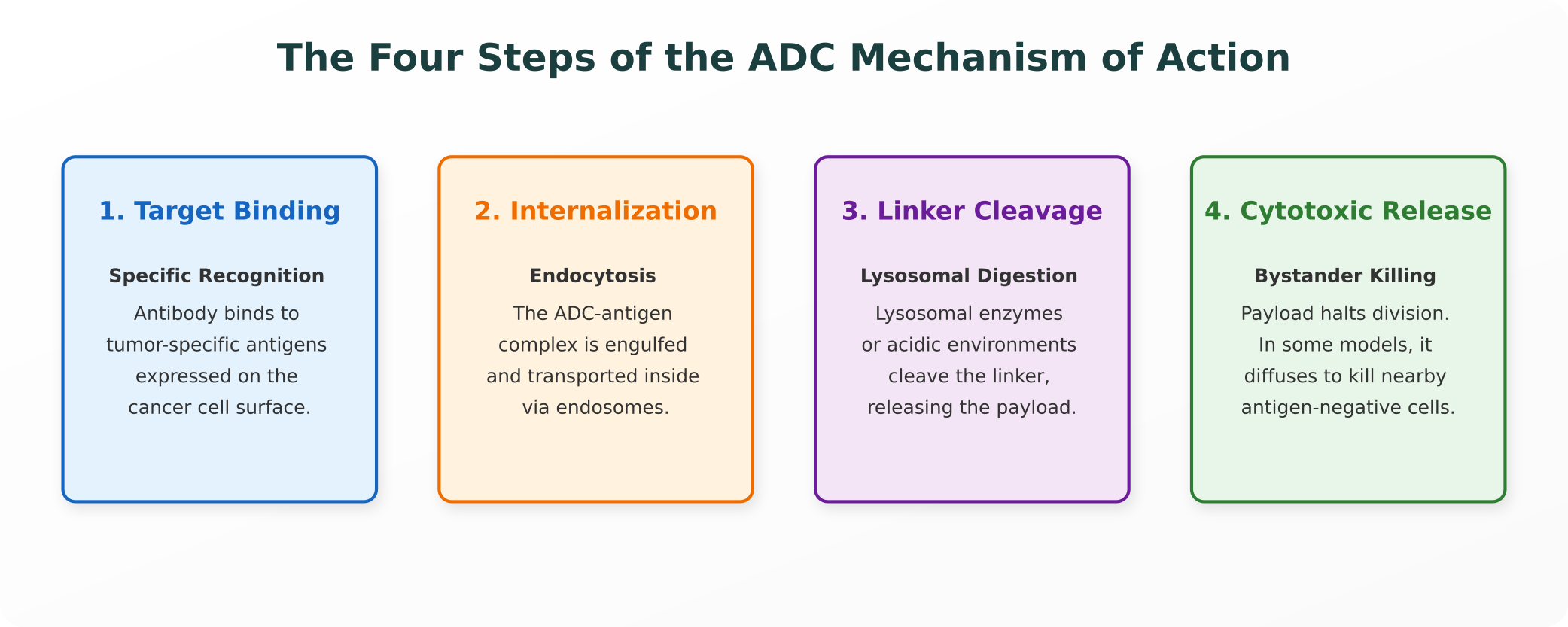
The Four Steps of the ADC Mechanism
The delivery of a cytotoxic payload specifically to a target tumor cell is a multi-step biological process:
1. The Three Core Components and Their Mechanism of Action
An antibody-drug conjugate is a tripartite molecule. Its therapeutic efficacy is dictated by the precise chemical optimization and integration of its three constituent parts [2]:
- The Antibody: A highly selective monoclonal antibody (mAb) designed to target a tumor-associated antigen expressed in high abundance on the surface of cancer cells, with minimal expression in healthy tissues.
- The Cytotoxic Payload: A highly potent small-molecule drug, typically far too toxic to be administered systemically on its own (such as microtubule inhibitors or DNA-damaging agents).
- The Linker: The chemical bridge that covalently binds the payload to the antibody, designed to remain completely stable in systemic circulation while enabling rapid, controlled release of the payload once inside the target cell.
The Mechanism of Action
When an ADC is administered, its therapeutic journey follows a sequential path:
- Antigen Binding: The antibody component binds with high affinity to its specific target antigen on the cancer cell membrane.
- Internalization: The bound complex is engulfed by the cell membrane and internalized into the cytoplasm via receptor-mediated endocytosis, forming an intracellular vesicle called an endosome.
- Lysosomal Fusion: The endosome fuses with a lysosome, an intracellular organelle filled with acidic enzymes.
- Payload Release: Lysosomal enzymes degrade the antibody or cleave the linker, releasing the active cytotoxic payload. The released drug then diffuses into the nucleus or cytoplasm, where it halts cell division or damages DNA, driving the cancer cell to undergo apoptosis.
Cleavable vs. Non-Cleavable Linkers
In ADC drug design, selecting the appropriate linker is a critical decision that directly affects therapeutic consistency [2]:
- Cleavable Linkers: Utilized in the majority of approved ADCs, these bridges rely on physiological triggers (such as acidic pH in lysosomes or specific intracellular protease cleavage) to release the payload. They are highly efficient at releasing active drugs once internalized, but require careful design to prevent premature cleavage in systemic circulation.
- Non-Cleavable Linkers: These links require complete degradation of the antibody backbone by lysosomal enzymes to release the payload, which remains attached to an amino acid residue (such as lysine or cysteine). Non-cleavable linkers offer exceptional systemic stability and lower off-target toxicity, but their efficacy depends heavily on the cell’s ability to completely degrade the antibody.
2. The Bystander Effect: A Critical Engineering Tradeoff
In clinical oncology, tumors are rarely uniform. The expression of target antigens is often highly heterogeneous, meaning a tumor mass contains a mixture of antigen-positive and antigen-negative cells. If an ADC only killed cells that expressed the target antigen, surviving antigen-negative cells would quickly replicate, driving treatment resistance.
To solve this, advanced ADCs utilize a mechanism known as the bystander effect [2]:
- The Mechanism: Once the linker is cleaved inside an antigen-positive cancer cell, the released cytotoxic payload (if it is uncharged and hydrophobic) can diffuse across the cell membrane into the extracellular space.
- The Clinical Impact: The active payload then penetrates neighboring, antigen-negative tumor cells, killing them even though they were never directly targeted by the antibody. This property is highly valuable for overcoming tumor heterogeneity.
- The Engineering Tradeoff: While the bystander effect is exceptionally powerful in heterogeneous tumors, it introduces a major safety risk. The diffusing payload can also cross into nearby healthy tissue, causing off-target toxicities (such as neutropenia or ocular damage). Conversely, non-bystander ADCs (such as ARX788, which utilizes highly stable, non-cleavable linkers and hydrophilic payloads) offer a significantly improved safety profile but are limited to highly homogeneous tumor environments. Balancing bystander potency against systemic safety remains one of the field’s unresolved engineering challenges.
3. The Evolution Across Generations
The clinical utility of ADCs has advanced through three distinct engineering phases [2]:
- First Generation: Early ADCs utilized less controlled, stochastic conjugation chemistries, where payloads were randomly attached to lysine or cysteine residues on the antibody. This resulted in highly heterogeneous mixtures with variable Drug-to-Antibody Ratios (DAR ranging from 0 to 8). This lack of uniform DAR meant some molecules carried too much payload (inducing severe toxicity) while others carried none (resulting in sub-therapeutic dosing).
- Second Generation: Improved linker stability and payload design, coupled with more selective conjugation, resulted in better DAR control (typically averaging 4). However, off-target toxicity remained a major barrier.
- Third Generation (Current): Advanced conjugation technologies (such as site-specific conjugation and engineered amino acids) enable precise control of DAR (for example, achieving a uniform DAR of exactly 8 in trastuzumab deruxtecan). This uniform drug loading ensures consistent pharmacokinetics, predictable therapeutic activity, and a wider therapeutic window.
4. Real-World Clinical Milestones
The success of modern ADC oncology is anchored in several rigorously validated, approved therapeutics:
- Trastuzumab Deruxtecan (Enhertu): A HER2-directed ADC utilizing a cleavable linker and a topoisomerase I inhibitor payload. It has demonstrated efficacy in HER2-expressing solid tumors (including breast, gastric, and lung cancers), establishing the viability of targeting HER2-low tumors due to its highly potent bystander effect [3].
- Sacituzumab Govitecan (Trodelvy): Targets Trop-2 and delivers an active metabolite of irinotecan (SN-38). Its approval for triple-negative and hormone receptor-positive metastatic breast cancer was validated by landmark trials, including the ASCENT [4] and TROPiCS-02 [5] clinical studies, which showed significant progression-free survival benefits in pre-treated populations.
- Enfortumab Vedotin (Padcev): Targets Nectin-4 and delivers the microtubule-disrupting agent MMAE. Its pivotal Phase 3 EV-301 trial [6] demonstrated a significant overall survival benefit in patients with advanced urothelial carcinoma compared to standard chemotherapy.
- Belantamab Mafodotin (Blenrep): A BCMA-directed ADC carrying a microtubule inhibitor payload, validated in the DREAMM-7 trial [7] for relapsed or refractory multiple myeloma, demonstrating the efficacy of advanced conjugates in hematological malignancies.
5. Unresolved Engineering Challenges
Despite clear clinical progress, several systemic bottlenecks remain the focus of active structural biology and clinical research:
- Resistance Mechanisms: Cancer cells can develop resistance by downregulating target antigen expression, mutating the antigen structure, altering lysosomal processing pathways, or upregulating efflux pumps that actively expel the cytotoxic payload.
- The Safety-Potency Balance: Optimizing linkers to prevent any premature systemic leakage while ensuring rapid, complete cleavage inside the tumor lysosome remains a delicate biochemical challenge.
- Manufacturing and CMC Complexity: ADCs are structurally complex biomolecules. Synthesizing, purifying, and validating a sterile, stable conjugate with a uniform DAR under strict GMP (Good Manufacturing Practice) standards is exceptionally difficult and costly, limiting global patient access.
By continuing to investigate these biophysical and clinical barriers with absolute scientific rigor, researchers are turning antibody-drug conjugates from speculative target-delivery models into highly reliable, life-saving oncology therapeutics.
References
- Grand View Research. (2024). Antibody-Drug Conjugates Market Size, Share & Trends Analysis Report By Application (Blood Cancer, Breast Cancer, Urothelial/Bladder Cancer), By Technology (Cleavable, Non-cleavable), By Payload Technology, and Segment Forecasts 2024 - 2030. Grand View Research. Report ID: GVR-4-68039-315-8.
- Molecular Cancer. (2025). Antibody-drug conjugates in cancer therapy: current landscape, challenges, and future directions. Molecular Cancer, 24(15). https://doi.org/10.1186/s12943-025-02489-2
- Modi, S., et al. (2022). Trastuzumab Deruxtecan in Previously Treated HER2-Low Advanced Breast Cancer. New England Journal of Medicine, 387(1), 9–20. https://doi.org/10.1056/NEJMoa2203690
- Bardia, A., et al. (2021). Sacituzumab Govitecan in Metastatic Triple-Negative Breast Cancer. New England Journal of Medicine, 384(16), 1529–1541. https://doi.org/10.1056/NEJMoa2028485
- Rugo, H. S., et al. (2022). Sacituzumab Govitecan in Hormone Receptor-Positive/Human Epidermal Growth Factor Receptor 2-Negative Metastatic Breast Cancer (TROPiCS-02). Journal of Clinical Oncology, 40(33), 3365–3376. https://doi.org/10.1200/JCO.22.01002
- Powles, T., et al. (2021). Enfortumab Vedotin in Previously Treated Advanced Urothelial Carcinoma. New England Journal of Medicine, 384(12), 1125–1135. https://doi.org/10.1056/NEJMoa2035807
- Mateos, M. V., et al. (2024). Belantamab Mafodotin, Bortezomib, and Dexamethasone for Multiple Myeloma (DREAMM-7). New England Journal of Medicine. https://doi.org/10.1056/NEJMoa2400155
Explore Purna's Molecular Intelligence Platform
AI-powered workspace for biology teams to accelerate drug discovery from target identification to lead optimization.
Try Purna AI →