Biomedical Literature Synthesis: A Practical Workflow for Disease and Drug Discovery Research
Modern biomedical research produces an overwhelming volume of information. Tens of thousands of scientific papers, preprints, and clinical trial results are published weekly. For research teams seeking to identify novel therapeutic targets, understanding this vast ocean of data is a major challenge. The solution lies in structured biomedical literature synthesis, a systematic process that transforms raw unstructured texts into actionable biological networks and validated hypotheses.
Traditionally, gathering and synthesizing literature has been a highly manual, error-prone task. Biologists spend days querying databases, downloading PDFs, and manually extracting relationships between genes and diseases. This guide outlines a structured, reproducible 4-stage workflow for biomedical literature synthesis that combines modern information extraction techniques with biological reasoning.
The 4-Stage Literature Synthesis Workflow
To systematically convert unstructured text into therapeutic insight, research teams need a robust, sequential pipeline. This workflow structures raw papers into structured evidence, as illustrated in the following diagram:
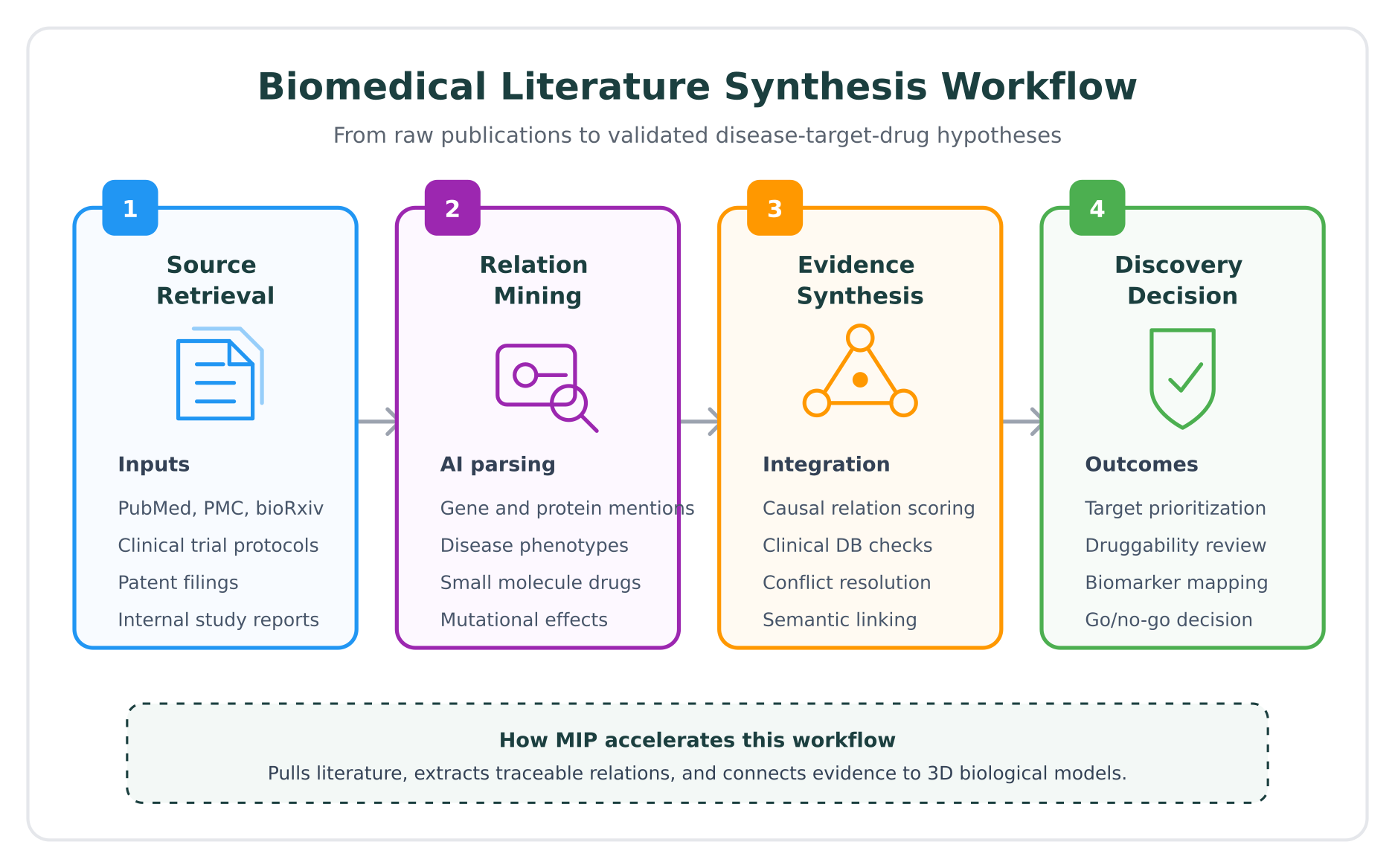
This pipeline consists of four essential stages, transitioning from raw data to actionable hypotheses:
Stage 1: Disease Biology Landscape Synthesis
Before identifying specific drug targets, researchers must establish a comprehensive baseline of the disease itself. This stage focuses on understanding the molecular mechanisms, patient sub-population heterogeneity, unmet medical needs, and the current treatment landscape.
- Sources to Synthesize: Key sources include disease-specific natural history registries, clinical trial data, epidemiological studies, global health surveys, and diagnostic guidelines.
- The Goal: Define the disease-driving pathways, identify where current standard-of-care therapies fail, and establish the specific clinical phenotypes that a new therapeutic candidate must address.
- Common Pitfall: Relying too heavily on outdated clinical review papers. Review articles, while useful, are often static and can lag years behind current natural history databases and patient registries, leading to a mischaracterized understanding of patient sub-population needs.
Stage 2: Target Identification & Validation Synthesis
With the disease landscape established, the workflow transitions to identifying and validating candidate molecular targets. This stage involves compiling genetic, functional, and mechanistic evidence linking a candidate target to the disease.
- Sources to Synthesize: Researchers typically integrate genome-wide association studies (GWAS), functional genomic screens (such as CRISPR or RNAi knockdowns), proteomic mass spectrometry datasets, and peer-reviewed molecular biology journals.
- The Goal: Build a robust biological hypothesis linking target modulation (either inhibition or activation) with disease modification.
- Common Pitfall: Overweighting correlative genetic evidence as if it were causal. Finding a genomic variant associated with a disease in a GWAS is only an association. It is a critical error to treat this as definitive target validation without confirming the downstream functional and mechanistic impact of that variant in disease-relevant cell models.
Stage 3: Cross-Modality Evidence Synthesis
Once a target is validated mechanistically, researchers must look beyond the primary biology to evaluate the broader therapeutic feasibility. This stage synthesizes the competitive landscape, preclinical safety signals, and biomarker evidence.
- Sources to Synthesize: Essential resources include peer-reviewed safety and toxicology literature, structural biology databases (such as the Protein Data Bank), patent filings, and clinical trial results of similar molecular classes.
- The Goal: Assess target tractability (druggability), identify early safety red flags, evaluate translation markers, and map the competitive landscape.
- Common Pitfall: Ignoring preclinical safety warnings or toxicity signals from related, discontinued chemical classes. Researchers often focus on the potential efficacy of their target while underestimating reported safety issues in knockout models or related structural classes, which can lead to costly late-stage failures.
Stage 4: From Synthesis to Drug Discovery Decision
The final stage is translating the accumulated, synthesized evidence into an actual, objective go/no-go research decision. Rather than ending with a passive literature summary, this step uses structured criteria to decide whether to advance a program into active chemical synthesis or lead optimization.
- Sources to Synthesize: This decision-making step compiles target prioritization matrices, safety risk assessments, chemical feasibility scores, and IP/patent freedom-to-operate analyses.
- The Goal: Define clear, pre-established criteria (such as minimum druggability scores, acceptable toxicology profiles, and clear biomarker paths) to justify starting a wet-lab drug discovery campaign.
- Common Pitfall: Failing to establish objective, pre-defined quantitative criteria for “Go” decisions. Without rigid, pre-defined gates, teams are susceptible to confirmation bias, often continuing to fund unproductive targets simply because of emotional or financial investment in the initial hypothesis.
How Evidence Synthesis AI Accelerates the Pipeline
Integrating evidence synthesis AI into this 4-stage pipeline fundamentally changes how researchers validate complex biological mechanisms. Rather than simply retrieving documents, domain-specific AI models can reason across synthesized literature to construct cohesive mechanistic hypotheses.
For example, when evaluating a disease like amyotrophic lateral sclerosis (ALS), an AI system can analyze thousands of publications to trace pathways from genetic variants to mitochondrial dysfunction. It does this by extracting causal relationships across separate papers:
| Source Publication | Extracted Causal Link |
|---|---|
| Journal of Cell Biology, 2024 | Variant A in gene X causes mislocalization of protein Y. |
| Brain Research, 2025 | Mislocalization of protein Y disrupts mitochondrial import complex Z. |
| Nature Neuroscience, 2026 | Impairment of complex Z leads to neuronal apoptosis in ALS models. |
By linking these disparate findings, the AI synthesizes a complete pathway that no single paper described. This capability is critical for generating valid disease mechanism hypotheses from genes, variants, and literature. It provides researchers with a clear, evidence-backed framework for their experimental designs, allowing them to focus resources on the most promising pathways. Detailed workflows for structuring these analyses can be found in our guide on AI hypothesis generation in biology.
Applying Disease Literature Synthesis to Target Prioritization
Once a biological pathway is mapped, the next challenge is selecting and prioritizing the best node in that pathway to target therapeutically. This is where disease literature synthesis is applied to evaluate target tractability, safety, and novelty.
By scoring target candidates using synthesized literature data, research teams can avoid subjective bias and construct a prioritized list of candidates. This approach is highly complementary to traditional computational screening methods, as discussed in our review of drug target identification methods. Integrating text mining with structural biology is particularly effective for prioritizing targets from disease biology to lead candidates.
Accelerating Literature Synthesis with Molecular Intelligence
The ultimate goal of literature synthesis is not just to gather text, but to ground that text in hard biological reality. This is the core principle of molecular intelligence, domain-trained AI that reasons across biological databases, literature, and physical structures in a single workspace.
Rather than treating literature as an isolated data silo, a molecular intelligence platform integrates text-extracted relations with physical structural data and clinical records:
- Text Mining: The system extracts a relationship stating that a specific missense mutation in a receptor disrupts ligand binding.
- Structural Validation: The platform pulls the 3D structure of the receptor-ligand complex from the Protein Data Bank (PDB) and visualizes the mutated residue.
- Biophysical Simulation: It runs stability and binding energy predictions to computationally verify whether the physical structure supports the literature assertion.
- Clinical Verification: It queries clinical databases like ClinVar and gnomAD to check if the mutation is observed in patient populations and what phenotypes are reported.
By combining literature synthesis with multi-omics and structural data in a single interface, researchers can validate findings in seconds rather than days. This eliminates manual tool-switching and ensures every hypothesis is backed by both literature evidence and physical biochemistry.
MIP is Purna AI’s Molecular Intelligence Platform, an AI-powered workspace for biology teams. Variant interpretation, protein structure prediction, code execution, and 30+ database integrations in one environment. Explore the platform at purna.ai.
Research teams looking to integrate advanced literature synthesis and biological reasoning into their workflows can apply for up to $10,000 in free MIP credits to evaluate the platform on their own research targets.
Explore Purna's Molecular Intelligence Platform
AI-powered workspace for biology teams to accelerate drug discovery from target identification to lead optimization.
Try Purna AI →