AI Hypothesis Generation in Biology: A Practical Framework for Researchers
AI hypothesis generation is useful in biology when it helps researchers move from scattered evidence to specific, testable mechanisms. It is not useful when it simply turns a literature summary into a confident-sounding claim.
For scientists, the key question is practical: can AI help identify plausible disease hypotheses, mechanism hypotheses, biomarker hypotheses, or target hypotheses while preserving citations, uncertainty, and experimental next steps? The answer is yes, but only if the workflow treats AI as an evidence organizer and reasoning aid rather than an automated conclusion engine.
This guide gives researchers a measured framework for using AI hypothesis generation in biology. It covers what AI can contribute, where causal reasoning can go wrong, how to turn evidence into experiments, and how a molecular intelligence workspace can make the process more reviewable.
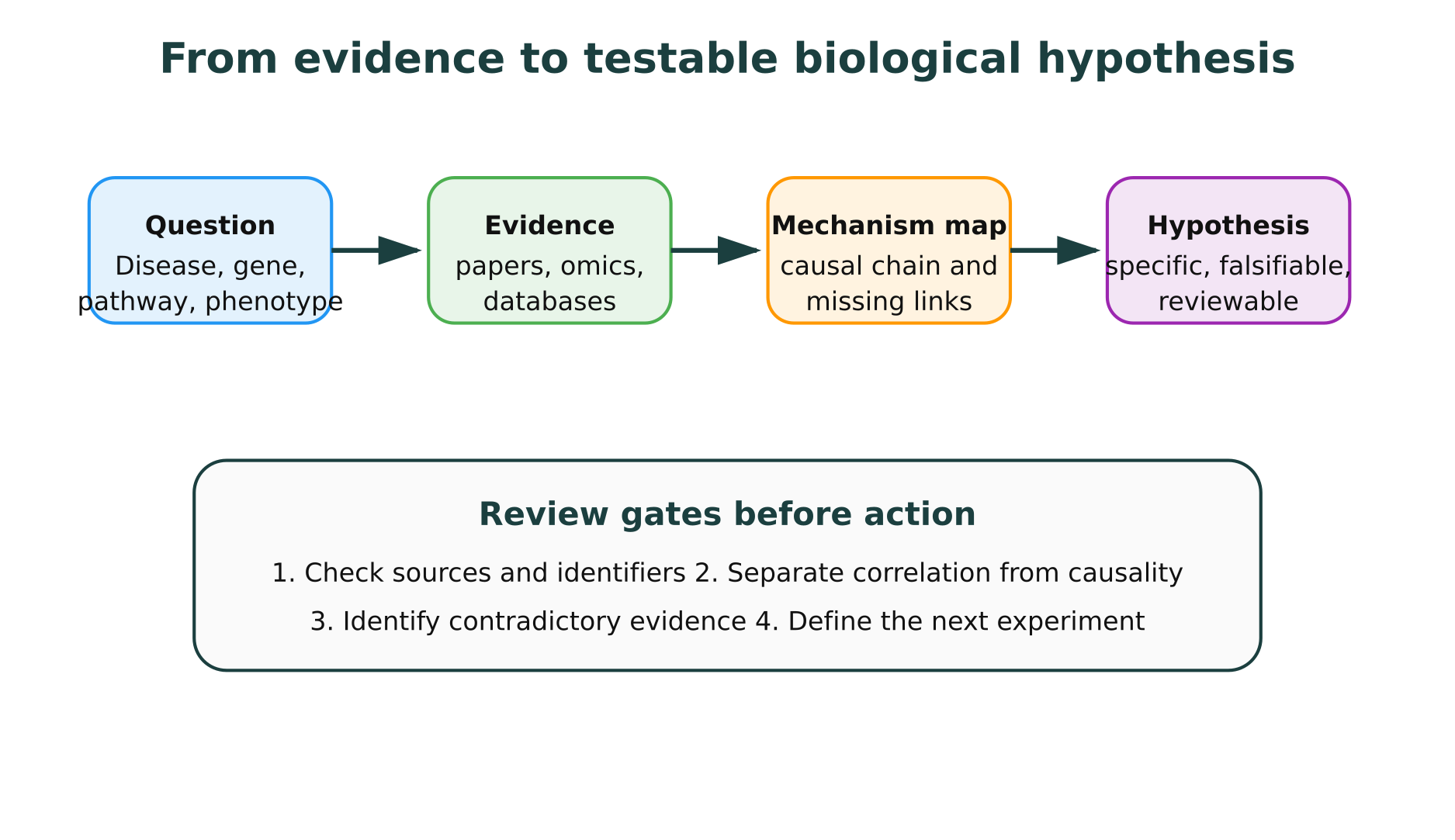
flowchart LR
  A["Scoped biological question"] --> B["Retrieve papers, databases, and data"]
  B --> C["Evidence map"]
  C --> D["Several candidate hypotheses"]
  D --> E["Discriminating experiments"]
  E --> F["Scientist review and revision"]
  C --> G["Contradictions and unknowns"]
  G --> D

  classDef question fill:#e0f7fa,stroke:#1b3f3f,color:#000000;
  classDef evidence fill:#fff3e0,stroke:#1b3f3f,color:#000000;
  classDef review fill:#f3e5f5,stroke:#1b3f3f,color:#000000;
  class A question;
  class B,C,G evidence;
  class D,E,F review;
Why AI hypothesis generation matters in biology
Biology is full of partial evidence. A gene is differentially expressed in a disease cohort. A GWAS locus points to a noncoding region. A missense variant affects a conserved residue. A pathway is enriched in single-cell data. A paper reports a perturbation effect in one model system, but another study reports a weaker result.
A scientist’s job is to turn these fragments into an explanation that can be tested. That work is difficult because the evidence is distributed across literature, databases, assays, species, tissues, and molecular scales. AI can reduce the mechanical burden of finding and organizing the evidence, but it must keep the scientific burden visible.
The idea is not new. Don Swanson’s 1986 paper in Perspectives in Biology and Medicine on fish oil and Raynaud’s syndrome introduced a classic example of literature-based discovery, where disconnected bodies of biomedical literature suggested a new hypothesis. Modern systems have more data, stronger retrieval, knowledge graphs, embeddings, and large language models, but the underlying scientific discipline is the same: connect what is known, identify what is missing, and propose what should be tested.
In 2024, Cell published a perspective on biomedical discovery with AI agents, reflecting a broader shift from single-step search tools toward systems that can retrieve evidence, plan analyses, call tools, and iterate. That direction is promising for biology, but it also increases the need for audit trails. A multi-step AI system can be more useful than a chatbot, and it can also hide more assumptions if not designed carefully.
For broader context on connected biological reasoning, see our pillar guide to what molecular intelligence means and our overview of AI tools for biology research.
What counts as a good biological hypothesis?
A biological hypothesis should be specific enough to be wrong. If it cannot be tested, contradicted, scoped, or revised, it is probably not yet a hypothesis. It may be a theme, association, or research direction.
A useful hypothesis usually has five parts:
- Biological object: gene, variant, pathway, cell type, protein domain, metabolite, target, or phenotype.
- Mechanism: the proposed causal or explanatory relationship.
- Context: tissue, disease stage, population, model system, perturbation, or assay condition.
- Evidence basis: papers, databases, omics results, structural evidence, or prior experiments.
- Next test: the experiment or analysis that would strengthen, weaken, or falsify the claim.
For example, “IL-33 is involved in asthma” is not a strong hypothesis. A stronger version would be: “In severe eosinophilic asthma, epithelial IL-33 release increases type 2 inflammation and airway remodeling through ST2-positive immune cells, and blocking this axis should reduce remodeling markers in an airway organoid co-culture model.” That statement may still be incomplete, but it specifies mechanism, context, and a test.
A practical framework for AI hypothesis generation
AI driven hypothesis generation works best as a staged workflow. Each stage should produce an intermediate artifact that a scientist can inspect. Avoid workflows where a model reads a prompt and outputs a final mechanism without showing retrieval, evidence selection, or uncertainty.
Step 1: Frame the biological question
Start with a question that names the biological decision. Good prompts are not vague requests to “generate hypotheses.” They specify the system being studied and the evidence that should matter.
Examples:
- “Given these genes upregulated in fibrotic lung tissue, propose mechanisms that connect epithelial injury to fibroblast activation. Separate human cohort evidence from mouse model evidence.”
- “For this rare missense variant, generate hypotheses for loss of function or gain of function using protein domain context, conservation, and available literature.”
- “Given this candidate target for inflammatory bowel disease, summarize evidence for causal disease relevance, safety liabilities, and tractability, then propose validation experiments.”
This resembles the discipline needed for natural language bioinformatics: plain language is powerful only when it is specific enough to route to the right databases, tools, and review steps.
Step 2: Retrieve evidence from the right sources
AI hypothesis generation should begin with retrieval, not imagination. The system should gather relevant literature, curated database records, omics results, pathway annotations, protein information, and prior perturbation studies.
The right sources depend on the question:
| Hypothesis type | Useful evidence sources | Common weak spots |
|---|---|---|
| Disease mechanism | PubMed, OMIM, DisGeNET, Monarch, pathway databases, model organism data | Species mismatch, correlative studies, disease-stage ambiguity |
| Biomarker hypothesis | Cohort omics, assay metadata, tissue specificity, clinical endpoints | Batch effects, leakage, confounding, lack of validation cohort |
| Drug target hypothesis | Genetics, expression, pathway position, perturbation data, tractability, safety | Causality, tissue exposure, redundancy, toxicity |
| Variant mechanism | ClinVar, gnomAD, UniProt, PDB, AlphaFold, conservation, functional assays | Transcript errors, model confidence, overinterpreting predictors |
| Protein function | Domains, structures, interactions, active sites, sequence conservation, papers | Missing cofactors, wrong biological assembly, disorder |
Several biomedical knowledge resources illustrate why provenance matters. DisGeNET’s 2019 update, published in Nucleic Acids Research in 2020, aggregates gene-disease associations from multiple sources. The next-generation Open Targets Platform, published in Nucleic Acids Research in 2023, integrates target-disease evidence for drug discovery. The Monarch Initiative’s 2024 Nucleic Acids Research update emphasizes phenotype, gene, and disease integration across species. These resources are useful, but none eliminates the need to inspect evidence type and context.
Step 3: Build an evidence map before writing hypotheses
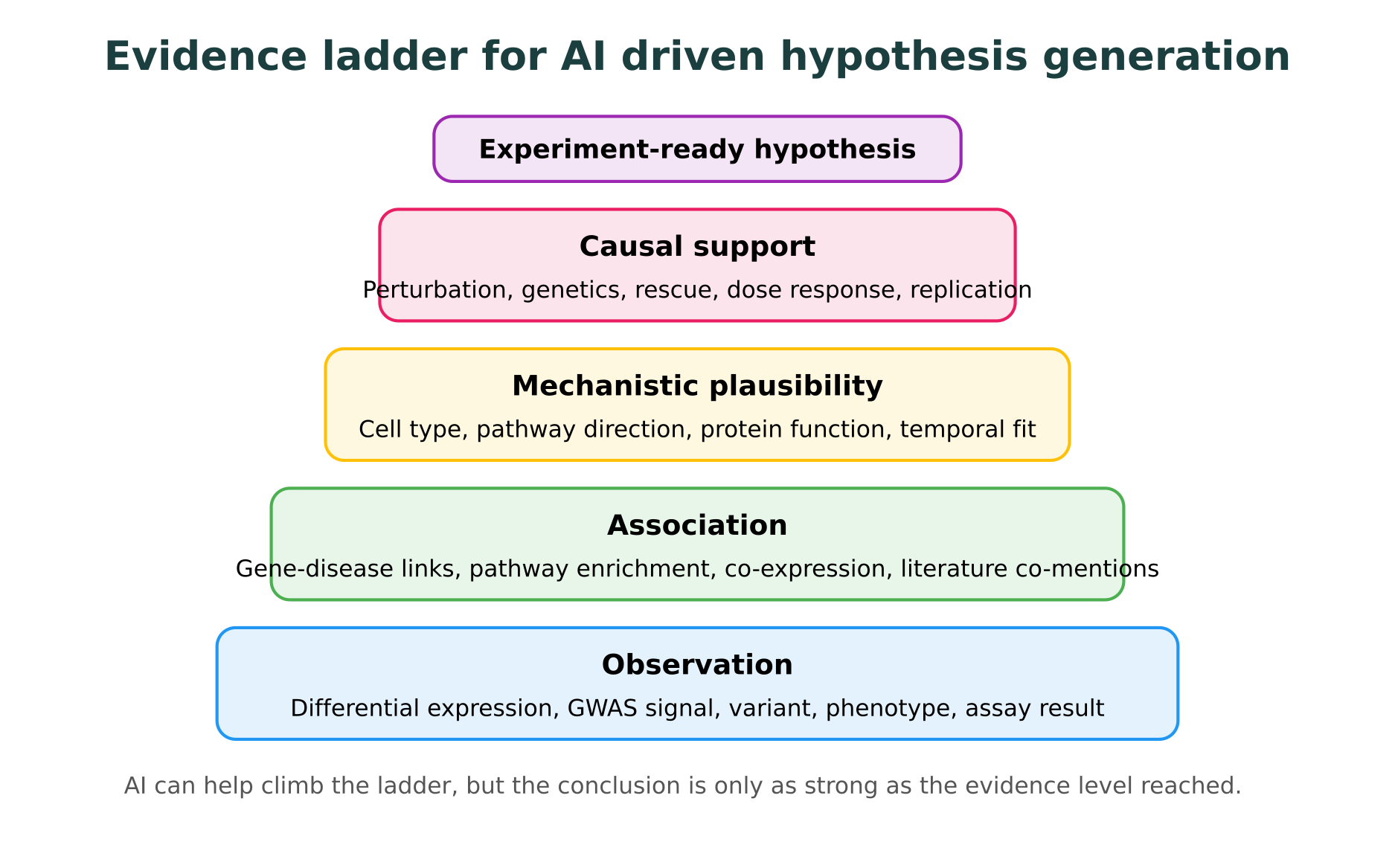
Before generating hypotheses, ask the system to create an evidence map. This should separate observations, associations, mechanistic evidence, contradictions, and missing data.
A simple evidence map can include:
- Observed signal: what was measured, in which system, with what assay.
- Entity normalization: gene symbols, variants, proteins, diseases, tissues, and species.
- Supporting evidence: records and papers that support the relationship.
- Contradictory evidence: papers, datasets, or model systems that do not agree.
- Causal anchors: perturbation, genetics, rescue, temporal sequence, or dose response.
- Unknowns: missing tissues, missing time points, uncertain cell type, absent validation.
This step prevents a common AI failure mode: compressing mixed evidence into a single confident paragraph. In biology, contradictions are not noise to be smoothed away. They are often the signal that defines the boundary conditions of the hypothesis.
Step 4: Generate several hypotheses, not one answer
AI is most useful when it expands the hypothesis space in a structured way. Ask for several candidate mechanisms with evidence, weaknesses, and discriminating experiments.
A useful output might compare hypotheses like this:
| Candidate hypothesis | Why it is plausible | What would weaken it | Next experiment |
|---|---|---|---|
| Pathway activation drives phenotype | Enrichment, pathway literature, perturbation signal | No temporal relationship, weak cell-type specificity | Perturb pathway in relevant cell model and measure phenotype |
| Observed gene is a compensatory response | Expression increases after injury, not before | Knockdown worsens phenotype in disease model | Time-course perturbation with injury markers |
| Variant disrupts protein stability | Conserved buried residue, structural model, predicted ΔΔG shift | Functional assay normal, low-confidence structure | Compare wild type and mutant stability and localization |
| Biomarker reflects cell composition | Marker tracks with cell-type abundance | Signal remains after deconvolution and sorted cells | Validate in sorted cells or spatial assay |
The goal is not to pick the most attractive story. The goal is to identify the hypotheses that are both biologically plausible and experimentally distinguishable.
Step 5: Convert hypotheses into reviewable experiments
A hypothesis that does not point to a test is unfinished. AI can help propose experiments, but scientists should review feasibility, controls, model system relevance, statistical power, and ethical constraints.
For each hypothesis, require:
- Primary experiment: the direct test.
- Positive and negative controls: what would validate the assay.
- Readout: molecular, cellular, structural, phenotypic, or clinical endpoint.
- Expected direction: what result would support the hypothesis.
- Alternative interpretation: what else could explain the result.
- Replication plan: independent cohort, orthogonal assay, second model, or public dataset.
This is where AI can be valuable for research planning. It can suggest perturbations, assays, cell types, model systems, public datasets, and decision points. It cannot know all practical constraints in a lab, and it cannot replace experimental judgment.
What AI can automate, and what scientists must review
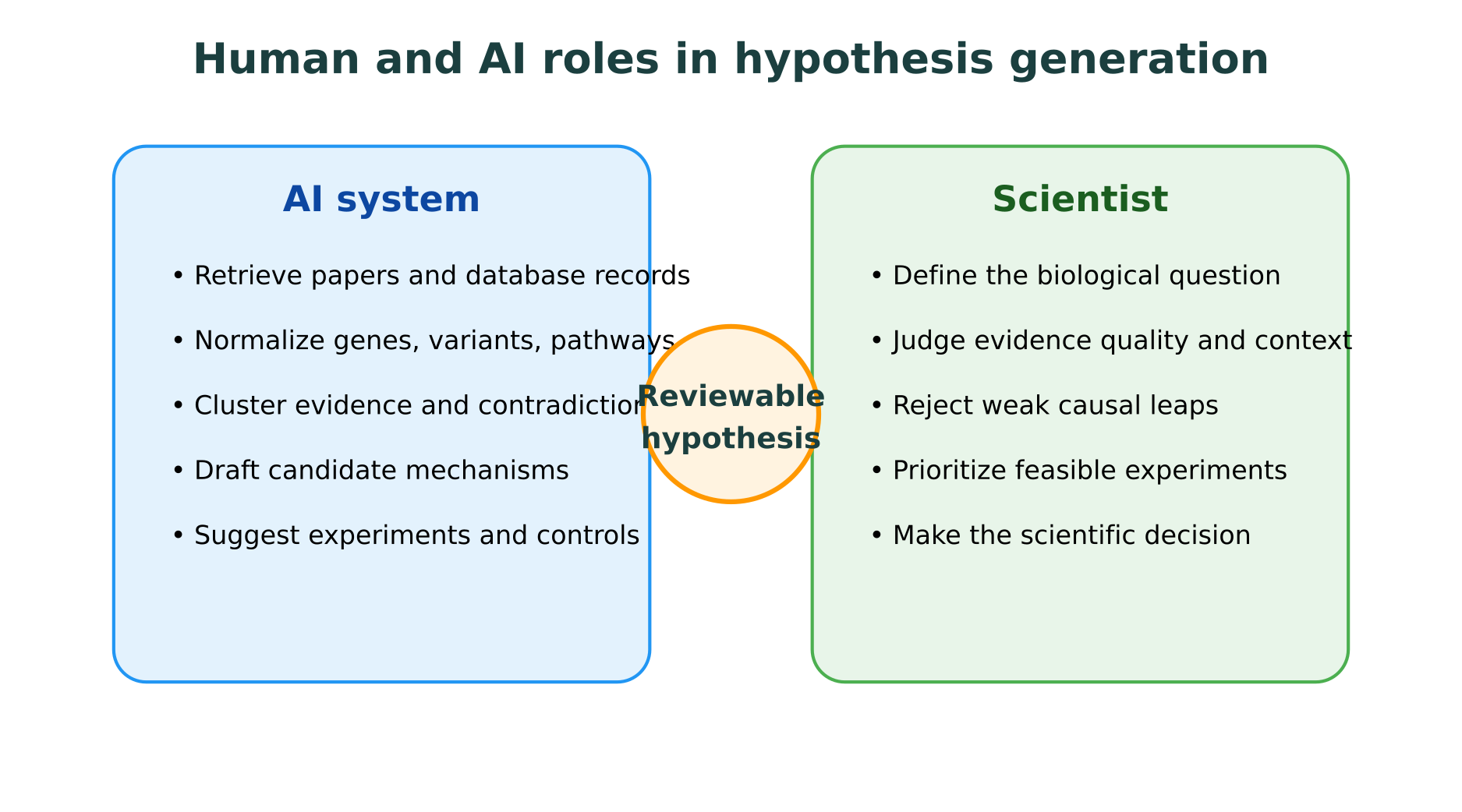
AI can accelerate the parts of hypothesis generation that are information-heavy and repetitive. It is weaker at causal judgment, model-system choice, and deciding whether the evidence is strong enough to act on.
| Task | AI can help with | Scientist must review |
|---|---|---|
| Literature discovery | Search papers, cluster claims, identify older and recent evidence | Study design, relevance, effect size, reproducibility |
| Database reasoning | Normalize entities, retrieve records, cite sources | Database version, source reliability, annotation conflicts |
| Omics interpretation | Suggest pathways, cell types, and candidate mechanisms | QC, confounders, statistics, batch effects, cohort design |
| Variant or protein hypotheses | Map variants, retrieve structures, summarize domains and conservation | Transcript choice, model confidence, assay evidence, clinical context |
| Target hypotheses | Gather genetics, expression, literature, and safety signals | Causal strength, tractability, therapeutic window, validation plan |
| Experiment planning | Propose assays, controls, and readouts | Feasibility, sample availability, ethics, cost, timeline |
Large language models can also create a false sense of completeness. A well-written mechanism can sound plausible even if it is built on weak associations. That is why every AI-generated hypothesis should include citations and explicit uncertainty.
Common failure modes in AI hypothesis generation
Failure mode 1: Correlation becomes causality
A gene that is upregulated in disease may be a driver, a response, a cell-composition artifact, or a marker of tissue damage. AI systems trained to produce coherent explanations may overstate the causal direction unless prompted to separate association from causation.
Failure mode 2: Evidence loses biological context
A finding from a mouse injury model may not transfer to a human chronic disease. A cell-line perturbation may not reflect primary tissue. A pathway that is enriched in bulk RNA-seq may reflect immune infiltration rather than pathway activation inside the cell type of interest.
Failure mode 3: Contradictory studies disappear
Synthesis tools sometimes favor consensus narratives. In research, contradictory evidence is often the most important part of the output. It may reveal disease subtype, dose dependence, tissue specificity, or an assay artifact.
Failure mode 4: The hypothesis is not falsifiable
“This pathway may be involved” is not enough. The output should state what would change confidence. A useful system should help transform vague ideas into testable mechanisms.
Failure mode 5: The model cites without provenance
A citation attached to a paragraph is not the same as source-level provenance. Scientists need to know which sentence came from which paper, which database record, and which computational output. This is the same reason biology AI assistants need citations rather than generic references.
Where Purna’s Molecular Intelligence Platform fits
Purna’s Molecular Intelligence Platform, MIP, is designed for hypothesis generation workflows where evidence spans databases, papers, structures, variants, and omics. It is better understood as an IDE for Biology than as a generic chatbot.
Consider a disease biology team studying a candidate mechanism from RNA-seq data. A fragmented workflow might involve separate literature searches, pathway enrichment scripts, protein database lookups, variant checks, and slide-based synthesis. In MIP, the team can work through the reasoning in one workspace:
- Ask a scoped disease mechanism question in natural language.
- Retrieve cited evidence from biological and clinical databases.
- Run exploratory bioinformatics code in a containerized environment.
- Compare gene, pathway, protein, variant, and literature evidence.
- Retrieve PDB or AlphaFold structures when the mechanism involves protein function.
- Visualize structural context in Molstar and run DynaMut2 stability analysis when relevant.
- Separate established evidence from candidate hypotheses and missing experiments.
- Export a reviewable reasoning trail for team discussion.
The platform does not decide the biology. It helps scientists reduce the time spent stitching tools together, while keeping evidence, assumptions, and next experiments visible.
A checklist for responsible AI hypothesis generation
Use this checklist before moving from an AI-generated hypothesis to experiments, grant language, or a discovery decision.
- Is the hypothesis specific? It should name the biological object, mechanism, context, and expected direction.
- Are the citations inspectable? Key claims should connect to papers, databases, or computational outputs.
- Are contradictions included? The system should surface negative, conflicting, and boundary-condition evidence.
- Is causality supported or only suggested? Perturbation, genetics, timing, and rescue evidence matter.
- Does the model system match the question? Tissue, species, disease stage, and assay context should be explicit.
- Can the hypothesis be falsified? A clear experiment should be able to weaken the claim.
- Is the next experiment feasible? Scientific value depends on practical execution, not only plausibility.
- Can the reasoning be reproduced? Inputs, database versions, prompts, code, parameters, and outputs should be saved where possible.
The measured outlook
AI hypothesis generation in biology will likely become a normal part of research workflows, especially for literature synthesis, disease biology, target prioritization, variant interpretation, and multi-omics exploration. The durable value will come from systems that make scientific reasoning more inspectable, not systems that simply produce more hypotheses.
The best use case is not replacing a scientist’s judgment. It is helping scientists compare more mechanisms, notice evidence they might have missed, identify uncertainty earlier, and design sharper experiments.
Used well, AI can make hypothesis generation faster and more systematic. Used carelessly, it can make weak mechanistic stories sound stronger than they are. The difference is provenance, review gates, and a clear path from claim to experiment.
MIP is Purna AI’s Molecular Intelligence Platform, an AI-powered workspace for biology teams. Genomic variant interpretation, protein structure prediction, multi-omics analysis, bioinformatics code execution, and 30+ database integrations in one place. Explore the platform at purna.ai. Researchers can apply for up to $10,000 in free credits to run their analyses on MIP.
Explore Purna's Molecular Intelligence Platform
AI-powered workspace for biology teams to accelerate drug discovery from target identification to lead optimization.
Try Purna AI →