Natural Language Bioinformatics: How Scientists Can Query Biology Without Writing Pipelines
Natural language bioinformatics is the use of plain-language questions to search biological databases, run computational analyses, and synthesize evidence without manually writing every pipeline step. For scientists, the goal is not to avoid computation. The goal is to make computational biology accessible at the point where biological reasoning happens.
A researcher should be able to ask, “Which variants in this gene are associated with cardiomyopathy, and what evidence supports them?” or “Does this missense mutation fall in a conserved protein domain?” and receive a structured answer that points to the databases, code, assumptions, and limitations behind the result.
That is different from asking a general chatbot for a biology summary. Useful natural language bioinformatics needs live database access, reproducible execution, source-level citations, and expert review. Without those controls, fluent answers can become another source of error.
Why natural language bioinformatics matters for research teams
Bioinformatics work is often blocked by interface friction. The limiting step is not always sequencing depth, model performance, or statistical method choice. It is often the practical work of moving between tools: identifying the right database, translating identifiers, configuring packages, managing file formats, checking versioned references, and documenting the reasoning behind a result.
This is especially visible in biology because questions rarely stay inside one data type. A variant interpretation question may require ClinVar, gnomAD, OMIM, UniProt, PDB or AlphaFold, and literature. A drug target question may require disease genetics, transcriptomic evidence, pathway context, protein function, tissue expression, safety liabilities, and prior art. A structural biology question may require sequence annotations, domains, conservation, 3D visualization, and stability prediction.
Traditional bioinformatics tools solve important parts of this problem. Galaxy makes many workflows accessible through a web interface. Nextflow and Snakemake make pipelines portable and reproducible. Bioconductor gives researchers a rigorous R ecosystem for high-throughput biology. These are foundational tools, not obsolete ones. Nextflow, described in Nature Biotechnology in 2017, helped establish modern reproducible computational workflows. The Galaxy project has long emphasized accessible, reproducible, and transparent biomedical analysis.
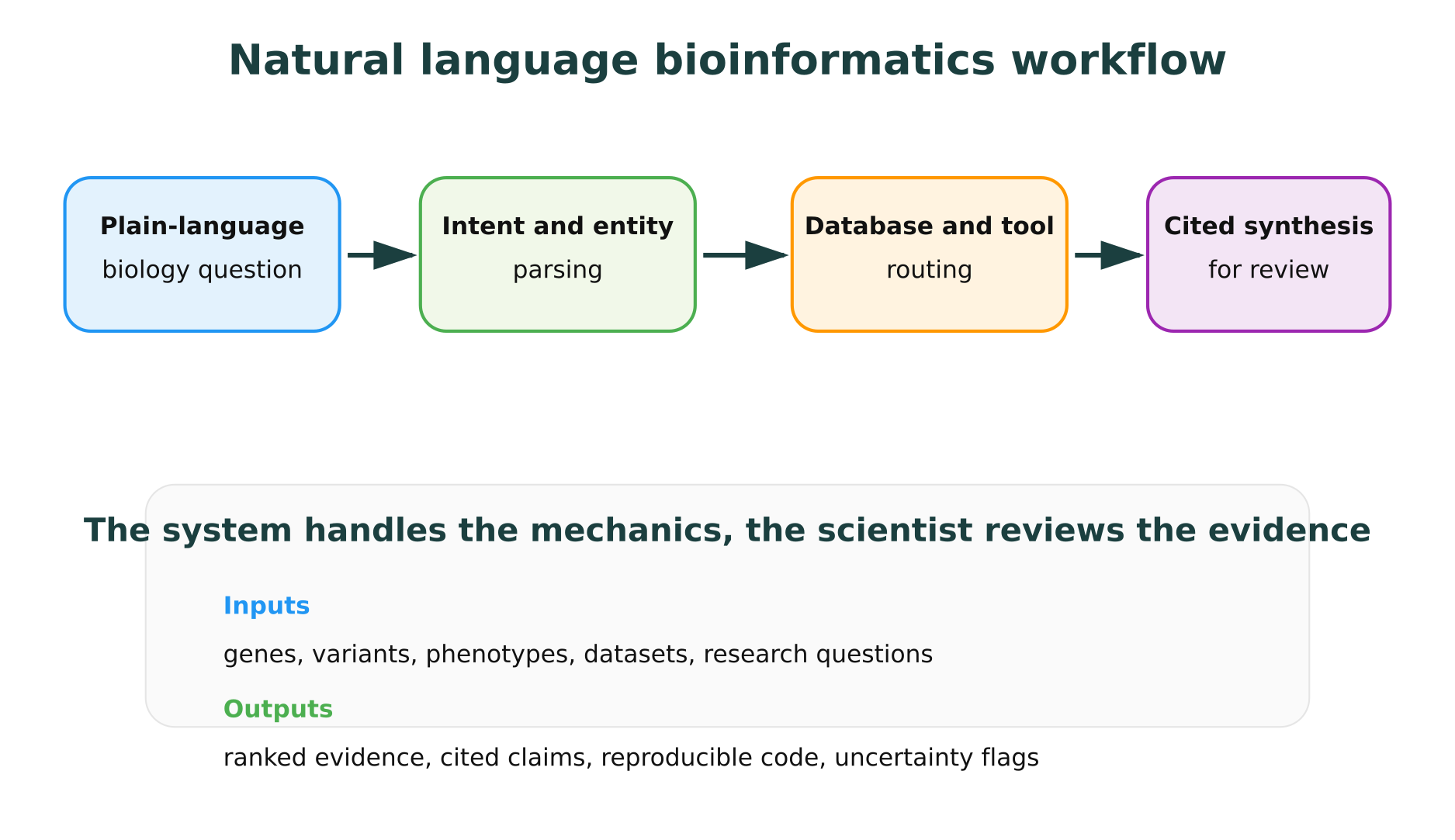
The gap is that many scientists do not begin with a pipeline. They begin with a biological question. Natural language bioinformatics tries to shorten the path from question to evidence while preserving scientific traceability.
If you want the broader platform context, see our guide to bioinformatics without coding and the pillar explanation of molecular intelligence.
What scientists can query with natural language bioinformatics
The highest-value use cases are not generic prompts like “analyze my data.” They are specific, scoped questions where the system can route to known data sources and tools.
Variant and gene-disease evidence
A clinical genomics researcher might ask:
“For BRCA2 c.5946delT, summarize ClinVar classification, gnomAD frequency, gene-disease association, protein context, and any conflicting evidence.”
A well-designed system should not answer from model memory. It should identify the variant, normalize the transcript or coordinate system, query current databases, and return source-linked evidence. ClinVar classifications, population frequencies, and gene-disease associations change over time, so the answer needs to be grounded in current database records.
This use case overlaps with our earlier post on querying biological databases using natural language, but the broader point is workflow design: natural language is valuable only when it controls reliable retrieval and analysis.
Protein structure and mutation interpretation
A structural biologist or translational scientist might ask:
“Map this missense substitution onto available structures, check whether it is in a functional domain, and summarize conservation and predicted stability impact.”
The answer should retrieve PDB or AlphaFold structures where appropriate, locate the residue, identify nearby domains or interfaces, run a stability method when relevant, and report uncertainty. Protein structure prediction and variant effect interpretation remain context-dependent. A model confidence score, a ΔΔG estimate, and a domain annotation are not equivalent evidence types.
For related workflows, see our posts on protein mutation impact prediction and sequence to structure to function.
Multi-omics and dataset triage
A computational biologist might ask:
“Given this differential expression result, which pathways, cell types, and disease mechanisms are most consistent with the observed changes?”
The system may need to inspect a table, run enrichment analysis, check pathway resources, compare with public expression datasets, and summarize which claims are well supported. This is where natural language should become a control layer over real analysis rather than a replacement for statistics.
Literature and database synthesis
A discovery scientist might ask:
“What evidence links target X to disease Y across genetics, expression, animal models, and recent literature?”
This requires literature retrieval, claim extraction, database cross-checking, and explicit separation between established evidence and plausible hypotheses. Biomedical natural language processing has advanced rapidly, and 2024 reviews in the medical NLP literature describe the strong influence of large language models and generative AI. But for research decisions, literature synthesis still needs provenance, not just fluent summarization.
Natural language bioinformatics is not just chatbot code generation
A common misunderstanding is that natural language bioinformatics means asking an LLM to write a Python script. Code generation can help, but it is not enough for scientific work.
A script can be syntactically correct and scientifically wrong. It may query the wrong transcript, use an outdated genome build, assume an input file format that is not present, ignore multiple testing correction, or summarize a database field without checking evidence strength. In biology, small identifier and context errors can completely change the interpretation.
The difference is architectural:
| Capability | Chatbot code generation | Natural language bioinformatics workspace |
|---|---|---|
| Data access | Often absent or indirect | Direct connections to biological databases |
| Execution | User runs code elsewhere | Code runs in a controlled environment |
| Citations | May cite papers inconsistently | Claims link to databases, papers, or tool outputs |
| Reproducibility | Depends on user setup | Environment, parameters, and outputs can be logged |
| Expert review | Required but unsupported | Review points can be built into the workflow |
| Best use | Drafting scripts and explaining concepts | Querying, running, and documenting biological analyses |
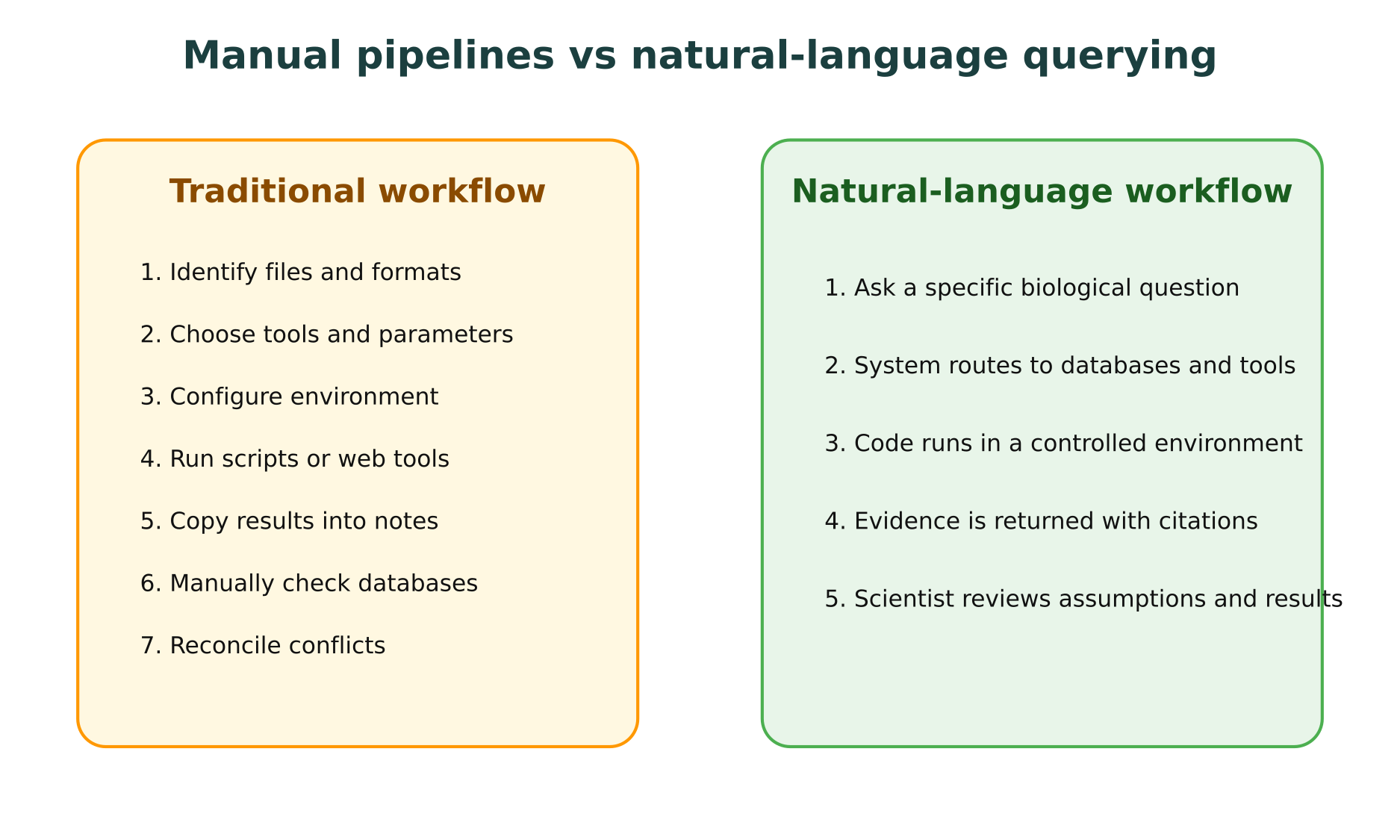
A practical workflow for querying biology without writing pipelines
Natural language interfaces work best when scientists frame questions precisely. The following workflow is useful whether you are using a domain-specific AI bioinformatics software platform, a database-connected assistant, or an internal lab tool.
1. State the biological task, not just the data type
Poor prompt:
“Analyze these variants.”
Better prompt:
“Prioritize these missense variants for possible loss-of-function relevance in inherited cardiomyopathy. Include ClinVar classification, population frequency, gene-disease evidence, protein domain context, and any conflicting interpretations.”
The better version tells the system what evidence classes matter. It also helps the scientist evaluate whether the output covers the right domains.
2. Specify identifiers and reference context
Bioinformatics depends on precise identifiers. Where possible, include gene symbols, transcript accessions, genome build, organism, sample metadata, assay type, and file format.
For example:
- Human genome build: GRCh37 or GRCh38
- Transcript accession: NM_000059.4 rather than only BRCA2
- Protein accession: UniProt ID when relevant
- Assay: bulk RNA-seq, single-cell RNA-seq, proteomics, ATAC-seq, variant panel
- Biological context: disease, tissue, cell type, treatment, phenotype
The FAIR Guiding Principles, published in Scientific Data in 2016, emphasized that scientific data should be findable, accessible, interoperable, and reusable. Natural language systems do not remove the need for these principles. They depend on them.
3. Ask for evidence categories explicitly
A useful prompt should request the evidence you intend to review:
- Database records and accessions
- Literature citations with publication years
- Method names and parameters
- Conflicting evidence
- Negative evidence or missing data
- Confidence limits and uncertainty
This avoids one of the main risks of AI-assisted science: answers that feel complete because they are well written, but omit the evidence needed for review.
4. Separate retrieval, analysis, and interpretation
Scientists should distinguish three layers:
- Retrieval: What did the databases or papers say?
- Analysis: What computation was performed on the data?
- Interpretation: What conclusion is being proposed, and how strong is it?
A natural language bioinformatics system should make these layers visible. For example, a variant may be absent in gnomAD, a stability model may predict destabilization, and a domain annotation may suggest functional relevance. Those are separate evidence items. The interpretation should not collapse them into a single unsupported claim.
5. Review before acting
Automation can accelerate evidence gathering, but scientists remain responsible for the conclusion. Review should include identifier checks, source checks, method checks, and uncertainty checks.
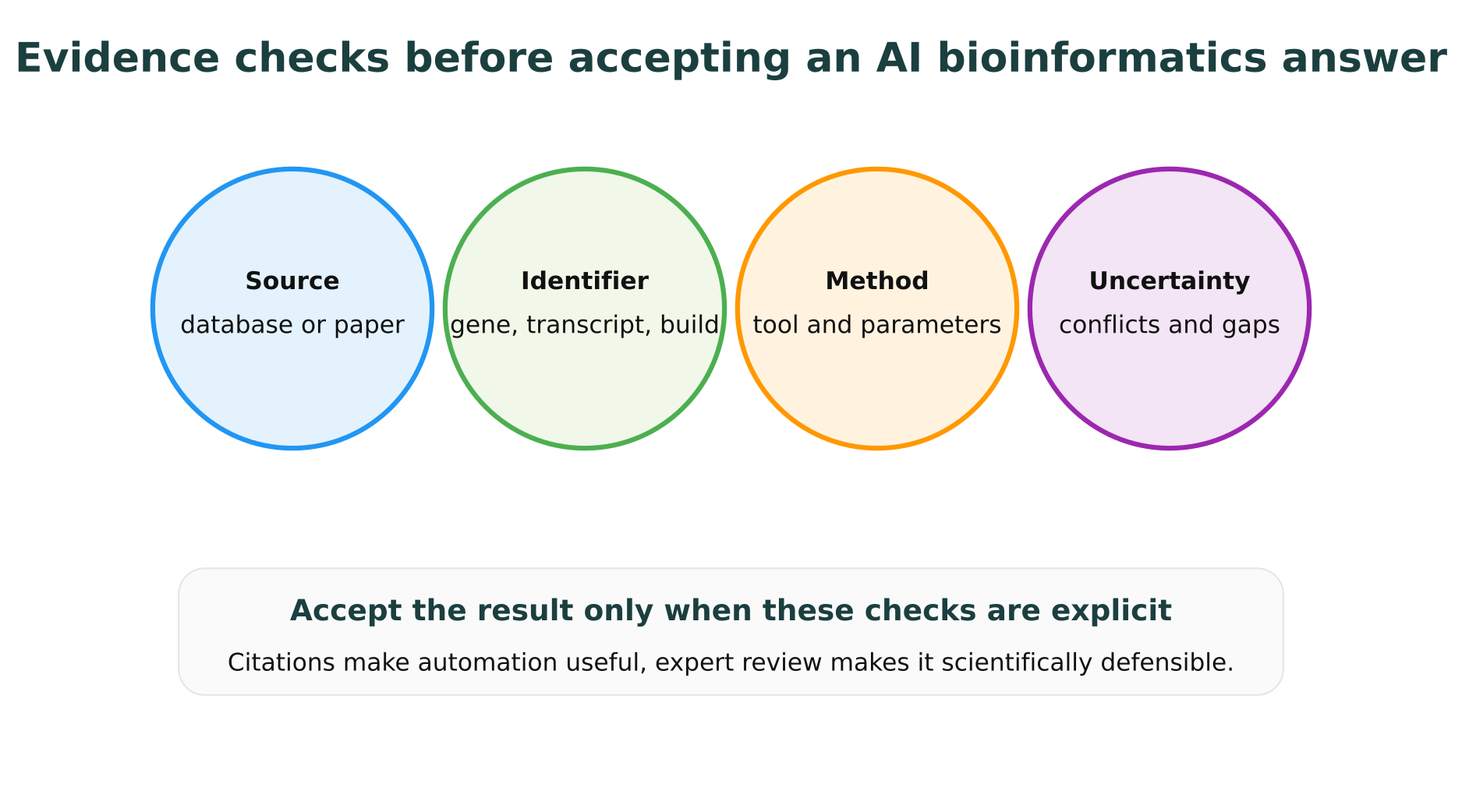
Where expert review still matters
Natural language interfaces reduce friction, not accountability. The following areas still require expert judgment.
Study design and causal interpretation
AI can help connect genes, pathways, phenotypes, and literature, but causal claims require study design, controls, perturbation evidence, and biological plausibility. A correlation between expression and disease severity does not establish mechanism.
Database conflicts
Biological databases can disagree. ClinVar submissions may conflict. Protein annotations can differ by isoform. Literature may include small cohorts, model systems with limited translational relevance, or preprints that have not been peer reviewed. A good system should expose conflicts rather than smooth them away.
Statistical assumptions
For omics analyses, the statistical model matters. Normalization, batch correction, covariate selection, multiple testing correction, and effect-size interpretation cannot be treated as formatting details. Natural language can help configure and explain these steps, but it should not hide them.
Clinical or regulated decisions
Clinical interpretation requires validated workflows, documented review, and appropriate oversight. AI-generated summaries can support evidence gathering, but they do not replace professional responsibility or laboratory standard operating procedures.
How Purna’s Molecular Intelligence Platform fits
Purna AI’s Molecular Intelligence Platform is designed around the idea that natural language bioinformatics should be connected to real biological infrastructure. In MIP, the natural language interface is not a standalone chatbot. It is a control layer for database-connected research workflows.
A scientist can ask a question about a gene, variant, protein, disease mechanism, or omics result, and the platform can route the task across 30+ clinical and biological databases, including resources such as ClinVar, gnomAD, OMIM, UniProt, PDB, PharmGKB, and LOVD. Answers are designed to be citation-backed, so researchers can inspect the source of each claim.
For structure-focused questions, MIP can retrieve structures from PDB or AlphaFold, visualize proteins in Molstar, run DynaMut2 stability analysis, and connect the result to domains, conservation, and functional interpretation. For computational work, it supports bioinformatics code execution in containerized environments, which lets researchers move from question to executed analysis without rebuilding local tooling each time.
This is the reason we describe MIP as an IDE for Biology, not just a question-answering assistant. It lets scientists move between questions, code, databases, literature, and interpretation in one workspace.
Evaluation checklist for AI bioinformatics software
When evaluating AI bioinformatics software for natural language workflows, use a checklist rather than a demo impression.
| Question | Why it matters |
|---|---|
| Does it query live biological databases? | Static model memory is not enough for changing scientific records. |
| Are citations linked to source records? | Scientists need provenance for every factual claim. |
| Can it execute code in a controlled environment? | Many analyses require computation, not just retrieval. |
| Does it preserve parameters and outputs? | Reproducibility depends on documented settings. |
| Can it flag uncertainty and conflicts? | Biological evidence is often incomplete or inconsistent. |
| Does it support expert review? | Automation should expose review points, not obscure them. |
| Does it integrate multiple data types? | Real questions often span variants, proteins, omics, pathways, and literature. |
The best systems will not promise that scientists no longer need to think. They will make the thinking more evidence-rich, faster to document, and easier to reproduce.
The practical future: scientists ask better questions, systems do more of the mechanics
Natural language bioinformatics will not eliminate pipelines. Pipelines remain essential for standardized production workflows, large cohorts, regulated analyses, and methods development. What will change is how many routine research questions require a scientist to manually assemble a pipeline before learning anything useful.
For exploratory work, database querying, evidence synthesis, and early hypothesis evaluation, natural language can become the entry point. The scientist defines the biological question. The system handles routing, retrieval, analysis, and documentation. The scientist reviews the evidence and decides what it means.
That balance is important. Biology is too complex for unreviewed automation, but the current manual burden is too high for the scale of modern data. Natural language bioinformatics is useful when it respects both realities.
MIP is Purna AI’s Molecular Intelligence Platform, an AI-powered workspace for biology teams. Genomic variant interpretation, protein structure prediction, multi-omics analysis, bioinformatics code execution, and 30+ database integrations in one place. Explore the platform at purna.ai. Researchers can apply for up to $10,000 in free credits to run their analyses on MIP.
Explore Purna's Molecular Intelligence Platform
AI-powered workspace for biology teams to accelerate drug discovery from target identification to lead optimization.
Try Purna AI →