AI for Drug Target Identification: From Disease Biology to Prioritized Targets
AI for drug target identification is most useful when it helps research teams move from scattered disease biology to a ranked set of target hypotheses that can be inspected, challenged, and tested. It should not be treated as a shortcut from gene list to drug program.
Target identification remains one of the highest-leverage decisions in drug discovery. If the biology is wrong, later improvements in chemistry, screening, and clinical trial design cannot fully recover the program. If the target is plausible but the causal direction, tissue context, modality, or safety profile is unclear, the program can spend years optimizing around a weak premise.
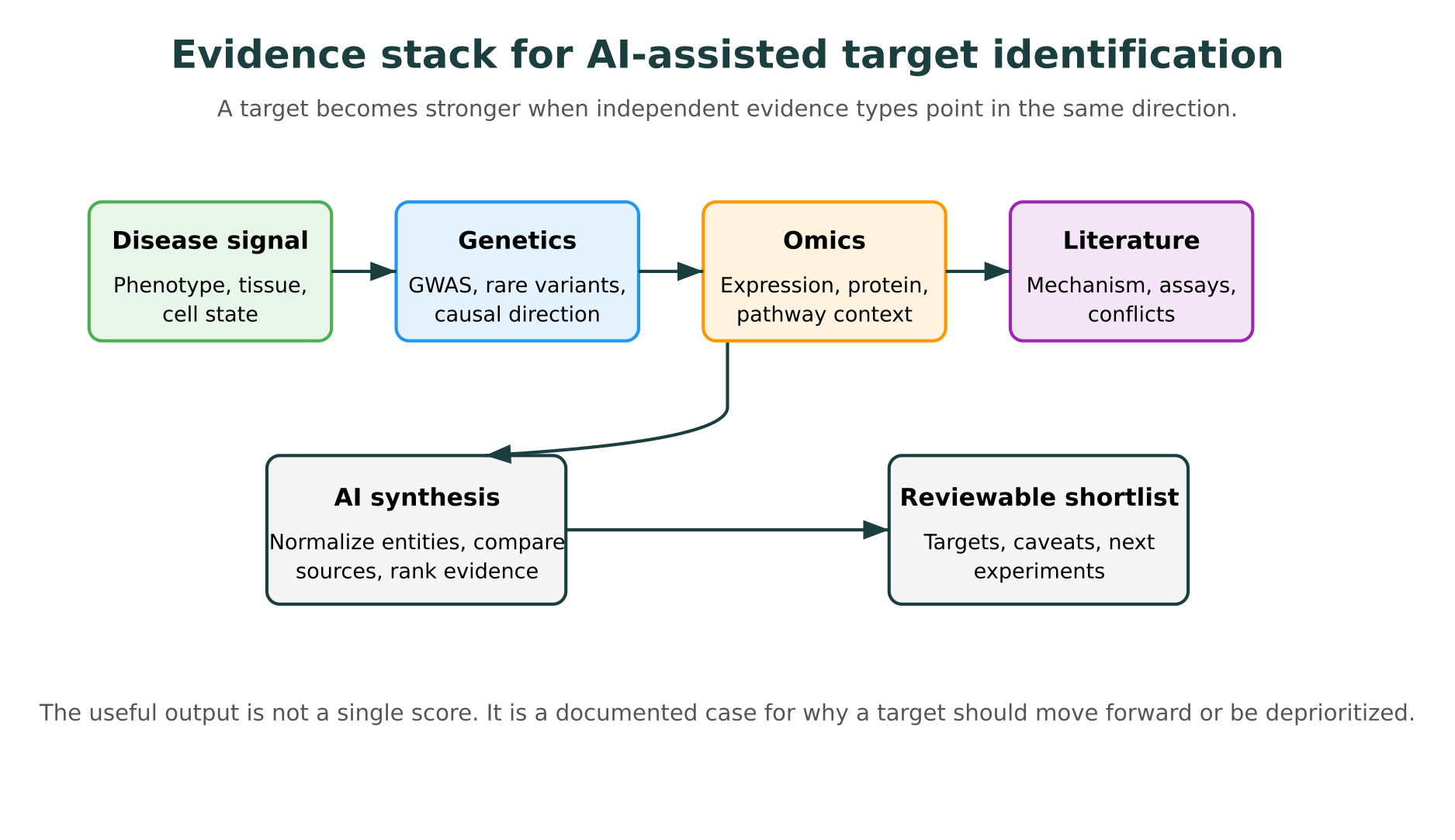
The practical role for AI is therefore disciplined evidence synthesis. It can connect genetics, omics, literature, pathway data, structures, known pharmacology, and safety signals. It can also expose where the evidence is thin. The output should be a reviewable target case, not a single opaque score.
flowchart TD
  A["Disease question"] --> B["Normalize phenotype, tissue, and entities"]
  B --> C["Retrieve evidence"]
  C --> D["Genetics and omics"]
  C --> E["Literature and pathways"]
  C --> F["Structure and pharmacology"]
  D --> G["Prioritized target hypothesis"]
  E --> G
  F --> G
  G --> H["Expert review and experiments"]
  H --> I{"Advance, revise, or stop"}

  classDef input fill:#e3f2fd,stroke:#1b3f3f,color:#000000;
  classDef evidence fill:#e8f5e9,stroke:#1b3f3f,color:#000000;
  classDef decision fill:#fff3e0,stroke:#1b3f3f,color:#000000;
  class A,B input;
  class C,D,E,F evidence;
  class G,H,I decision;
Why AI for drug target identification starts with disease biology
The first question is not “which target has the highest AI score?” It is “what disease mechanism are we trying to change?”
A target can look attractive in one context and weak in another. The same gene may be relevant in one tissue, cell state, disease stage, ancestry group, or molecular subtype but irrelevant elsewhere. AI systems that ingest large datasets can make this easier to explore, but they can also blur these distinctions if the inputs are not well specified.
Before ranking targets, teams should define:
- Disease context: phenotype, subtype, stage, tissue, cell population, and model system.
- Therapeutic hypothesis: whether the target should be inhibited, activated, degraded, replaced, edited, or used as a biomarker.
- Evidence threshold: whether the goal is exploratory biology, preclinical target nomination, indication expansion, or clinical translation.
- Validation path: the experiments that would make the target more or less credible.
This workflow fits naturally with molecular intelligence, where the goal is not to produce fluent biological explanations, but to connect evidence across databases, structures, omics, variants, and literature in a way scientists can audit.
What evidence should AI integrate for target identification?
AI-assisted target identification usually combines several evidence layers. Each layer answers a different question, and no layer is sufficient by itself.
Human genetics
Human genetics is often the strongest starting point because it can connect natural variation to disease risk or protection. Genome-wide association studies, rare variant burden tests, Mendelian randomization, colocalization, and loss-of-function analyses can all help assess whether perturbing a gene is likely to affect a disease phenotype.
The value is not simply that a gene appears near a GWAS locus. Teams need to ask whether the locus maps to the target, whether the causal direction is known, whether the association colocalizes with expression or protein quantitative trait loci, and whether the effect is disease-specific.
The Open Targets Platform is useful here because it aggregates target-disease evidence across multiple sources and separates evidence types such as genetic associations, clinical precedence, text mining, expression, pathways, and animal models. Its own documentation is careful about interpretation: association scores are useful for ranking, but they should not be read as a direct confidence score for causality.
That caution matters. A genetics-backed target may be a better starting point than a purely literature-backed target, but it still requires biological interpretation and experimental validation.
Omics and cell-state context
Transcriptomics, proteomics, metabolomics, and single-cell data help locate the target in the disease system. They can show whether a candidate target is expressed in the relevant tissue, which cell types carry the signal, whether the pathway changes with disease severity, and whether perturbation signatures reverse or reinforce the disease state.
AI can help by integrating noisy and high-dimensional datasets, but the same statistical discipline still applies. Batch effects, sample composition, disease heterogeneity, platform differences, and reference atlas bias can all make a target look stronger or weaker than it is.
For teams working across modalities, our guide to genomics, proteomics, and transcriptomics explains why the strongest biological conclusions usually come from convergent evidence rather than from one omics layer alone.
Literature and pathway evidence
The biomedical literature contains mechanisms, perturbation experiments, disease models, clinical observations, and negative findings that are not always captured in structured databases. Large language models and biomedical NLP systems can help extract gene-disease, drug-target, pathway, and phenotype relationships from papers.
The risk is over-synthesis. A mouse knockout result, a cell-line perturbation, a pathway review, and a human cohort association should not be collapsed into one generic claim. Useful AI systems separate organism, assay, perturbation type, effect direction, and uncertainty.
This is where natural language bioinformatics becomes valuable. A plain-language interface is useful only if it routes questions to real sources and preserves provenance.
Structure, tractability, and known pharmacology
A target can be biologically compelling and still difficult to modulate. Structural biology and pharmacology help answer whether a protein has an accessible binding site, whether similar protein family members have known ligands, whether an antibody or RNA modality is more realistic than a small molecule, and whether existing drugs already provide clinical precedence.
AlphaFold DB now provides open access to more than 200 million protein structure predictions, and the 2026 release added high-confidence complex structures for selected homomers and heteromers. These resources can make early structural triage faster, especially when experimental structures are unavailable.
Predicted structures still need careful interpretation. Confidence metrics, disorder, conformational state, ligand context, oligomeric assembly, and experimental validation all affect whether a binding site hypothesis is credible. For structure-focused workflows, see our guides to AlphaFold vs Boltz vs ESMFold, protein mutation impact prediction, and protein-ligand docking with AI.
Known pharmacology is also informative. ChEMBL, for example, brings together chemical, bioactivity, and genomic data that can help teams understand whether a target has measured ligands, related compounds, or family-level tractability.
A practical target prioritization framework
Target prioritization works best when it makes assumptions explicit. The following checklist is a practical way to evaluate AI-generated target hypotheses before moving them into experimental planning.
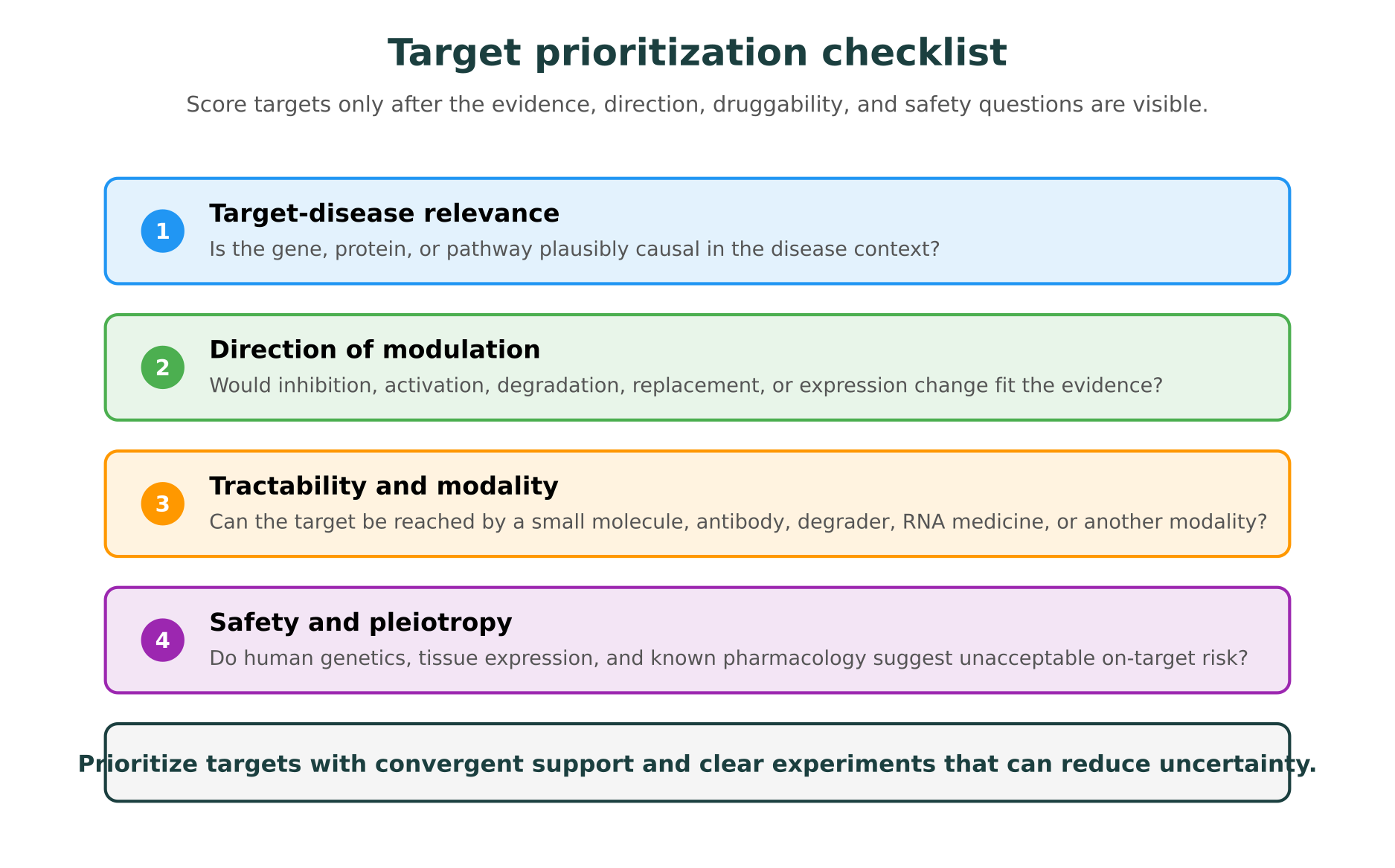
1. Is the target connected to the disease mechanism?
Ask whether the target is plausibly causal, not merely associated. Evidence may include human genetics, disease-relevant expression, perturbation studies, pathway placement, and independent literature support.
Weak signal: the target appears in many papers because the pathway is popular.
Stronger signal: genetic, omics, and perturbation evidence point to the same disease mechanism in the relevant tissue or cell type.
2. Is the direction of modulation clear?
A target hypothesis needs direction. Should the target be inhibited, activated, degraded, stabilized, replaced, or transcriptionally modulated?
This is often where promising target lists become fragile. A gene may be upregulated in disease because it drives pathology, because it is a compensatory response, or because it marks a cell population that expands during disease. AI can surface these alternatives, but it should not hide them.
Directionality evidence may come from loss-of-function variants, gain-of-function variants, perturb-seq, CRISPR screens, disease models, pharmacology, or clinical observations.
3. Is there a feasible modality?
Tractability depends on the target and the therapeutic strategy. A kinase with a well-defined ATP-binding pocket is different from a transcription factor, secreted protein, transporter, structural protein, RNA target, or protein-protein interaction interface.
AI can help map a target to potential modalities:
| Target question | Evidence to inspect | Possible modality implication |
|---|---|---|
| Has the target or family been drugged before? | ChEMBL, DrugBank, clinical precedence | Small molecule or biologic may be plausible |
| Is there an accessible extracellular domain? | UniProt, structure, topology | Antibody or ligand trap may be plausible |
| Is disease driven by excess protein activity? | Genetics, expression, perturbation | Inhibitor, degrader, or RNA silencing may fit |
| Is disease driven by loss of function? | Genetics, functional assays | Replacement, activation, gene therapy, or editing may fit |
| Is the pocket uncertain? | PDB, AlphaFold, docking, dynamics | More structural validation is needed |
The key is to connect modality to mechanism. A target is not useful because it is “druggable” in the abstract. It is useful if a realistic intervention can change the disease-relevant biology in the right direction.
4. What safety signal could stop the program?
Safety should be part of target identification, not a late-stage afterthought. Human genetics can identify protective or risk variants. Tissue expression can reveal potential on-target toxicity. PheWAS can surface pleiotropic effects. Known pharmacology can show class liabilities.
This is especially important for chronic diseases, pediatric indications, immune targets, CNS targets, and targets with broad tissue expression. The safest-looking target in an efficacy-only ranking may become unattractive once tissue specificity and pleiotropy are considered.
5. What experiment reduces uncertainty?
A ranked list is only useful if it leads to better experiments. For each target, the AI-assisted output should propose what evidence would change the decision.
Examples include:
- A CRISPR perturbation in a disease-relevant cell model
- A single-cell analysis to confirm target expression in the relevant cell state
- Colocalization to test whether a GWAS and molecular QTL signal share a causal variant
- A protein structure or binding assay to test tractability
- A rescue experiment to clarify whether the target is causal or compensatory
- A safety-focused expression or PheWAS review before nomination
This is where AI should become operational. It helps choose the next experiment, not merely decorate a target list.
Where knowledge graphs and foundation models fit
Knowledge graphs are well suited to target identification because they represent biological entities and relationships directly: genes, proteins, variants, diseases, drugs, pathways, phenotypes, tissues, assays, and publications.
Graph-based systems can support target work in several ways:
- Link prediction for target-disease or drug-disease relationships
- Mechanism tracing across pathways and protein interactions
- Drug repurposing hypotheses based on shared disease biology
- Safety signal detection through contraindications, adverse events, and pleiotropy
- Literature-aware relationship extraction and source tracking
TxGNN, published in Nature Medicine in 2024, is a useful example from drug repurposing rather than de novo target identification. It uses a graph foundation model to rank candidate drug indications and contraindications across 17,080 diseases, including diseases with limited existing treatments, and provides multi-hop rationales. The important lesson is not that graph AI removes validation. It is that graph methods can make relationships and explanations inspectable when the biomedical search space is large.
For target identification, the same principle applies. AI-generated rankings are more useful when they show the path from disease biology to target rationale:
- Disease phenotype maps to a pathway.
- Pathway maps to a candidate target.
- Genetic or omics evidence supports the target in the relevant context.
- Structural or pharmacological evidence suggests feasible modulation.
- Safety evidence does not immediately contradict the hypothesis.
When any step is missing, the system should show that gap.
What AI can help with, and what it cannot decide
AI can reduce the mechanical work of assembling evidence across databases and papers. It can also help teams avoid narrow search habits by surfacing targets outside the most familiar literature. But it cannot decide that a target is valid in the biological sense.
| Workflow step | AI can help with | Researchers must verify |
|---|---|---|
| Disease framing | Cluster phenotypes, extract disease mechanisms, map cell states | Whether the disease model matches the therapeutic question |
| Evidence retrieval | Query databases, papers, omics datasets, structures | Whether sources are current, relevant, and complete |
| Target ranking | Combine genetics, expression, literature, pathway, and pharmacology signals | Whether weights reflect the program’s biology and risk tolerance |
| Directionality | Summarize loss-of-function, gain-of-function, and perturbation evidence | Whether modulation direction is causally justified |
| Druggability | Retrieve structures, family pharmacology, and ligand evidence | Whether a realistic modality can achieve the intended effect |
| Safety review | Surface tissue expression, PheWAS, contraindications, and clinical precedent | Whether risk is acceptable for the indication and population |
| Experiment planning | Suggest validation experiments and decision points | Which experiments are feasible, decisive, and ethically appropriate |
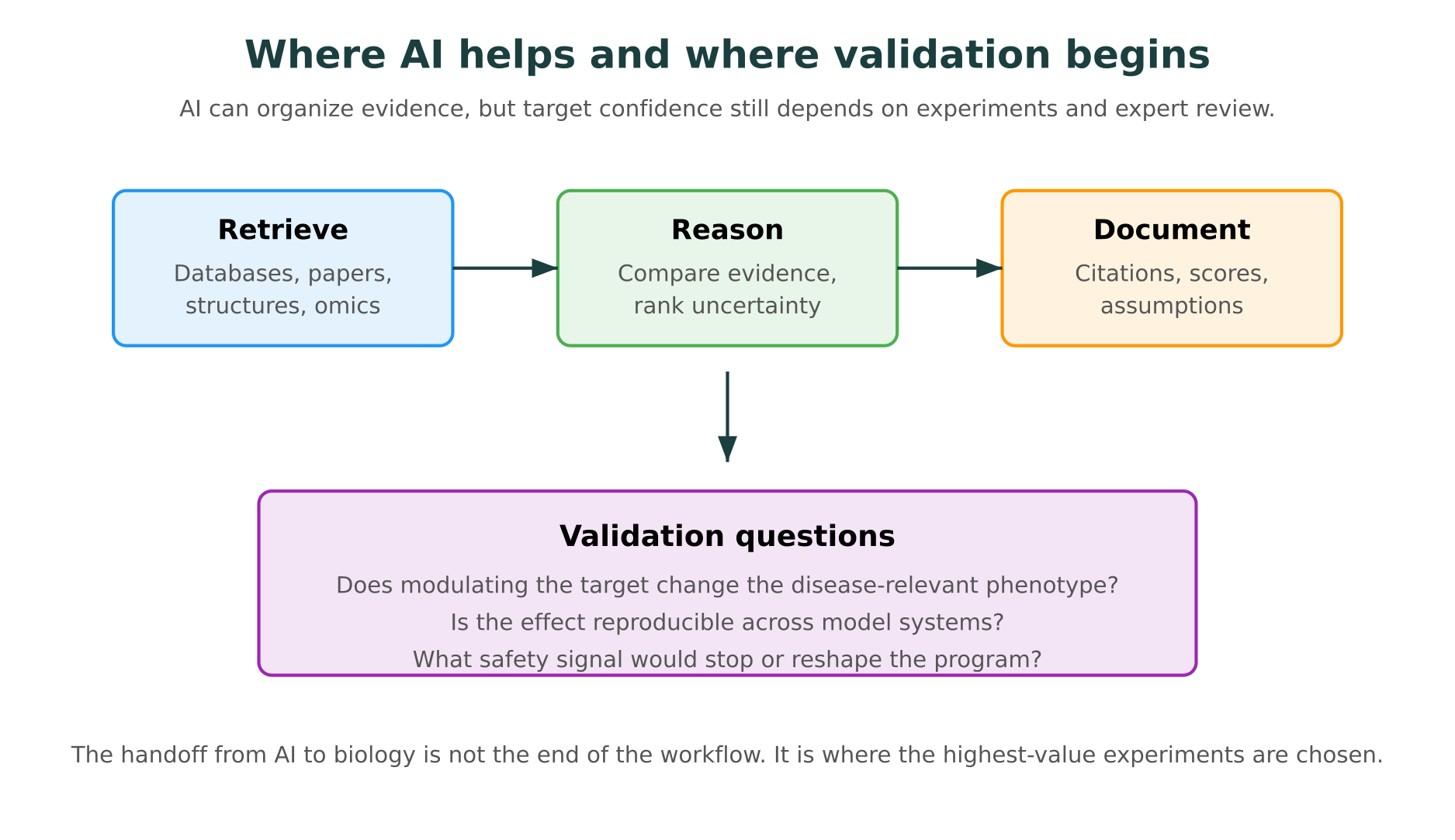
A realistic example: prioritizing targets for a fibrotic disease
Consider a team working on a fibrotic disease where the initial evidence includes transcriptomic changes in diseased tissue, several GWAS loci, and a set of papers implicating immune activation and extracellular matrix remodeling.
A weak AI workflow might produce a ranked list of genes with short summaries. That may be useful for orientation, but it is not enough for target nomination.
A stronger AI-assisted workflow would separate the evidence:
- Disease biology: Which cell types show fibrotic activation? Are epithelial cells, fibroblasts, macrophages, or endothelial cells carrying the strongest signal?
- Genetics: Which loci map convincingly to genes, and is there colocalization with expression or protein abundance?
- Directionality: Do protective variants suggest inhibition or activation? Are upregulated genes causal drivers or downstream markers?
- Tractability: Are candidate proteins secreted, membrane-bound, enzymatic, intracellular, or structurally disordered?
- Safety: Are targets broadly expressed in essential tissues? Do human loss-of-function data suggest tolerance or risk?
- Experiments: Which perturbation model would test whether modulating the target changes extracellular matrix deposition or inflammatory signaling?
The final output might rank five targets, but the ranking is not the main value. The main value is that each target has a transparent case: evidence for, evidence against, assumptions, and experiments that can change the decision.
How Purna’s Molecular Intelligence Platform fits
Purna’s Molecular Intelligence Platform is designed for target workflows where evidence lives across many systems. In one target identification exercise, a scientist may need Open Targets-style association evidence, ClinVar or gnomAD context, UniProt annotations, PDB or AlphaFold structures, literature synthesis, pathway context, and custom bioinformatics analysis.
MIP brings these steps into a shared workspace. Researchers can ask natural-language questions, query 30+ clinical and biological databases, inspect cited evidence, retrieve structures from PDB or AlphaFold, visualize proteins in Molstar, run DynaMut2 stability analysis where relevant, and execute bioinformatics code in containerized environments.
For target identification, that means a team can move from a disease hypothesis to a documented target shortlist without losing provenance across tools. The platform does not replace expert judgment or wet-lab validation. It helps make the reasoning trail faster to assemble and easier to review.
This connects to the broader workflow in our guide to computational drug target discovery, which covers multi-omics evidence, genetic validation, structural druggability, and knowledge graph prioritization in more depth.
Practical recommendations for research teams
AI for drug target identification works best when teams treat it as an evidence management and reasoning layer.
- Start with the biological decision. Define the disease context, target product profile, and acceptable risk before ranking genes.
- Separate evidence types. Keep genetics, omics, literature, structure, pharmacology, and safety evidence distinct before synthesizing.
- Ask for directionality. A target without a clear modulation direction is not ready for nomination.
- Demand source-level provenance. Every important claim should point back to a database record, paper, analysis result, or model output.
- Use scores as triage, not truth. Association scores and AI rankings help sort candidates, but they do not establish causality.
- Plan validation early. The best AI output is a shortlist with experiments that can reduce uncertainty.
The most useful systems will be the ones that help scientists say both “this target is worth testing” and “this target is not ready yet.” In drug discovery, disciplined deprioritization is as valuable as discovery.
Researchers interested in exploring AI-assisted target identification workflows can apply for up to $10,000 in free MIP credits to run database queries, molecular analyses, structure reviews, and bioinformatics workflows on Purna’s platform.
Purna AI’s Molecular Intelligence Platform (MIP) is an AI-powered workspace for biology teams. It brings together molecular analysis, variant interpretation, protein structure prediction, and clinical database integrations into one environment. Built for teams who work with biological data and need consistent, reproducible answers without juggling disconnected tools. Learn more at purna.ai.
Explore Purna's Molecular Intelligence Platform
AI-powered workspace for biology teams to accelerate drug discovery from target identification to lead optimization.
Try Purna AI →