
Cell and Gene Therapy: AI for Rare Disease
The landscape of modern therapeutics is undergoing a profound paradigm shift. For decades, drug discovery was dominated by small molecules and systemic biologics designed to manage the symptoms of highly prevalent, chronic conditions. Today, the rise of advanced cellular and genetic engineering is enabling a new class of corrective medicines: cell and gene therapies (CGT).
For the millions of individuals living with rare and ultra-rare conditions, this shift is particularly transformative. However, developing these highly precise biological products is an incredibly complex, high-risk process.
Increasingly, research teams are utilizing AI in cell and gene therapy workflows to accelerate design pipelines, optimize viral vectors, and streamline clinical studies. Yet, in a space with high, patient-relevant stakes, we must separate speculative computational hype from established biological reality.
This article examines why rare disease represents a distinct biological challenge, explains how AI is being applied across the CGT development lifecycle, analyzes the evolving regulatory environment, and outlines the honest limitations of computational modeling in clinical translation.
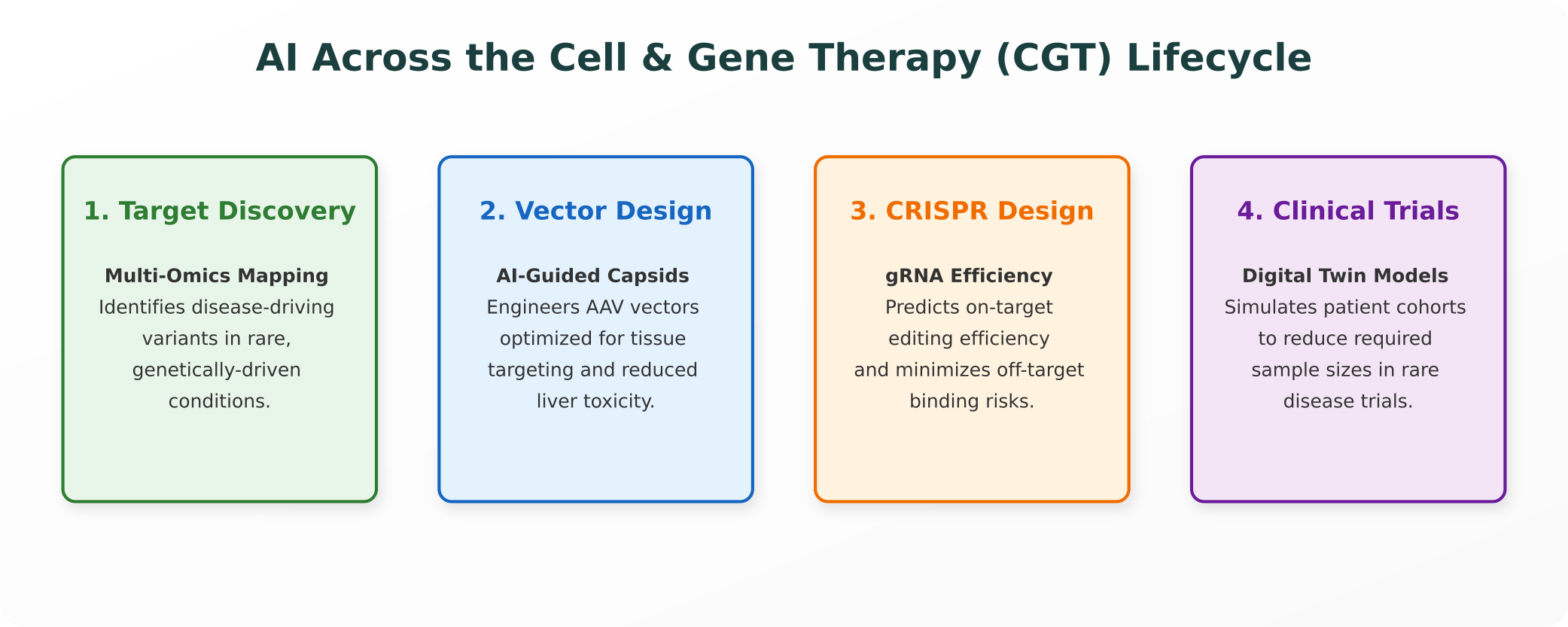
AI Across the Cell & Gene Therapy (CGT) Lifecycle
The integration of artificial intelligence spans every phase of advanced therapeutic design, from initial target discovery to clinical trial optimization:
1. Rare Disease: A Genuinely Distinct Biological Challenge
To understand why advanced therapeutics are so critical, we must first define why rare disease represents a distinct research paradigm:
- The Global Scale: While individual rare diseases affect small cohorts, collectively they represent a massive global health crisis. Rare diseases affect an estimated 0.35 billion people worldwide.
- The Genetic Basis: Approximately 80% of documented rare diseases have a genetic basis. This genetic etiology makes cell and gene therapies uniquely suited for these conditions, as they can directly correct the root molecular cause rather than managing systemic symptoms.
- Structural Constraints: Because patient populations are so small, conducting traditional, large-scale randomized clinical trials is often physically and ethically infeasible. Furthermore, natural history data (documenting how a disease progresses without treatment) is frequently limited or entirely non-existent. This lack of baseline data makes clinical trial design and endpoint selection exceptionally difficult.
2. Why Advanced Therapeutics Are Well-Suited to Rare Disease
Advanced cell and gene therapies are designed to modify, replace, or correct the underlying genetic program of a patient’s cells:
- Cell Therapy: Involves introducing, removing, or modifying living cells (such as engineering a patient’s own T cells in CAR-T therapy) to fight disease.
- Gene Therapy: Focuses on introducing a functional copy of a mutated gene, or directly editing the genome using systems like CRISPR, typically ferried into cells via engineered viral vectors like adeno-associated virus (AAV).
- Real, Approved Milestones: The therapeutic viability of this approach is backed by several landmark, approved therapies:
- Zolgensma: A gene therapy delivering a functional copy of the SMN1 gene to treat spinal muscular atrophy (SMA).
- Elevidys: An AAV-based gene therapy delivering micro-dystrophin for Duchenne muscular dystrophy (DMD).
- Casgevy: The first FDA-approved CRISPR-based gene editing therapy, developed to treat sickle cell disease and beta-thalassemia.
- Zevaskyn: Approved in April 2025, the first cell-based gene therapy designed for dystrophic epidermolysis bullosa, a devastating, rare skin disorder.
- NexCAR19: India’s first indigenous CAR-T cell therapy, developed in collaboration between IIT Bombay and the Tata Memorial Centre, lowering manufacturing costs to make advanced therapeutics accessible to underrepresented populations.
These approved therapies demonstrate that precise molecular correction can result in durable, life-saving clinical outcomes.
3. How AI is Applied Across the CGT Lifecycle
Developing advanced biologics requires optimizing incredibly complex molecular components. This is where AI for rare disease drug development is applied to narrow down design variables.
Gene Therapy Vector and Capsid Design
Ferrying a therapeutic gene into the correct target cells requires an engineered vehicle, typically an AAV capsid.
- The AI Application: Traditional AAV capsids are often cleared by the liver, causing systemic toxicity, or are neutralized by the patient’s existing immune system. Platforms like Dyno Therapeutics utilize gene therapy vector design AI models trained on large-scale, in vivo non-human primate (NHP) data to engineer synthetic AAV capsids.
- The Goal: Design capsids optimized for highly selective tissue delivery (such as penetrating the central nervous system or targeting cardiac muscle) while minimizing liver accumulation and improving manufacturing yield. This platform has drawn major partnerships with global leaders like Astellas, Roche, and NVIDIA.
CRISPR Guide RNA Optimization
Gene editing therapies rely on a guide RNA (gRNA) to direct the Cas nuclease to a precise genomic coordinate.
- The AI Application: Machine learning models analyze genomic sequence contexts to predict both on-target cleavage efficiency and the risk of off-target binding. This allows researchers to select gRNA candidates that maximize precise editing while minimizing the risk of introducing unwanted mutations elsewhere in the genome.
Target Identification and Biomarker Discovery
Finding credible disease-driving targets in rare, complex conditions is a massive data challenge.
- The AI Application: Platforms integrate sparse, heterogeneous multi-omics datasets (genomics, transcriptomics, proteomics) across small patient cohorts to identify hidden target-disease networks and discover predictive clinical biomarkers.
Clinical Trial Design
Due to the scarcity of patients, running clinical trials in rare disease requires extreme efficiency.
- The AI Application: In AI clinical trials rare disease workflows, machine learning models analyze natural history registries, Electronic Health Records (EHR), and digital twin models (simulating control cohorts based on historical clinical data).
- The Goal: Maximize patient recruitment efficiency, optimize trial protocols, and utilize synthetic control arms to reduce the required size of a clinical trial cohort, making efficacy verification possible even in ultra-rare populations.
4. The Evolving Regulatory Environment
Because AI-driven therapeutic design and digital twin modeling are relatively new, regulatory bodies are actively establishing compliance frameworks:
- The FDA 2025 Draft Guidance: In 2025, the FDA released draft guidance regarding the use of AI and machine learning to support regulatory decision-making for drug and biological products.
- The Credibility Framework: This guidance introduces a rigorous credibility framework tied to a model’s defined “context of use.” This is directly relevant to CGT manufacturing, where predictive models are increasingly proposed for real-time comparability assessments and predictive release testing (verifying that a batch of engineered cells is safe and potent before infusion). This is an actively evolving regulatory area, meaning researchers must maintain strict documentation and verification standards.
5. Honest Limitations and the Evidence Bar
While AI is a powerful tool for generating and prioritizing hypotheses, it is not a substitute for physical biochemistry and clinical evidence:
- No Substitute for the Wet-Lab: An AI-predicted vector property, such as reduced immunogenicity or specific tissue targeting, is merely a computational hypothesis. It remains unverified until it undergoes rigorous in vitro binding assays, in vivo animal pharmacokinetic studies, and prospective human clinical trials. AI narrows the candidate pool from millions to a few highly validated leads; it does not replace the physical pipeline.
- The Evidence Bar remains Unchanged: Computational modeling and digital twin simulations can shorten the pre-clinical design phase and optimize trial protocols, but they do not lower the regulatory threshold for approval. To achieve market authorization, advanced cell and gene therapies must still demonstrate substantial evidence of safety and clinical efficacy through prospective, controlled clinical trials.
Purna AI: Evidence-Grounded Molecular Intelligence
Most generic AI search tools operate as unconstrained language models, presenting researchers with loose associations that lack biological context or verified citations.
Purna AI’s Molecular Intelligence Platform (MIP) is built to solve this exact bottleneck. Designed specifically as a biology IDE and workspace for professional R&D teams, Purna integrates text-extracted relations with live reference databases and physical biochemistry:
- Rigid Evidence Grounding: Purna does not generate speculative, ungrounded claims. Every target, variant, and clinical phenotype analyzed by the platform is tied directly to 30+ live biological databases and indexed literature with clickable, verified citations.
- Integrated 3D Structural Validation: For any engineered vector or mutated protein, Purna integrates structural molecular biology natively. Researchers can instantly pull 3D receptor structures from the Protein Data Bank (PDB), visualize active-site geometries using Molstar, and run biophysical simulations to computationally verify binding pocket interactions.
- Continuous, Workflow-Aware Curation: Purna acts as a force multiplier for advanced therapeutic teams. By automating the mechanical tasks of multi-omics data gathering, database querying, and initial relation mapping, Purna allows researchers to focus on critical study designs and high-confidence drug discovery decisions.
By transforming raw computational signals into structured, evidence-backed molecular intelligence, Purna AI replaces speculative search and empowers research teams to advance their advanced therapeutic pipelines with complete scientific integrity.
Explore Purna's Molecular Intelligence Platform
AI-powered workspace for biology teams to accelerate drug discovery from target identification to lead optimization.
Try Purna AI →