GRCh37 vs GRCh38 vs T2T-CHM13: Why Reference Genome Builds Still Trip People Up

A major, recurring source of errors in clinical and computational genomics is the misalignment of reference genome builds. Despite the completion of the human genome draft over two decades ago, biological pipelines are still frequently disrupted by coordinate mismatches. It is common for a variant caller to output a pathogenic classification, only for downstream annotation tools to silently misinterpret the coordinates because one database was built on hg19 while another was queried against hg38.
This friction occurs because researchers often treat coordinate systems and assembly files as generic interchangeable indices. In practice, converting coordinates using liftover tools is not a trivial formality: it represents a significant mathematical and structural realignment of sequences. Misunderstanding the biological and structural changes across builds introduces silent, untracked errors that compromise variant consistency and prevent reproducible research.
This article serves as a definitive, technically precise reference guide, outlining what actually changed across GRCh37, GRCh38, and T2T-CHM13, and why build mismatches continue to disrupt active pipelines in practice.
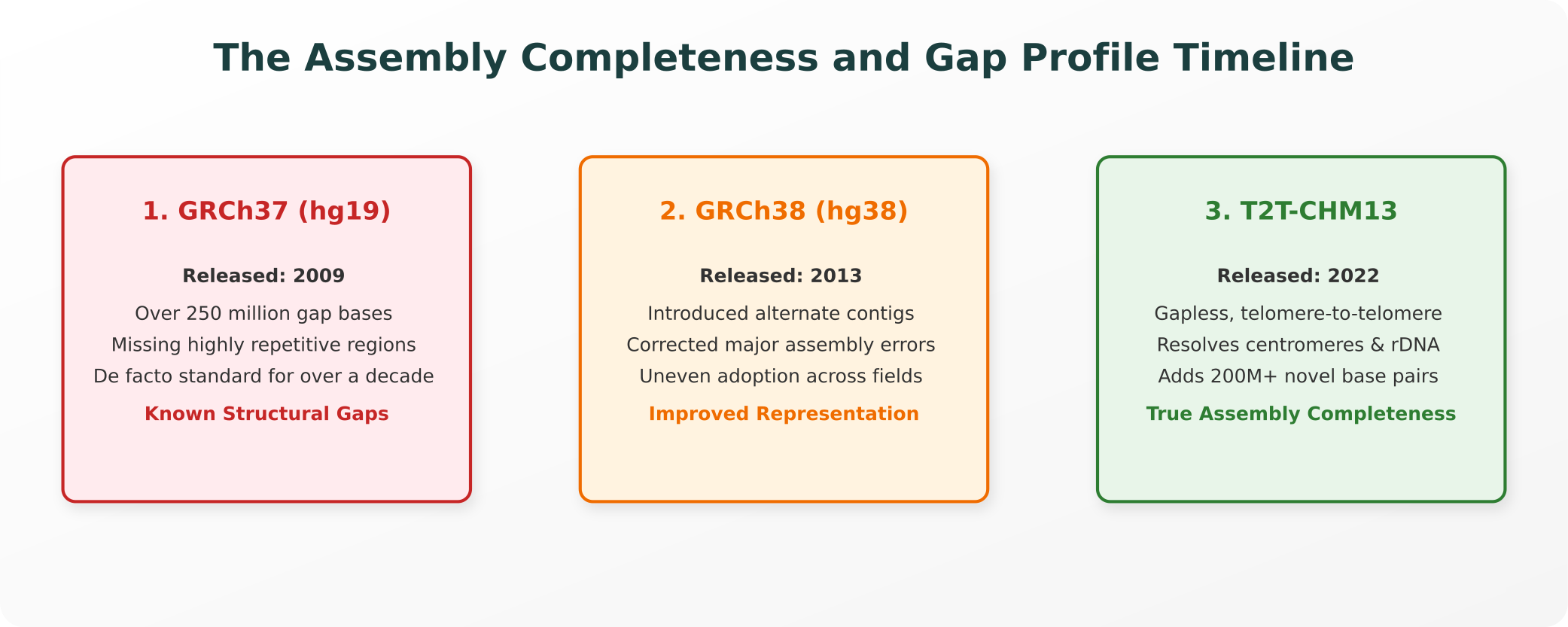
The Assembly Completeness and Gap Profile Timeline
Biological assemblies have evolved from fragmented draft consensus records to complete, telomere-to-telomere sequence mappings:
1. GRCh37 (hg19): The Long-Standing Baseline
Released by the Genome Reference Consortium (GRC) in 2009, GRCh37 (commonly referred to as hg19 when packaged by UCSC) served as the de facto international baseline for clinical sequencing and secondary analysis for over a decade.
- What It Is: GRCh37 is a composite reference genome assembled from Sanger sequencing reads of multiple anonymous human donors.
- Why It Persisted: Despite its age, hg19 remained the clinical standard long after newer builds were released. Large-scale global databases (such as gnomAD and ClinVar), clinical diagnostic assays, and national cohort projects had built massive, validated coordinate-level archives. Re-aligning millions of raw FASTQ files to a new reference required immense computational cost and regulatory validation, creating high institutional inertia against upgrading.
- Gaps and Limitations: Because GRCh37 was assembled using shorter Sanger reads, it contained over 250 million gaps represented as Ns in the sequence. These gaps were concentrated in highly repetitive, heterochromatic regions (such as centromeres, telomeres, and ribosomal DNA arrays), leaving large stretches of the human genome completely unmapped.
2. GRCh38 (hg38): The Structural Realignment
Released in late 2013, GRCh38 (hg38) was designed to correct major structural assembly errors, close thousands of physical sequencing gaps, and introduce a more flexible genomic architecture.
- What Changed: GRCh38 closed major sequence gaps, corrected misassembled genes, and updated the coordinates of thousands of established loci.
- Alternate Contigs and Patches: To capture human genetic diversity without altering the coordinates of the primary assembly, GRCh38 introduced alternate loci contigs (ALT contigs) and periodic patch releases. These ALT contigs represent highly divergent structural haplotypes (such as the MHC region on chromosome 6) as separate, unlocalized sequences, allowing alignment tools to map reads to divergent alleles.
- Uneven Adoption Barriers: While hg38 represented a massive biological improvement, its adoption was slow and uneven across the field. Standard alignment tools that were not optimized for ALT contigs (such as older versions of BWA) mapped reads redundantly, resulting in low mapping quality scores (MAPQ) and missed variant calls. Re-processing established cohort data remained computationally expensive, leaving many major consortia anchored on hg19 for years.
3. T2T-CHM13: True Assembly Completeness
In 2022, the Telomere-to-Telomere (T2T) Consortium published T2T-CHM13, representing the first complete, gapless assembly of a human genome.
- What “Telomere-to-Telomere” Actually Means: Prior assemblies left centromeres, telomeres, and repetitive segmental duplications completely unresolved. By utilizing ultra-long, high-accuracy sequencing technologies (such as PacBio HiFi and Oxford Nanopore), the T2T Consortium successfully sequenced through these repetitive barriers, resolving every chromosome from one telomeric end to the other without a single sequencing gap.
- Unlocking New Biology: T2T-CHM13 resolved over 200 million novel base pairs that were completely missing or represented as gaps in GRCh38. This newly mapped sequence includes nearly a hundred novel protein-coding genes and resolves highly repetitive centromeric regions and ribosomal DNA arrays.
- Current Adoption Status: T2T-CHM13 represents a major milestone, but it functions as an emerging rather than a fully universal standard. Because it is derived from a homozygous, complete hydatidiform mole cell line (CHM13), it lacks a Y chromosome in its default assembly (which was later resolved by sequencing a separate male donor). Furthermore, because clinical annotation databases and diagnostic frameworks are anchored on GRCh38, transitioning clinical pipelines to T2T-CHM13 is a gradual, ongoing process.
Why Mismatches Actually Break Pipelines
When files using different reference builds are combined in a single workflow, the resulting failures are rarely obvious. Instead, they manifest as silent, untracked coordinate realignments that compromise data integrity:
- Silent Coordinate Shifts: A specific nucleotide coordinate on chromosome 1 in GRCh37 does not point to the same physical position on chromosome 1 in GRCh38. Because coordinates shift by millions of bases due to closed gaps and structural corrections, querying hg17/hg19 coordinates against an hg38 annotation database will silently extract annotations for completely different genes, introducing massive false-positive or false-negative clinical calls without throwing any system errors.
- Liftover Failures in Divergent Regions: Researchers often use liftover tools (such as CrossMap or UCSC liftover) to translate coordinates from one build to another. While highly effective for simple, non-divergent regions, liftover tools regularly introduce errors in structurally divergent areas. If a genomic region was misassembled or underwent massive structural revision between GRCh37 and GRCh38, the liftover tool will either fail to map the coordinates (resulting in lost variant records) or map them incorrectly, introducing false variants.
- Impaired Variant Replication: Large-scale association studies (GWAS) often fail to replicate findings simply because different cohorts utilized different reference builds during the initial alignment phase, shifting association coordinates and obscuring true replication signals.
A Practical Guide to Build Verification
To prevent build-mismatch errors in computational pipelines, researchers should adopt several strict verification habits:
- Verify the Fasta Header: Never trust file extensions or directory names. Always inspect your reference genome FASTA file header. If chromosome names begin with
chr(e.g.,>chr1), the file likely follows the UCSC naming convention (hg19/hg38). If they begin with numbers directly (e.g.,>1), the file follows the Ensembl/GRC naming convention (GRCh37/GRCh38). Mismatching these styles causes standard annotation tools to crash instantly. - Document Build Metadata in VCFs: When generating Variant Call Format (VCF) files, always ensure the file header contains explicit
##referencefields documenting the exact reference assembly file and build version used during alignment. - Minimize Liftover Use: Treat liftover tools as a convenient, preliminary option for discovery, never as a clinical standard. For final clinical variant annotations or high-confidence association studies, always re-align your raw FASTQ reads directly to your target reference genome to ensure complete coordinate alignment and biological accuracy.
References and Authoritative Specifications
For researchers seeking to review the primary literature and genomic assemblies discussed, the following publications serve as authoritative, verified references:
- The Genome Reference Consortium (GRC): Official portal documenting assembly updates, patch releases, and coordinate mappings for GRCh37 and GRCh38. ncbi.nlm.nih.gov/grc
- The T2T-CHM13 Publication: Sergey Nurk et al. (2022). “The complete sequence of a human genome.” Science, 376(6588), 44-53. doi:10.1126/science.abj6987
- UCSC Genome Browser Gateway: Assembly metadata, liftover chain files, and coordinate browser for hg19, hg38, and T2T-CHM13. genome.ucsc.edu
- The original SAM/BAM and alignment standards: Heng Li et al. (2009). “The Sequence Alignment/Map format and SAMtools.” Bioinformatics, 25(16), 2078-2079. doi:10.1093/bioinformatics/btp352
Explore Purna's Molecular Intelligence Platform
AI-powered workspace for biology teams to accelerate drug discovery from target identification to lead optimization.
Try Purna AI →