
Peptide vs Protein vs Antibody Therapeutics: How the Development Pipelines Actually Differ
The classification of therapeutic agents as “biologics” or “biotherapeutics” is common in biopharmaceutical reporting. While convenient for high-level regulatory grouping, lumping peptides, non-antibody proteins, and monoclonal antibodies into a single category obscures the real, highly practical differences in how these three modalities are discovered, manufactured, and developed.
Each modality represents a distinct molecular scale and biophysical profile. A peptide, a non-antibody protein (such as an enzyme or cytokine), and a monoclonal antibody (mAb) require entirely different manufacturing infrastructures, preclinical testing assays, and regulatory filing strategies. Misunderstanding these operational divergences leads to inaccurate timeline planning, misallocated budgets, and failed clinical translations.
This article provides a technically precise comparison of these three modalities, analyzing how their development pipelines, manufacturing processes, and clinical translation paths actually differ.
Development Profiles by Modality
The molecular scale of each therapeutic class dictates its physical production methods, stability profiles, and clinical timelines:
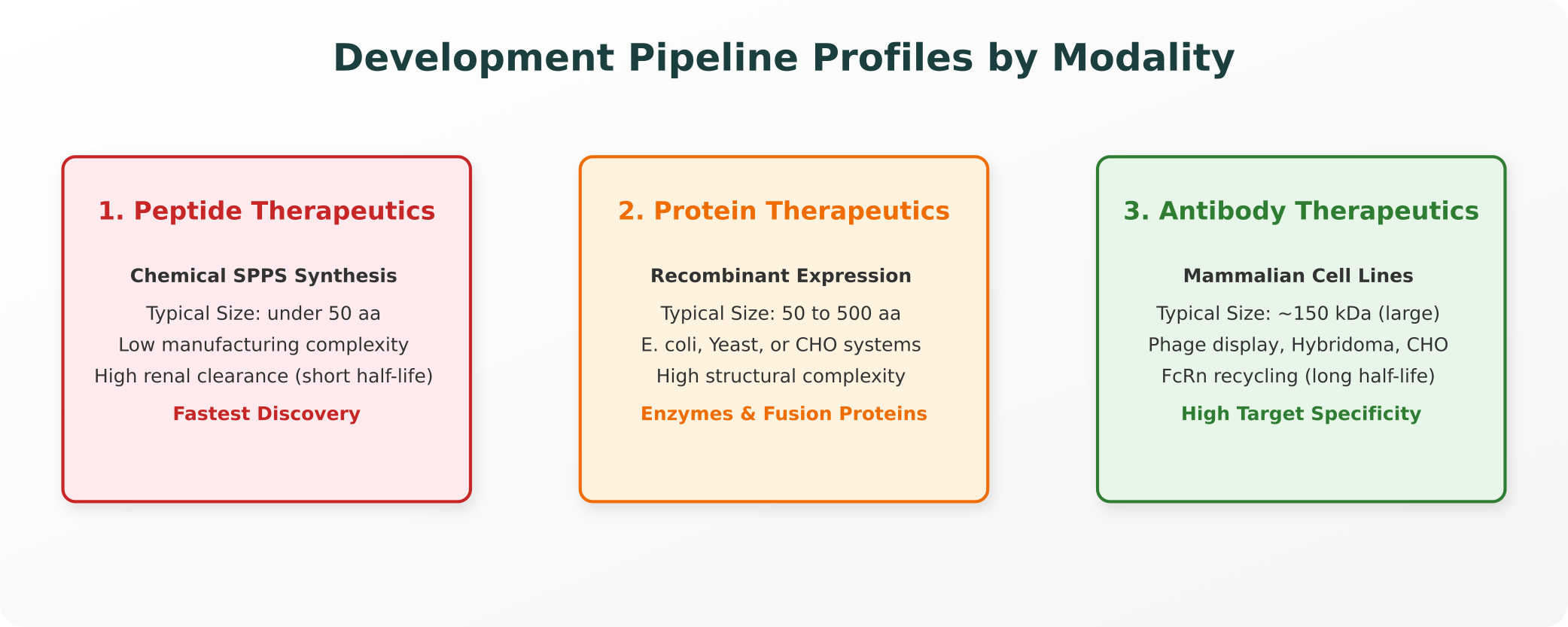
1. Peptide Therapeutics: Chemical Precision, Half-Life Barriers
Peptide therapeutics represent the bridge between small-molecule chemistry and large macromolecular biologics.
- Molecular Profile: Typically defined as chains containing fewer than 50 amino acids, with molecular weights generally below 5 to 10 kilodaltons (kDa).
- Discovery and Design: Peptides are often discovered through natural sequence derivation (such as hormone sequences) or selected programmatically via synthetic display libraries (like phage display). Their small size allows for rapid, iterative chemical modifications, such as introducing unnatural amino acids or cyclization, to optimize binding affinity and target specificity.
- Manufacturing Methods: Unlike larger proteins, peptides are primarily manufactured using Solid-Phase Peptide Synthesis (SPPS), a fully chemical process. This eliminates the need for biological cell culture expression, host cell protein purification, or viral clearance steps, resulting in simpler, highly reproducible manufacturing.
- Development Challenges: The primary bottleneck in peptide development is metabolic stability. Because linear peptides are rapidly degraded by circulating proteases and filtered by the kidneys (renal clearance), they often have very short half-lives (frequently measured in minutes). Extending their half-life requires chemical engineering steps (such as PEGylation, fatty acid conjugation, or backbone modifications) which can extend both the discovery phase and the preclinical formulation timeline.
2. Protein Therapeutics: Structural Complexity and Recombinant Expression
Non-antibody protein therapeutics encompass highly diverse functional classes, including replacement enzymes, growth factors, cytokines, and recombinant fusion proteins.
- Molecular Profile: Typically range from 50 to over 500 amino acids, with molecular weights stretching from 10 to over 100 kDa.
- Discovery and Design: Discovery begins with identifying a target biological function (such as an enzyme deficiency) and cloning the corresponding human gene. Unlike antibodies, which bind and block targets, non-antibody proteins are often engineered to replace missing endogenous activity or act as receptor agonists.
- Manufacturing Methods: Because of their larger size and folding complexity, these molecules cannot be synthesized chemically. They are manufactured using recombinant expression systems, utilizing hosts like Escherichia coli (for simpler, non-glycosylated proteins), yeast (Saccharomyces cerevisiae), or mammalian cell lines (such as Chinese Hamster Ovary, or CHO, cells) for proteins requiring complex post-translational modifications (PTMs).
- Development Challenges: Non-antibody proteins often contain complex tertiary and quaternary structures, making them highly sensitive to physical instability, aggregation, and denaturation during manufacturing biotherapeutics processes. Recombinant expression also requires rigorous downstream purification to remove host cell contaminants, adding significant cost and time compared to chemical peptide synthesis.
3. Antibody Therapeutics: High Specificity, Mammalian Scale
Monoclonal antibodies and their derivatives represent the largest and most established biopharmaceutical class, characterized by extreme targeting specificity and extended half-lives.
- Molecular Profile: Classic IgG antibodies are large, Y-shaped glycoproteins with molecular weights of approximately 150 kDa.
- Discovery and Design: Monoclonal antibodies are discovered using established immunological and molecular platforms, primarily hybridoma technology, phage display, or transgenic animals. The discovery phase is highly structured but requires substantial upfront investment to screen and humanize candidate clones.
- Manufacturing Methods: Antibodies require complex glycosylation patterns to maintain stability and engage host immune effector functions. Consequently, they are manufactured almost exclusively in mammalian expression systems, primarily CHO cell lines, in large-scale bioreactors.
- Development Challenges: The antibody drug pipeline involves a long, expensive cell-line development (CLD) phase to identify and clone high-producing, stable cell lines (known as “clones”). The downstream purification process is highly standardized (utilizing Protein A chromatography) but involves substantial raw material costs. However, antibodies possess a major biophysical advantage: they engage the neonatal Fc receptor (FcRn), which rescues them from cellular degradation and grants them exceptionally long circulating half-lives (frequently 2 to 3 weeks in humans).
Direct Pipeline Comparison
The following comparison table outlines how the development, manufacturing, and clinical development of biologics parameters differ across the three modalities:
| Parameter | Peptide Therapeutics | Recombinant Proteins | Antibody Therapeutics |
|---|---|---|---|
| Primary Production Method | Chemical (SPPS) | Recombinant (E. coli, Yeast, CHO) | Recombinant Mammalian (CHO) |
| Structural Complexity | Low (linear, cyclic, simple folds) | High (complex folds, multiple domains) | Extremely High (disulfide bonds, glycosylation) |
| Typical In Vivo Half-Life | Minutes to hours (unless modified) | Hours to days | 2 to 3 weeks (due to FcRn recycling) |
| Immunogenicity Risk | Low | Moderate to high (especially foreign enzymes) | Moderate (humanized or fully human mAb) |
| Typical Discovery Phase | Short (weeks to months) | Moderate (months) | Long (months to years, including humanization) |
| Manufacturing Scale-Up | Chemical scale-up (linear, predictable) | Highly variable (expression host dependent) | Standardized but slow (mammalian cell line development) |
| Filing & Regulatory Pathway | NDA (FDA CDER, chemical pathway) | BLA (FDA CDER/CBER, biologics pathway) | BLA (FDA CDER, standard biologics pathway) |
Navigating Modality Selection
Understanding the biophysical and operational profiles of peptide versus protein therapeutics helps research teams choose the most appropriate modality for their target:
- Peptides are the practical choice for intracellular targets or extracellular receptors where a short, synthetic molecule can act as an agonist or competitive blocker with low manufacturing overhead and low immunogenicity.
- Non-antibody proteins are the essential choice when the therapeutic objective is functional replacement (such as enzyme replacement therapy) or when a complex, multi-domain signaling cascade must be triggered.
- Antibodies remain the standard for extracellular targeting where high specificity, long systemic circulation, and robust engagement of host immune functions are required to achieve a therapeutic effect.
By grounding modality decisions in these clear, structural and manufacturing realities rather than generic biological groupings, biopharmaceutical teams can plan realistic development timelines, allocate budgets accurately, and design pipelines for clinical success.
References and Authoritative Sources
For researchers seeking to review the clinical and regulatory frameworks governing these biotherapeutic modalities, the following peer-reviewed articles and regulatory guidelines serve as primary references:
- Peptide Therapeutics Landscape: Lau, J. L., & Dunn, M. K. (2018). “Therapeutic peptides: Historical perspectives, current directions, and future directions.” Bioorganic & Medicinal Chemistry, 26(10), 2700-2707. doi:10.1016/j.bmc.2017.06.015
- Clinical Development of Biologics: Mullard, A. (2024). “FDA drug approvals.” Nature Reviews Drug Discovery. nature.com/nrd
- Monoclonal Antibody Manufacturing: Ecker, D. M., Jones, S. D., & Levine, H. L. (2015). “The therapeutic monoclonal antibody market.” mAbs, 7(1), 9-14. doi:10.4161/19420862.2015.989042
- FDA Guidance on Biosimilars and Biologics: “Scientific Considerations in Demonstrating Biosimilarity to a Reference Product.” U.S. Food and Drug Administration. fda.gov/regulatory-information
Explore Purna's Molecular Intelligence Platform
AI-powered workspace for biology teams to accelerate drug discovery from target identification to lead optimization.
Try Purna AI →