What an API Actually Does in a Molecular Intelligence Platform
The term “API” is used constantly in modern biotechnology and informatics. As research software has transitioned from isolated, local scripts to cloud-native platforms, APIs have become the invisible connective tissue of modern science. However, while most researchers understand at a high level that an API connects different software tools, they often lack a precise mental model of what it actually does mechanically and why it represents a major engineering hurdle in computational biology.
At its most fundamental level, an Application Programming Interface (API) is a defined, structured way for one piece of software to request data or functionality from another, without needing to know how that system works internally.
This guide defines the core concepts of an API in plain terms, grounds them in real biological databases, and explores why cross-database bioinformatics API integration is a difficult engineering challenge.
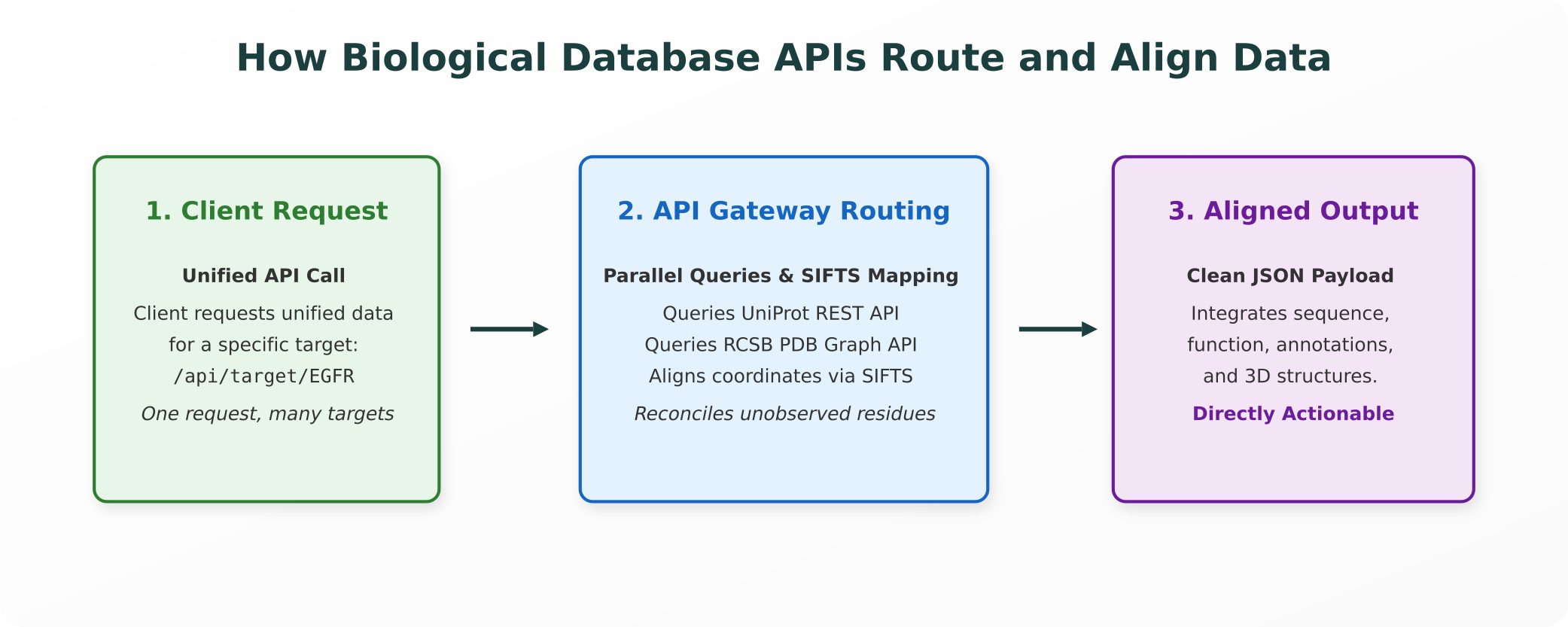
How Biological Database APIs Route and Align Data
APIs act as the active routing layer that connects and aligns disparate biological databases into a single, cohesive dataset:
1. Defining the Core Concept Precisely
To understand what is an API, it is useful to begin with a standard, real-world analogy.
Consider a restaurant menu. As a diner, you look at the menu to see what dishes are available. When you place an order with the waiter, you are making a structured request. The kitchen receives your order, prepares the dish, and the waiter delivers it back to you. Crucially, you do not need to know how the kitchen operates, who is cooking, or what specific stoves are used; you only need to know how to read the menu and make a structured request.
In software engineering, the API is the menu. It establishes a set of strict rules and “endpoints” (the dishes) that a client software can query. When your software sends a structured request to an external server’s API endpoint, that server processes the query, retrieves the data from its internal databases, and returns a clean, structured payload (usually in JSON format) back to your application. This allows different platforms to share data seamlessly, completely hiding the internal complexity of their databases and codebases.
2. Grounding the Concept in Real Biological APIs
This mechanism is not just a theoretical abstraction. It is the primary way biological knowledge is shared globally. Every major biological database maintains a public biological database API to allow researchers to query their datasets programmatically:
The UniProt REST API
The Universal Protein Resource (UniProt) is the world’s primary repository for protein sequence and functional annotation data.
- The Scale: The UniProt REST API is freely available, requires no login, and powers UniProt.org itself. It handles an average of 303 million requests per month from researchers and external platforms globally.
- The Mechanism: When a software platform needs to retrieve functional annotations for a target protein, it does not download the entire multi-gigabyte UniProt database. Instead, it sends a single, rapid HTTPS request to the UniProt API endpoint (such as
https://rest.uniprot.org/uniprotkb/P00533.json), which instantly returns a clean, structured JSON file containing the sequence, catalytic sites, and disease associations for the target receptor.
The RCSB PDB API
The Research Collaboratory for Structural Bioinformatics Protein Data Bank (RCSB PDB) houses three-dimensional structural data for macromolecules.
- The Access Methods: The PDB maintains two distinct API architectures:
- REST APIs: Used for rapid, single-item lookups of structural metadata.
- GraphQL APIs: An advanced, highly flexible API design that allows client applications to request only the specific data fields they need in a single query, drastically reducing network payload sizes.
The PDBe Aggregated API
Protein Data Bank in Europe (PDBe) provides an integrated, structural knowledge graph.
- The Architecture: PDBe maintains a RESTful API with over 80 distinct endpoints. It continuously aggregates structural data from the PDB, sequence annotations from UniProt, and chemical details from ChEMBL, exposing this unified data graph via structured programmatic feeds updated weekly.
3. Why Cross-Database Integration Is a Hard Technical Problem
If public APIs are freely available for UniProt, PDB, and other repositories, why is combining them into a unified API in biology platform so difficult?
The challenge lies in data reconciliation. Different biological databases are designed, maintained, and updated independently by separate international organizations. They use distinct coordinate scales, nomenclatures, and indexing systems. Reconciling these differences is a major computational biology challenge, best illustrated by a real, structural resource: SIFTS.
The SIFTS Case Study
Structure Integration with Function, Taxonomy and Sequences (SIFTS) is an integrative resource jointly maintained by PDBe and UniProt. Its sole purpose is to map protein sequences (defined in UniProt) to their corresponding 3-dimensional structures (defined in the PDB) at the individual residue level.
- The Technical Difficulty: On paper, mapping a sequence to a structure sounds like a trivial database lookup. In reality, it is exceptionally hard. When a protein is crystallized for X-ray diffraction or imaged via Cryo-EM, flexible, highly disordered regions of the protein often do not resolve in the structural data.
- Unobserved Residues: These disordered regions create “unobserved residues”—segments of the amino acid sequence that physically exist in the UniProt record but are completely missing from the PDB 3D coordinate file.
- The Alignment Shift: This mismatch causes coordinate shifts. Residue 150 in the UniProt sequence may correspond to residue 120 in the PDB chain due to missing unobserved segments.
- The SIFTS Solution: SIFTS solves this by programmatically aligning every single residue across both databases daily. It records exactly which residues are unobserved, matches sequence coordinates to 3D chain coordinates, and exposes this mapping via dedicated API endpoints.
This case study demonstrates that querying an API is only the first step. The real engineering value of an integrated biology platform is the translation and reconciliation of differently structured datasets, ensuring that the biological context remains completely intact when data flows across different systems.
4. Practical Significance for Researchers
Understanding APIs allows researchers to move past manual, web-based workflows:
- Eliminating Manual Data-Copying: Without APIs, a researcher seeking to analyze a list of twenty mutated targets must manually visit UniProt.org to copy sequences, navigate to RCSB.org to download PDB files, and manually cross-reference coordinates in Excel.
- Programmatic Automation: By leveraging biological database APIs, researchers can write simple scripts to programmatically query multiple databases, align coordinates, and extract structured datasets in seconds. This ensures that analyses are automated, reproducible, and backed by the most current public data.
5. A Modern Extension: APIs as Tools for AI Agents
A highly active, current area of software engineering is the transition from human-queried APIs to AI-orchestrated tools. Modern AI systems capable of autonomous, multi-step reasoning do not possess built-in biological knowledge. Instead, they utilize APIs as their primary means of taking action:
- The Mechanism: When an AI research agent is tasked with evaluating a target, it uses APIs to programmatically query UniProt, retrieve PDB structural files, and run biochemical calculations.
- The Consequence: The same underlying API endpoints that human programmers write scripts to access are now serving as the fundamental toolset for autonomous software, enabling rapid, multi-stage scientific research pipelines orchestrated entirely by AI.
References and Primary Sources
For researchers looking to build, integrate, or reference biological APIs, the following public endpoints and peer-reviewed publications serve as primary, verified resources:
Programmatic Endpoints and Documentation
- UniProt REST API Documentation: Detailed access guides and schema structures for sequence-level queries. Available at: rest.uniprot.org
- RCSB PDB API Documentation: Documentation and specifications for REST and GraphQL structural metadata queries. Available at: data.rcsb.org
- PDBe API Documentation: Structural biology data aggregation endpoints from the Protein Data Bank in Europe. Available at: ebi.ac.uk/pdbe/api
- SIFTS Mapping Service: Primary data mappings between UniProt sequences and PDB structural coordinates at residue resolution. Available at: ebi.ac.uk/pdbe/docs/sifts
Primary Scientific Literature
- The UniProt Consortium. UniProt: the Universal Protein Knowledgebase in 2025. Nucleic Acids Research, 2025, Vol. 53, Database issue, D609-D617. DOI: 10.1093/nar/gkae1010
- Rose, Y., Duarte, J. M., Lowe, R., Segura, J., Bi, C., Bhikadiya, C., et al. RCSB Protein Data Bank: Architectural Advances Towards Integrated Searching and Efficient Access to Macromolecular Structure Data from the PDB Archive. Journal of Molecular Biology, 2021, Vol. 433, No. 11, 166704. DOI: 10.1016/j.jmb.2020.11.003
- Dana, J. M., Gutmanas, A., Harrus, P., Berrisford, J. M., Bando, O. D., Gane, P. J., et al. SIFTS: updated Structure Integration with Function, Taxonomy and Sequences resource allows 40-fold increase in coverage of structure-based annotations for proteins. Nucleic Acids Research, 2019, Vol. 47, Database issue, D482-D489. DOI: 10.1093/nar/gky1114
- Berman, H. M., Westbrook, J., Feng, Z., Gilliland, G., Bhat, T. N., Weissig, H., et al. The Protein Data Bank. Nucleic Acids Research, 2000, Vol. 28, No. 1, 235-242. DOI: 10.1093/nar/28.1.235
Explore Purna's Molecular Intelligence Platform
AI-powered workspace for biology teams to accelerate drug discovery from target identification to lead optimization.
Try Purna AI →