The Microbiome-Disease Connection: What's Proven, What's Still Speculative
The human gut microbiome represents one of the most complex, rapidly evolving fields of modern medical science. Housing tens of trillions of microbial cells and thousands of distinct species, this intricate ecosystem is actively involved in host metabolism, immune modulation, and overall physiological homeostasis. Over the past two decades, gut microbiome research has exploded, linking the composition of our gut bacteria to an enormous range of human conditions, from metabolic disorders and gastrointestinal infections to neurodegenerative diseases and psychiatric illnesses.
However, as the volume of publications grows, so too does the gap between biological reality and popular representation. In microbiome science, a fundamental division exists: the difference between an observational correlation and a demonstrated causal role. While it is simple to find statistical associations linking specific microbial signatures with various diseases, establishing that a change in the microbiome directly causes or modifies a disease phenotype is a much higher scientific bar.
This article provides a rigorous, evidence-grounded analysis of the microbiome-disease connection. By mapping current evidence across three distinct structural categories, we establish a clear framework for evaluating microbiome causation vs correlation in clinical medicine.
The Microbiome Evidence Matrix
To evaluate the validity of any microbiome-disease claim, researchers sort findings based on the strength of their underlying evidence, as illustrated in the following diagram:
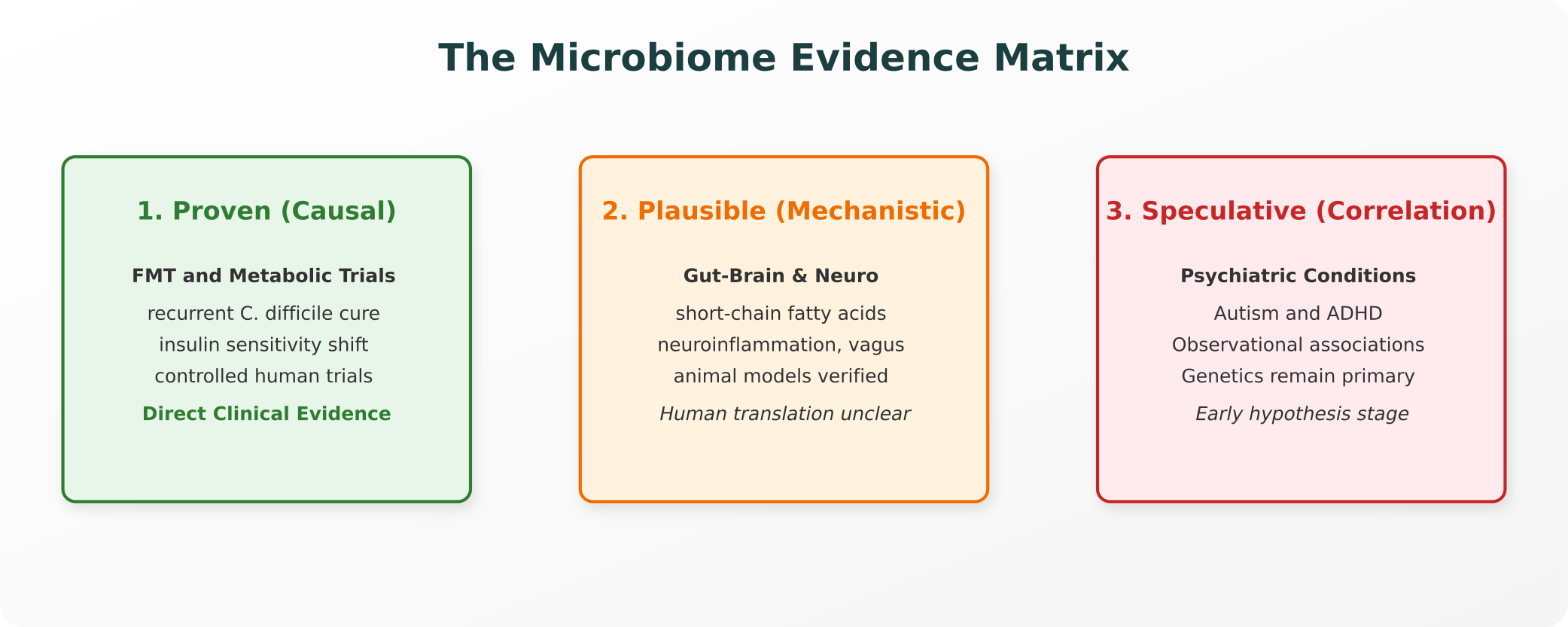
1. The Proven Category: Direct Human Clinical Causation
The gold standard for establishing causality in medical science is the prospective, randomized, controlled interventional trial in humans. In microbiome research, this is the only category that qualifies as “proven,” where changing the gut microbial composition directly results in a modified clinical outcome.
- Fecal Microbiota Transplantation (FMT) for C. difficile: This is the most robust, clinically validated example of microbiome-mediated disease modification. In patients with recurrent Clostridioides difficile infection, standard antibiotic therapy often fails, resulting in high relapse rates. Randomized clinical trials have consistently demonstrated that infusing a healthy donor’s fecal microbiota into the patient’s colon cures the infection in over 90% of cases, directly proving that restoring microbial diversity cures the disease pathology.
- Metabolic Phenotype Modulation: Beyond acute infections, controlled human FMT trials have demonstrated a causal role for gut microbial composition in host metabolic dysregulation. In randomized double-blind studies, transplanting the microbiota from lean, healthy donors into patients with metabolic syndrome resulted in a direct, statistically significant improvement in insulin sensitivity and glucose disposal.
These human interventional studies serve as the vital baseline of what “proven” looks like in this field: direct, controlled modification of the host microbiome in humans resulting in a measurable shift in host pathology, not merely an association in observational datasets.
2. The Plausible Category: Strong Mechanisms, Translation Gaps
The second category comprises conditions where scientists have mapped highly logical, biochemically plausible pathways, but where direct clinical causation in humans has not yet been established. The most prominent example is the study of the gut-brain axis evidence in neurodegenerative diseases like Parkinson’s and Alzheimer’s.
- Legitimate Biological Pathways: Researchers are actively investigating several high-value, biophysical communication channels connecting the gut to the brain:
- Short-Chain Fatty Acids (SCFAs): Microbial metabolites (such as butyrate, acetate, and propionate) enter systemic circulation to modulate host immune responses, microglia activation, and blood-brain barrier (BBB) integrity.
- Vagus Nerve Signaling: Direct neural communication between the enteric nervous system and the central nervous system via the vagus nerve.
- Systemic Neuroinflammation: Dysbiosis-induced gut permeability (often referred to as “leaky gut”) allows bacterial lipopolysaccharides (LPS) to enter circulation, driving chronic, low-grade systemic inflammation that can accelerate neurodegeneration.
- The Human Translation Gap: While these molecular pathways are highly compelling, the evidence remains heavily skewed toward animal models. A landmark 2022 review in the journal Science evaluated the current state of the gut-brain axis. The authors concluded that while the microbiome’s influence on brain function and behavioral development is well-established in gnotobiotic (germ-free) mice, the extent to which these rodent findings translate to human clinical causation remains largely unclear. Mouse physiology, diet, and lifespan are vastly different from humans, making the translation of these complex neurological phenotypes a major clinical hurdle.
3. The Speculative Category: Complex Neuropsychiatric Conditions
The most speculative and hyped category of microbiome research lies at the intersection of gut health and complex neuropsychiatric conditions, such as autism spectrum disorder (ASD), attention-deficit/hyperactivity disorder (ADHD), and major depressive disorder.
- The Causation vs. Correlation Dilemma: Numerous observational studies have noted that children with ASD have distinct gut microbial profiles compared to neurotypical controls, often accompanied by chronic gastrointestinal distress. However, disentangling cause from effect in these cohorts is exceptionally difficult.
- The Genetics and Diet Confounders: Neuropsychiatric conditions like autism have high, documented heritability, pointing to complex genomic variants as the primary biological drivers. Furthermore, children with ASD often display highly restricted, repetitive eating habits or sensory-based food preferences. This selective diet is itself a powerful driver of altered gut microbial composition. In this context, the altered microbiome is highly likely a secondary, diet-driven effect of the condition, rather than a primary or causal driver of the neurodevelopmental phenotype itself.
- Early-Stage Interventions: While some small-scale, open-label FMT or probiotic trials have reported behavioral improvements in ASD patients, these studies lack the sample sizes, double-blind controls, and long-term safety monitoring required to establish therapeutic efficacy. Currently, targeting the microbiome for psychiatric conditions remains in the early, hypothesis-generating phase, not established clinical practice.
4. Why This Distinction Matters Practically
The distinction between correlation and causation is not just an academic debate; it has direct, real-world consequences for patient safety and clinical integrity:
- The Poorly-Regulated Supplement Market: Conflating loose observational correlations with proven clinical outcomes has fueled a massive, multi-billion-dollar market for probiotic supplements and personalized “gut health” kits. Many of these products make bold, ungrounded claims regarding cognitive enhancement, metabolic control, or immune boosting, despite having zero clinical validation in healthy populations.
- Cultivating False Hope: For patients living with devastating, currently incurable neurodegenerative or psychiatric conditions, overhyped media coverage of early-stage, animal-model microbiome studies can create false hope, distracting resources and attention from clinically validated therapeutic interventions.
5. A Framework for Evaluating Future Microbiome Claims
To help navigate the constant stream of new publications and press releases, researchers and clinicians can utilize a simple, three-point evaluation framework:
- Was the Study Observational or Interventional? If a study simply documents that patients with disease X have different gut bacteria than healthy controls, it establishes association only. Direct causality can only be suggested if the study actively changes the microbiome (via FMT, selective antibiotics, or engineered live biotherapeutics) and measures whether the clinical disease outcome changes as a result.
- Was the Model Human or Animal? Always check the subject organism. If a paper demonstrates a spectacular microbiome-mediated cure, check if it was performed in germ-free mice. Remember that human physiological complexity and environmental variables are vastly more difficult to control than clean, laboratory mouse cages.
- Has the Finding Been Replicated? Microbiome composition is highly sensitive to geography, diet, genetics, and methodology. A single-cohort association in one country must be replicated across independent global cohorts before it can be treated as a stable, generalizable scientific pattern.
By applying this rigorous, evidence-based skepticism to every emerging claim, the scientific community can appreciate the genuine, exciting potential of microbiome research while preventing the spread of ungrounded, speculative hype.
MIP is Purna AI’s Molecular Intelligence Platform, an AI-powered workspace for biology teams. Genomic variant interpretation, protein structure prediction, multi-omics analysis, bioinformatics code execution, and 30+ database integrations in one place. Explore the platform at purna.ai. Researchers can apply for up to $10,000 in free credits to run their analyses on MIP.
References
- FMT for Recurrent C. difficile:
- van Nood, E., Vrieze, A., Speelman, P., et al. (2013). Duodenal Infusion of Donor Feces for Recurrent Clostridium difficile. New England Journal of Medicine, 368(5), 407-415. DOI: 10.1056/NEJMoa1205037
- FMT for Metabolic Syndrome and Insulin Sensitivity:
- Vrieze, A., Van Nood, E., Holleman, F., et al. (2012). Transfer of Intestinal Microbiota from Lean Donors Increases Insulin Sensitivity in Individuals with Metabolic Syndrome. Gastroenterology, 143(4), 913-916. DOI: 10.1053/j.gastro.2012.06.031
- The Gut-Brain Axis and Causality:
- Cryan, J. F., & Mazmanian, S. K. (2022). Microbiota-Brain Axis: Context and Causality. Science, 376(6596), 938-939. DOI: 10.1126/science.abo4442
- Dietary Confounders in Autism-Microbiome Studies:
- Yap, C. X., Henders, A. K., Alvares, G. A., et al. (2021). Autism-Related Dietary Preferences Mediate Autism-Gut Microbiome Associations. Cell, 184(24), 5916-5931. DOI: 10.1016/j.cell.2021.10.015
Explore Purna's Molecular Intelligence Platform
AI-powered workspace for biology teams to accelerate drug discovery from target identification to lead optimization.
Try Purna AI →