What Scientists Should Expect From a Biology AI Assistant With Citations
A biology AI assistant with citations should help scientists move from a biological question to reviewable evidence. It should not simply produce a fluent paragraph about a gene, variant, pathway, or paper. The useful version retrieves current sources, shows where each claim came from, separates database records from model inference, and leaves enough context for an expert to verify the answer.
That distinction matters because biology is full of precise identifiers, changing records, and evidence hierarchies. A gene symbol can refer to multiple transcripts. A variant classification can change in ClinVar. A protein annotation can differ by isoform. A paper summary can lose the difference between a mouse model, a cell line experiment, and a human cohort. Citations are not decoration in this setting. They are part of the scientific object being evaluated.
flowchart LR
  A["Biology question"] --> B["Normalize entities"]
  B --> C["Query databases and papers"]
  C --> D["Attach claim-level citations"]
  D --> E["Separate evidence, analysis, and interpretation"]
  E --> F["Scientist verifies sources"]
  C --> G["Record missing or conflicting evidence"]
  G --> E

  classDef input fill:#e0f2f1,stroke:#1b3f3f,color:#000000;
  classDef citation fill:#fff8e1,stroke:#1b3f3f,color:#000000;
  classDef review fill:#f3e5f5,stroke:#1b3f3f,color:#000000;
  class A,B input;
  class C,D,G citation;
  class E,F review;
Why a biology AI assistant with citations is different from a general chatbot
A general chatbot can explain concepts, draft code, and summarize familiar biology topics. It may be useful for brainstorming or for turning notes into clearer prose. But it is not automatically a reliable evidence layer for research decisions.
The issue is not just hallucination in the ordinary sense. The deeper problem is that biological knowledge is stored in curated, versioned, and specialized systems. ClinVar tracks variant interpretations and review status. UniProt curates protein function, domains, isoforms, and cross-references. The AlphaFold Protein Structure Database provides predicted structures at very large scale, with the 2024 Nucleic Acids Research update describing coverage for more than 214 million protein sequences. PubMed and journal databases organize literature, but they do not interpret experimental quality for you.
A scientific AI assistant must therefore do more than answer from model memory. It needs a retrieval layer, a database layer, and a reasoning layer that can preserve source context.
This is the same principle behind molecular intelligence: the useful system is not a chatbot bolted onto biology. It is an intelligent workspace connected to the data infrastructure scientists already trust.
The citation problem scientists actually need solved
Many tools claim to cite sources. For scientists, that is not enough. A citation is useful only if it supports the exact claim being made.
Consider the statement:
“This variant has evidence for pathogenicity.”
A scientist needs to know:
- Which variant notation was used?
- Which transcript or genome build was assumed?
- Was the source ClinVar, a primary paper, a prediction tool, or model inference?
- What was the review status or evidence strength?
- Were there conflicting submissions or contradictory papers?
- When was the source record accessed?
- Does the citation support the whole sentence, or only one part of it?
A weak assistant treats citation as a footnote. A strong assistant treats citation as a constraint on the answer.
Biomedical AI research is moving in this direction. A 2025 Nature Communications benchmark evaluated large language models across biomedical natural language processing tasks and emphasized careful task-specific evaluation rather than broad assumptions about model ability. A 2025 Journal of the American Medical Informatics Association systematic review of retrieval-augmented generation in biomedicine similarly framed retrieval as a way to improve biomedical LLM applications, while still requiring clinical and methodological safeguards.
The practical lesson is simple: retrieval helps, but retrieval alone is not enough. Scientists need source-aware synthesis.
What a biology AI assistant with citations should include
The best way to evaluate an AI research assistant for biology is to look for capabilities that map to the research workflow, not to the demo.
1. Live access to biological databases
Static model memory is not enough for biological research. A useful assistant should be able to query live or regularly updated resources when the question depends on current records.
Examples include:
- ClinVar for variant classifications, review status, clinical significance, and submission history. The 2025 Nucleic Acids Research ClinVar update describes continued support for germline and somatic variant classifications.
- gnomAD for population allele frequency and constraint context.
- UniProt for protein function, domains, variants, isoforms, and cross-references. The 2025 Nucleic Acids Research UniProt update describes the knowledgebase as a central resource for protein information.
- PDB and AlphaFold for structural context.
- OMIM, PharmGKB, LOVD, pathway resources, and literature databases where relevant.
The assistant should also tell you which resources were not checked. Missing evidence is often as important as positive evidence.
2. Entity normalization before answering
Biological questions depend on precise identifiers. A biology AI assistant should normalize entities before it synthesizes.
For a variant question, that may mean clarifying HGVS notation, transcript accession, genome build, gene symbol, dbSNP identifier, and protein change. For a protein question, it may mean selecting the relevant isoform and mapping residues between sequence and structure. For an omics question, it may mean preserving organism, tissue, assay type, reference genome, and sample metadata.
Without normalization, an assistant can cite the right database but answer the wrong question.
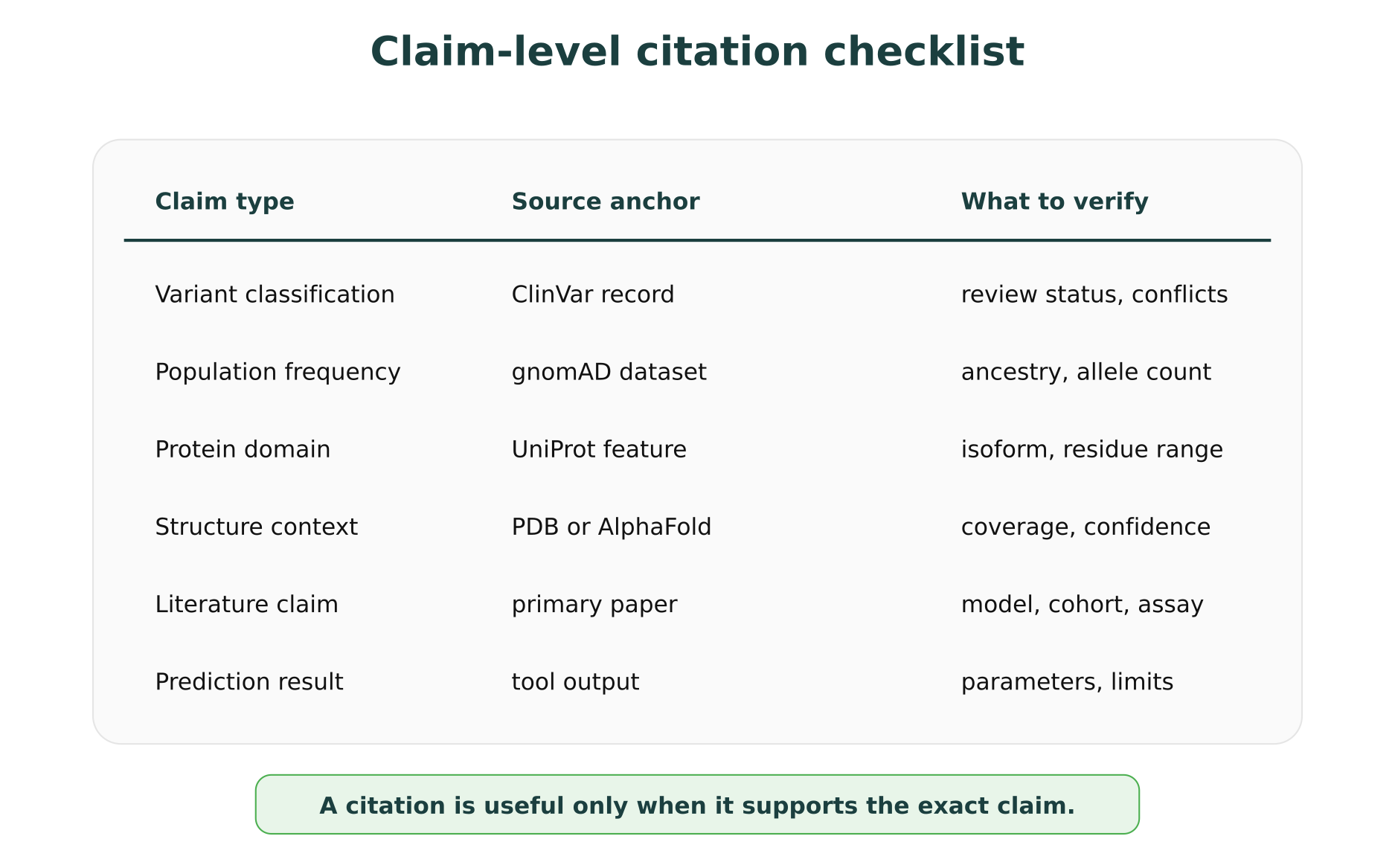
3. Claim-level citations
A paper-level citation at the end of a paragraph is not enough. The system should link claims to source records or specific papers.
For example:
| Claim type | Good source anchor | What to verify |
|---|---|---|
| Variant classification | ClinVar variation record | Review status, submitter conflicts, condition |
| Population frequency | gnomAD variant page or dataset version | Ancestry group, allele count, coverage |
| Protein domain | UniProt feature annotation | Isoform, residue range, domain evidence |
| Structure context | PDB entry or AlphaFold model | Coverage, confidence, experimental method |
| Literature claim | Primary paper, not only review | Model system, sample size, perturbation |
| Prediction result | Tool output and parameters | Method limits, confidence, reproducibility |
This is the difference between a cited answer and a reviewable answer.
4. Separation of evidence, analysis, and interpretation
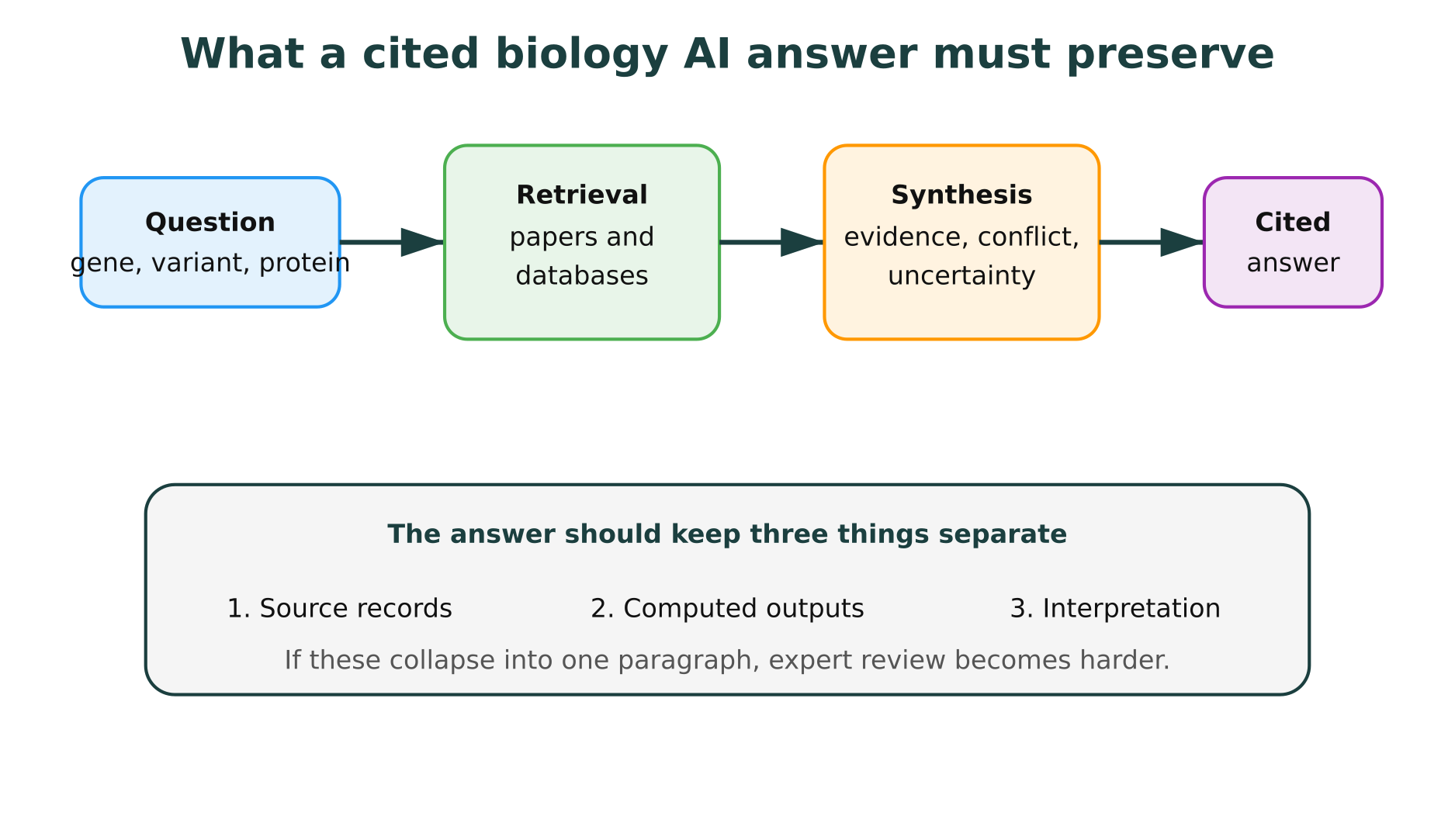
A biology AI assistant should make clear what was retrieved, what was computed, and what was inferred.
For example, in a missense variant workflow:
- Evidence: ClinVar has conflicting submissions, gnomAD frequency is low, UniProt shows the residue in a functional domain.
- Analysis: A stability model predicts a negative ΔΔG, and conservation analysis shows high conservation across orthologs.
- Interpretation: The variant may warrant prioritization for review, but classification still requires expert evaluation under the appropriate framework.
Those layers should not be collapsed into one confident sentence. In biology, the source of a claim changes how it should be trusted.
A practical example: evaluating a variant with a cited assistant
A researcher might ask:
“For this missense variant in a cardiomyopathy gene, summarize disease association, population frequency, protein domain context, structural context, and any conflicting evidence.”
A general chatbot may return a plausible explanation of the gene and disease. A biology AI assistant with citations should follow a more structured path.
Step 1: Normalize the variant
The assistant should identify the gene, transcript, protein change, genome build, and any alternative identifiers. If the prompt is ambiguous, it should say so rather than guessing silently.
Step 2: Route to relevant sources
The system should query the evidence types that match the question:
- ClinVar or LOVD for clinical assertions
- gnomAD for population frequency
- OMIM or ClinGen for gene-disease validity where available
- UniProt for domains and functional annotations
- PDB or AlphaFold for structure context
- PubMed or journal sources for recent disease literature
Step 3: Return a source-backed evidence table
The output should include a table like:
| Evidence category | Finding | Source | Confidence or caveat |
|---|---|---|---|
| Clinical assertions | Conflicting or reviewed classification | ClinVar | Review status matters |
| Population frequency | Rare, absent, or enriched | gnomAD | Check ancestry-specific counts |
| Gene-disease link | Established or limited | OMIM, ClinGen, literature | Disease specificity matters |
| Protein context | Domain, motif, interface, conservation | UniProt, structure resources | Isoform and coverage matter |
| Structural prediction | Local environment and stability estimate | PDB, AlphaFold, DynaMut2-like output | Prediction is not clinical evidence by itself |
Step 4: State what still requires expert review
The final interpretation should be explicit about uncertainty. It might say:
“The evidence supports prioritizing this variant for expert review because it is rare, maps to a conserved functional region, and has relevant disease literature. This is not a final classification. Review transcript choice, database version, submitter conflicts, phenotype fit, and applicable ACMG/AMP criteria before acting.”
That kind of answer is less flashy than a single conclusion, but it is far more useful for science.
Red flags when evaluating AI research assistants for biology
Scientists should be skeptical of tools that make citation quality hard to inspect. Watch for these red flags.
Citations that do not support the sentence
If a citation points to a paper about the general pathway but the sentence makes a specific claim about a variant, cohort, or mechanism, the citation is too weak.
Missing database version or access context
For changing resources, access date and dataset version matter. ClinVar, UniProt, AlphaFold DB, and literature indexes evolve. A good assistant should preserve enough context to reproduce or audit the result.
No negative evidence
Many scientific questions are shaped by what is not found. If the assistant only returns positive-looking evidence, it may be filtering out uncertainty.
Over-synthesis across incompatible evidence
Human cohort results, mouse models, cell lines, protein predictions, and pathway databases are not interchangeable. A useful assistant separates them rather than turning them into one undifferentiated claim.
No route back to source records
A citation that cannot be clicked, inspected, or exported is weak provenance. For serious research work, the assistant should let scientists open source records, papers, and analysis outputs.
What AI can help with, and what researchers must still verify
A cited scientific AI assistant can reduce a lot of mechanical work. It can search databases, summarize papers, extract claims, assemble evidence tables, draft methods-aware explanations, and prepare review notes. But it should not remove the scientist from the loop.
| AI can help with | Researchers must verify |
|---|---|
| Finding relevant papers and database records | Whether sources are complete and appropriate |
| Normalizing identifiers and routing queries | Transcript, genome build, isoform, and organism context |
| Summarizing evidence across sources | Whether the citation supports each claim |
| Creating evidence tables | Whether evidence strength is weighted correctly |
| Drafting interpretations | Whether conclusions follow from the data |
| Suggesting hypotheses | Whether they are testable and biologically plausible |
This is especially important in clinical or regulated contexts, where validated workflows, documented review, and professional oversight remain essential.
How Purna’s Molecular Intelligence Platform fits
Purna AI’s Molecular Intelligence Platform is built around the idea that a biology AI assistant should be connected to biological infrastructure. It is designed to answer questions with source-backed evidence across clinical and biological databases, not just from model memory.
In MIP, a researcher can ask about a gene, variant, protein, disease mechanism, or omics result, then inspect the supporting evidence. The platform connects to 30+ biological and clinical databases, including resources such as ClinVar, gnomAD, OMIM, UniProt, PDB, PharmGKB, and LOVD. For protein and structure workflows, MIP can retrieve PDB or AlphaFold structures, visualize proteins in Molstar, run DynaMut2 stability analysis, and connect structural results to domains, conservation, and functional interpretation.
This makes citations part of the workflow rather than an afterthought. The goal is not to replace expert judgment. It is to make evidence gathering faster, clearer, and easier to review.
For related reading, see natural language bioinformatics, how to query biological databases using natural language, and AI tools for biology research.
Evaluation checklist for a biology AI assistant with citations
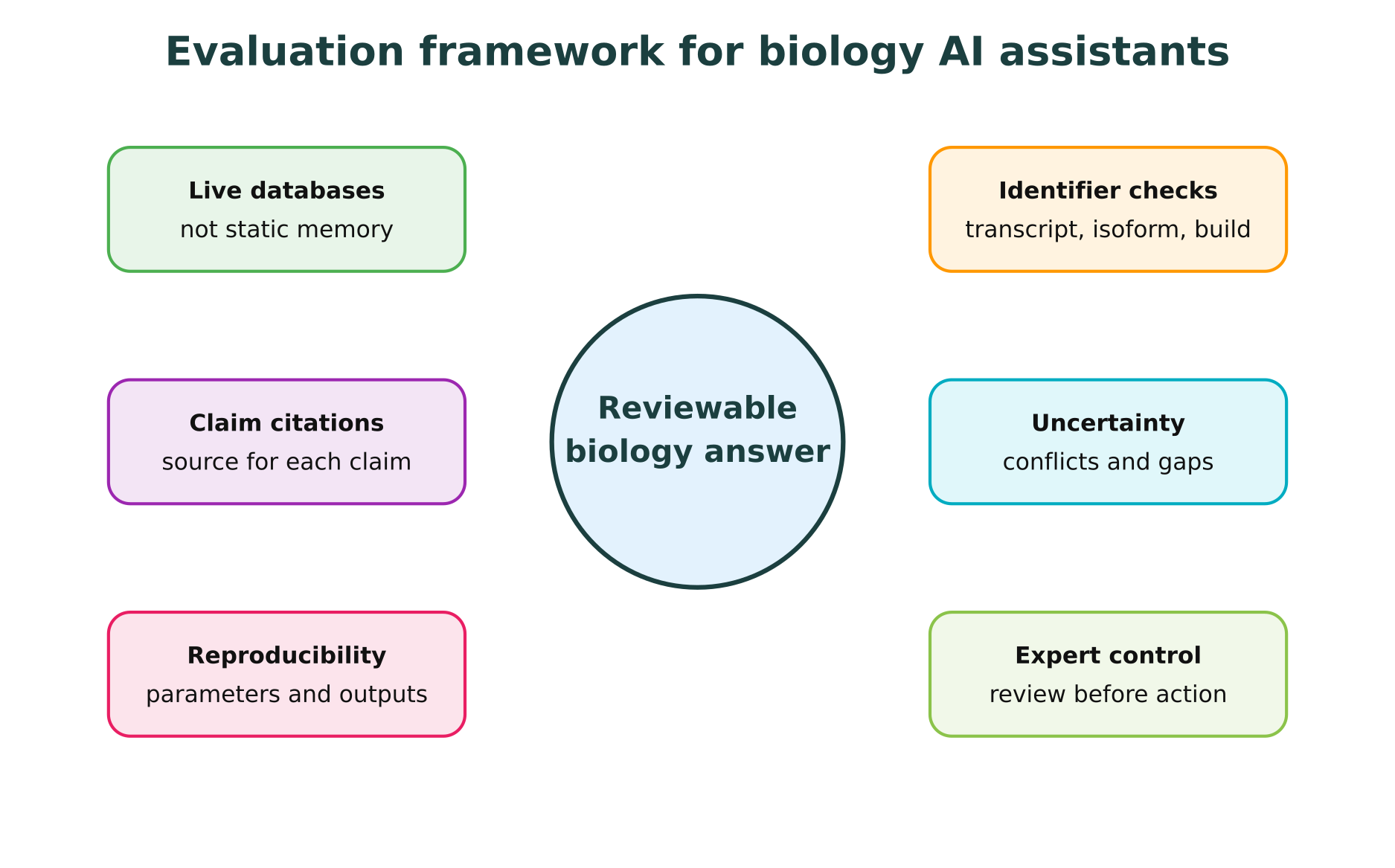
Before adopting a tool, ask these questions:
- Does it retrieve from current biological databases, or only from model memory?
- Are claims linked to source records, papers, or tool outputs?
- Does it normalize identifiers before answering?
- Does it separate retrieved evidence from model interpretation?
- Does it expose uncertainty, conflicts, and missing evidence?
- Does it preserve database versions, access dates, or analysis parameters where relevant?
- Can scientists export citations and evidence tables for review?
- Does it support expert review rather than hiding it?
- Can it reason across literature, variants, proteins, structures, and omics when the question requires it?
- Does it make clear what should not be automated?
If the answer to several of these is no, the tool may still be useful for ideation, but it should not be treated as evidence infrastructure.
The standard scientists should expect
Scientists should expect more from a biology AI assistant than fluent answers. The minimum standard is source-backed reasoning: current databases, specific citations, visible uncertainty, reproducible analysis context, and clear boundaries around what still needs review.
That standard will become more important as AI moves from literature summaries into variant interpretation, disease biology, drug discovery, multi-omics analysis, and protein structure workflows. The more consequential the research question, the more important provenance becomes.
A biology AI assistant with citations is useful when it makes the scientist faster without making the evidence weaker. It should reduce the time spent moving between databases and papers, while increasing the clarity of what was checked, what was found, and what remains uncertain.
MIP is Purna AI’s Molecular Intelligence Platform, an AI-powered workspace for biology teams. Genomic variant interpretation, protein structure prediction, multi-omics analysis, bioinformatics code execution, and 30+ database integrations in one place. Explore the platform at purna.ai. Researchers can apply for up to $10,000 in free credits to run their analyses on MIP.
Explore Purna's Molecular Intelligence Platform
AI-powered workspace for biology teams to accelerate drug discovery from target identification to lead optimization.
Try Purna AI →