

What an Orthogonal Assay Actually Confirms, and Why One Assay Is Never Enough
A technically precise comparative guide on orthogonal assays in drug discovery and target validation, defining true assay independence.
Read Depth vs. Coverage vs. Breadth: Sequencing Metrics That Get Used Interchangeably
A technically precise comparative guide explaining the biophysical and statistical differences between read depth, fold coverage, and breadth of coverage.
R vs Python for Bioinformatics: Where Each Ecosystem Actually Wins
A technically precise comparative guide on R vs Python in bioinformatics, analyzing where each ecosystem genuinely has the edge.
Introducing our new Background Orchestrator
Plan, execute, and verify complex computational biology workflows in the background with Purna's new Background Orchestrator.
All Posts
What an Orthogonal Assay Actually Confirms, and Why One Assay Is Never Enough
A technically precise comparative guide on orthogonal assays in drug discovery and target validation, defining true assay independence.
Read Depth vs. Coverage vs. Breadth: Sequencing Metrics That Get Used Interchangeably
A technically precise comparative guide explaining the biophysical and statistical differences between read depth, fold coverage, and breadth of coverage.
R vs Python for Bioinformatics: Where Each Ecosystem Actually Wins
A technically precise comparative guide on R vs Python in bioinformatics, analyzing where each ecosystem genuinely has the edge.
Introducing our new Background Orchestrator
Plan, execute, and verify complex computational biology workflows in the background with Purna's new Background Orchestrator.

Batch Effects in Omics Data: What They Are and How ComBat/Harmony Actually Fix Them
A technically precise comparative guide on bulk and single-cell batch effects, explaining how ComBat and Harmony work under the hood.

CRISPR Off-Target Prediction: How Cas-OFFinder, CRISPOR, and Similar Tools Actually Differ
An authoritative comparative guide explaining how CRISPR off-target prediction tools actually differ and what that means for guide RNA design.

Codon Usage Bias vs. Codon Optimality: Resolving a Common Conflation in Gene Expression
A technically precise comparative guide distinguishing between codon usage bias and codon optimality in synthetic biology and gene expression.

What Codon Optimization Actually Changes in Your Construct, and How to Check It
An authoritative comparative guide on codon optimization mechanics, explaining what changes under the hood and how to verify constructs before ordering.

GRCh37 vs GRCh38 vs T2T-CHM13: Why Reference Genome Builds Still Trip People Up
A technically precise comparative guide on GRCh37, GRCh38, and T2T-CHM13, analyzing why coordinate mismatches and liftovers continue to trip up pipelines.

From a Protein Sequence to a Predicted Structure: Running a BioLM Job End to End
An authoritative walkthrough of running protein structure prediction using Purna's BioLM Jobs, explaining parameters and confidence metrics.
Introducing Library: Your Research World on One Page
Meet Purna Library: organize articles in Corpus, connect MCP integrations, explore Skills, and discover research databases and capabilities.
Peptide vs Protein vs Antibody Therapeutics: How the Development Pipelines Actually Differ
A precise, comparative analysis of how development pipelines, manufacturing, and regulatory paths differ across peptide, protein, and antibody modalities.
The Literature Review Bottleneck No One Budgets Time For
An in-depth analysis of the literature review bottleneck in R&D workflows, and how Purna's automated curation pipeline accelerates discovery.
FASTQ, SAM, BAM, and CRAM: A Practical Field Guide to Sequencing File Formats
A precise, evidence-grounded guide explaining FASTQ, SAM, BAM, and CRAM formats and their roles in modern sequencing pipelines.
A Field Guide to the Different Types of AI Models Used in Biology
An educational field guide classifying and explaining the different types of AI models used in modern biological and drug discovery research.
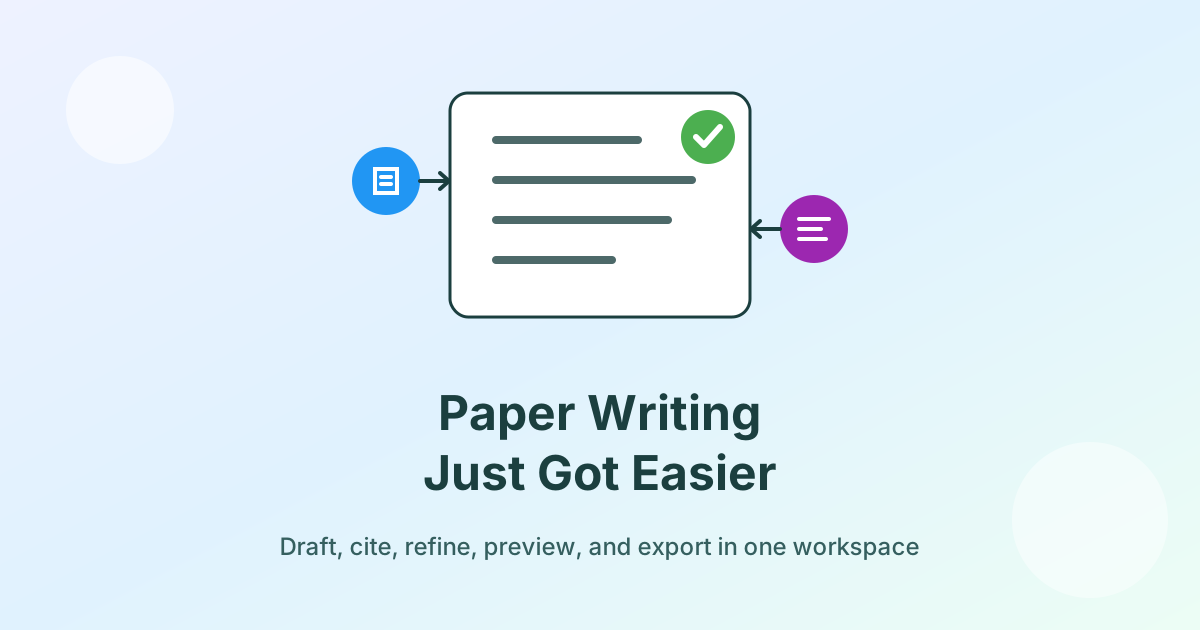
Paper Writing Just Got Easier
Draft, cite, refine, preview, and export scientific papers in one continuous workspace with Purna AI's updated paper writer.
How Long Does Target Validation Actually Take, and Where the Time Really Goes
A concise, product-focused analysis of the target validation timeline, showing how Purna accelerates pre-clinical evidence gathering.
What an API Actually Does in a Molecular Intelligence Platform
A precise, evidence-grounded guide explaining what an API actually does in a molecular intelligence platform, using real biological database APIs as examples.
The Microbiome-Disease Connection: What's Proven, What's Still Speculative
An in-depth, evidence-grounded analysis of the microbiome-disease connection, distinguishing between clinical causation and observational correlation.
What 'Undruggable' Actually Means, and Why the List Keeps Shrinking
A precise guide explaining what makes a target undruggable and how covalent inhibitors, PROTACs, and molecular glues are shrinking this list.
Antibody-Drug Conjugates: The Quiet Revolution Reshaping Oncology
A rigorous scientific overview of antibody-drug conjugates (ADCs) in oncology, exploring their mechanism of action, engineering, and clinical progress.
What Makes an AI System 'Agentic,' and Why It Matters for Your Research
A concise, product-focused look at what makes an AI system agentic and how Purna's autonomous workflows accelerate scientific research.
How Scientists Actually Diagnose a Disease at the Molecular Level
An engaging, accessible guide explaining how scientists use molecular diagnostics to detect disease, analyze DNA, and guide clinical decisions.
What Is a Protein Embedding?
A precise guide to understanding protein embeddings, their transformer-based self-supervised training, and downstream drug discovery applications.
Cell and Gene Therapy: AI for Rare Disease
Explains how AI accelerates cell and gene therapy design and clinical trials for genetically-driven rare diseases while keeping scientific validation rigorous.
Why Bioinformatics Tools Are Often Harder to Combine Than to Use Individually
An in-depth analysis of the interoperability gap in bioinformatics, exploring the software engineering barriers to combining pipeline tools.
Drug Repurposing With AI: Old Molecules, New Targets
A realistic and rigorous assessment of how AI is used in drug repurposing, distinguishing between statistical correlation and biological reality.
What Makes a Structure Prediction Trustworthy? A Guide to Trust and Evaluation
A rigorous, evidence-grounded guide to evaluating protein structure prediction confidence metrics, understanding pLDDT and PAE, and validating results.
How to Identify Research Gaps With AI Without Inventing Unsupported Claims
Explains how AI can help identify research gaps while keeping claims grounded in available evidence and uncertainty
Deep Research AI Tools for Scientists: What They Do Differently From Search
Explains how deep research AI differs from search for scientists, especially in synthesis, citations, and workflow support
Systematic Review AI: Where Automation Helps and Where Researchers Must Stay in Control
A measured look at AI support for systematic reviews, screening, extraction, synthesis, and human control points.
Biomedical Literature Synthesis: A Practical Workflow for Disease and Drug Discovery Research
A practical workflow for synthesizing biomedical literature across disease biology, targets, evidence, and drug discovery.
What Makes a Good Bioinformatics Analysis Platform for Research Teams?
Defines what research teams need from a modern bioinformatics workspace, from data access to reproducible interpretation.
AI Tools for Scientific Paper Writing: What Helps, What Can Harm, and What Still Needs Expert Review
A responsible guide to AI-assisted scientific writing, including drafting help, citation risks, and expert verification
Drug Target Identification Methods: Experimental, Computational, and AI-Assisted
A comprehensive comparison of experimental, computational, and AI-assisted drug target identification methods and their roles in target validation.
Multi-Omics Integration Tools: How to Choose the Right Approach for Your Research Question
Guides researchers through choosing multi-omics integration approaches based on the biological question and evidence needed.
AI for Drug Target Identification: From Disease Biology to Prioritized Targets
A practical guide to AI for drug target identification, from disease biology and genetics to prioritized, reviewable target hypotheses.
Protein Mutation Stability Prediction: How to Interpret ΔΔG in Research Workflows
A practical guide to protein mutation stability prediction, ΔΔG interpretation, structural context, and expert review in research workflows.
Protein Mutation Effect Prediction: From Sequence Change to Functional Hypothesis
A practical framework for protein mutation effect prediction, from sequence change to structure, evidence, and testable functional hypothesis.
How to Generate Disease Mechanism Hypotheses From Genes, Variants, and Literature
A practical workflow for disease mechanism hypothesis generation from genes, variants, literature, databases, and expert review.
AI Hypothesis Generation in Biology: A Practical Framework for Researchers
A practical framework for AI hypothesis generation in biology, from evidence mapping to testable mechanisms and expert review.
AI Tools for Biology Research: What Actually Helps Scientists in 2026
A scientist-focused map of AI tools for biology research, from citations and omics to structures, variants, code, and review.
What Scientists Should Expect From a Biology AI Assistant With Citations
A practical checklist for evaluating biology AI assistants with citations, provenance, database access, and expert review.
Natural Language Bioinformatics: How Scientists Can Query Biology Without Writing Pipelines
A practical guide to natural language bioinformatics, no-code database querying, AI bioinformatics software, and expert review.
Introducing Scribe Lab: document editing meets Deep Research
Scribe Lab brings document editing and Deep Research into one workspace so teams can turn evidence into scientific drafts faster.
Projects on Purna AI: a cleaner way to organize research work
Projects now keep chats, files, jobs, and outputs organized in one workspace on Purna AI's Molecular Intelligence Platform.
This Week on Purna AI Molecular Intelligence Platform
New on MIP this week: publication-quality scientific figures on demand, and protein embeddings and mutation likelihoods with ESM-2 and AbLang-2.
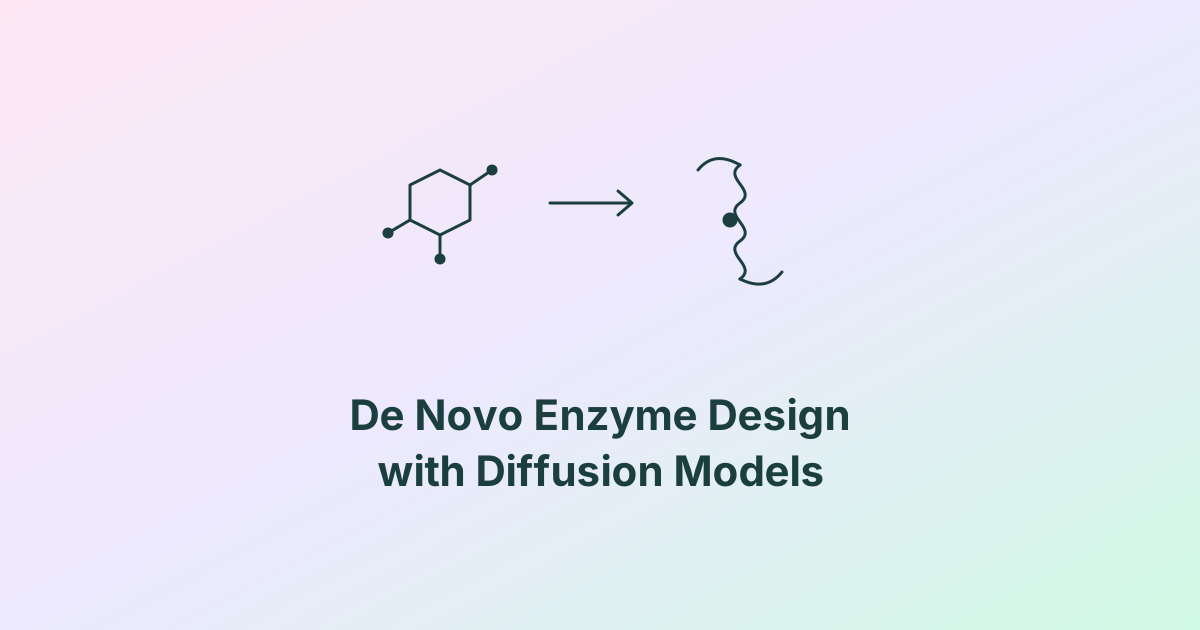
De Novo Enzyme Design with Diffusion Models: A Practical Guide
How diffusion models like DISCO are changing de novo enzyme design, and how to move from a SMILES string to a testable candidate enzyme.
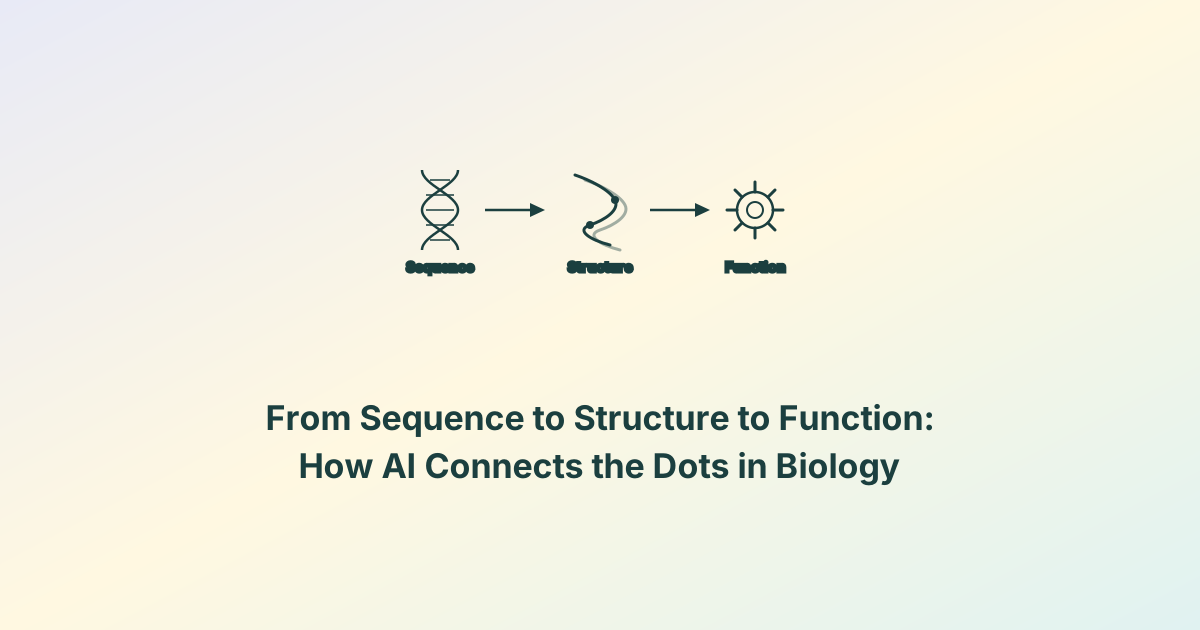
From Sequence to Structure to Function: How AI Connects the Dots in Biology
AI connects sequence analysis, structure prediction, and functional assessment into one continuous pipeline instead of fragmented tools.
AI in Proteomics: From Mass Spectrometry to Protein Function Prediction
How AI is transforming proteomics workflows, from peptide identification and quantification to PTM prediction, function annotation, and multi-omics integration.
Computational Drug Target Discovery: A Guide for Research Teams
How computational approaches identify and validate drug targets using multi-omics data, genetic evidence, structural druggability, and AI prioritization.
AI for Rare Disease Diagnosis: Current Progress and What Comes Next
AI rare disease diagnosis is advancing fast. We cover DeepRare, GeneDx, real accuracy numbers, and what still requires human expertise.
Open-Source vs Commercial Bioinformatics Platforms: Which Is Right for Your Lab?
Honest comparison of open-source and commercial bioinformatics platforms covering TCO, compliance, scalability, and a decision framework for lab leads.
How to Read a Genomic Report: A Guide for Clinicians
Learn how to read a genomic report step by step. Covers variant classifications, ACMG criteria, when to act, and common mistakes.
Protein-Ligand Docking in the Age of AI: Classical vs Deep Learning Approaches
Compare classical protein-ligand docking tools like AutoDock Vina with AI approaches like DiffDock. Practical guide for drug discovery teams.
Best Bioinformatics Platforms in 2026: Galaxy, Terra, and Cloud Alternatives Compared
Comprehensive comparison of the best bioinformatics platforms in 2026 covering Galaxy, Terra, DNAnexus, LatchBio, and AI-native alternatives.
How AI Is Compressing Drug Discovery Timelines
Where AI is actually saving time in drug discovery, from target identification to lead optimization, with real examples and honest limits.
PyMOL vs ChimeraX vs Molstar: Protein Visualization Tools Compared
Practical comparison of PyMOL, ChimeraX, and Molstar covering rendering, scripting, file formats, and when to use each protein visualization tool.
How to Query Biological Databases Using Natural Language
Learn how natural language biological database queries replace multi-tool workflows. Query ClinVar, gnomAD, UniProt, OMIM, PDB, and PharmGKB in seconds.
What Is a Variant of Uncertain Significance (VUS) and How Do You Resolve One?
A variant of uncertain significance (VUS) lacks enough evidence for classification. Learn what causes VUS, how reclassification works, and how to resolve them.
AlphaFold 3 vs Boltz-2 vs ESMFold: Protein Structure Prediction Tools Compared
Head-to-head comparison of AlphaFold 3, Boltz-2, and ESMFold covering accuracy, speed, licensing, and practical recommendations for each use case.
Bioinformatics Without Coding: How AI Is Making Computational Biology Accessible
How natural language interfaces and AI-powered platforms are making bioinformatics without coding a reality for wet lab scientists and non-programmers.
Genomics vs Proteomics vs Transcriptomics: What Researchers Need to Know
A clear comparison of genomics, proteomics, and transcriptomics: what each measures, when to use which, and how multi-omics integration changes research.
How to Predict the Impact of Protein Mutations on Structure and Function
A practical guide to predicting protein mutation effects using structure prediction, stability analysis, conservation scoring, and AI tools.
AI for Biology: What's Actually Working in 2026
A practical look at where AI is making real progress in biology, from genomic interpretation and protein design to drug discovery and rare disease diagnosis.
What Is Molecular Intelligence? The Definitive Guide
Molecular intelligence is domain-trained AI that reasons across biological data — genomics, proteomics, structure, and clinical databases — in one workspace.
$10,000 in Free Research Credits for the Molecular Intelligence Platform
Purna AI is offering up to $10,000 in free credits for researchers working on multi-omics datasets. Here's who qualifies and how to apply.
From Variant to Visit: How Genomics Actually Changes Management
Genomic testing changes care when it shifts us from treating the average to treating the individual — altering drugs, doses, and surveillance.
How Molecular Intelligence Is Reshaping Drug Discovery
An overview of how AI-powered molecular intelligence platforms are accelerating the drug discovery pipeline from target identification to lead optimization.
Protein Folding Meets Generative AI: What It Means for Therapeutics
Exploring the convergence of protein structure prediction and generative models, and how this impacts the design of next-generation therapeutics.
No posts found matching your criteria.
Stay in the loop
Get the latest on molecular intelligence, AI-driven drug discovery, and computational biology.
We email once every two weeks. No spam.